UAE envoy welcomes new Saudi military attaché in Islamabad

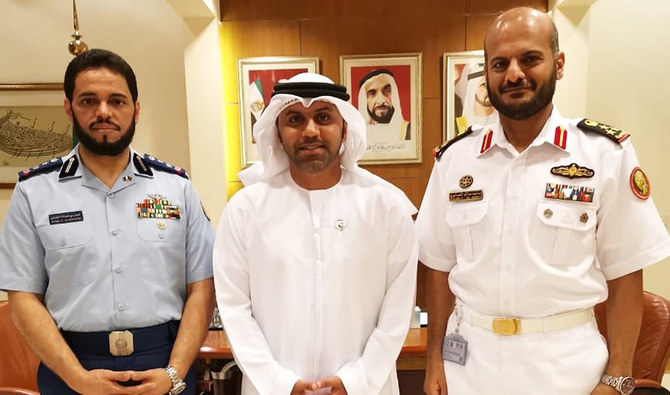
UAE ambassador to Pakistan, Hamad Obaid Alzaabi, welcomes new Saudi military attaché of the Kingdom of Saudi Arabia, Brigadier General Pilot Awad Alzahrani, at his office in Islamabad, July 23, 2019. (UAE Embassy Twitter)
Updated 24 July 2019
Follow

UAE envoy welcomes new Saudi military attaché in Islamabad

  • UAE ambassador wished new attache success in his latest assignment
  • Both UAE and Saudi Arabia have strong economic and defence ties with Pakistan

ISLAMABAD: The United Arab Emirates (UAE) ambassador to Pakistan, Hamad Obaid Alzaabi, welcomed Brig. Gen. Pilot Awad Alzahrani, the new Saudi military attaché of the Kingdom of Saudi Arabia, at his office in Islamabad on Tuesday.
General Alzahrani assumed the role earlier this month at the Saudi embassy in the Pakistani capital.
During a meeting with the new military attache, Ambassador Alzaabi wished him “success in his new assignment,” the UAE embassy said in a Twitter post.
Earlier this month, Saudi ambassador to Pakistan, Nawaf bin Said Al-Malki, had also welcomed the new military attaché at his office and expressed his well-wishes on his new posting in Pakistan.
Both UAE and Saudi Arabia have strong ties with Pakistan and are economic and trading partners. Pakistan and the UAE also have a long history of military and maritime partnership and defense cooperation. The militaries of both states carry out joint training exercises and liaison on issues of security. 


At Islamabad conference, Pakistan pitches agriculture as next frontier for Chinese investment

Updated 6 sec ago
Follow

At Islamabad conference, Pakistan pitches agriculture as next frontier for Chinese investment

  • Hundreds of Chinese and Pakistani firms attended the event focusing on fertilizers, seeds, smart farming and irrigation techniques
  • PM Sharif urges Pakistani farmers, businesses and universities to engage with Chinese institutions and experts to modernize agriculture

ISLAMABAD: Prime Minister Shehbaz Sharif on Monday pitched Pakistan’s agriculture sector as the next major frontier for Chinese investment, highlighting opportunities in agri-business, food processing and farming technologies.

The prime minister said this while addressing the Pakistan-China Agriculture Investment Conference, which brought together Chinese and Pakistani agriculturists, entrepreneurs, experts, academicians and government officials.

Hundreds of Chinese and Pakistani firms attended the event that focused on fertilizers, seed varieties, machinery, precision farming and smart irrigation systems, according to the organizers.

Sharif said China had never shied away from providing Pakistan with best possible expertise and technologies, and both sides had signed several memorandums of understanding (MoUs) at similar summits in Shandong and Beijing in last two years.

“I was very happy to express my satisfaction over the progress we are making in terms of converting these MOUs into agreements,” he said. “Today’s conference is a clear indication that Chinese business houses are more than willing to shake hands with Pakistani business houses.”

The conference was billed by Pakistan’s Ministry of National Food Security and Research as a platform for deepening bilateral agricultural ties and supporting broader economic engagement between the two countries.

Sharif called on Pakistani farmers, agribusinesses and universities to actively engage with Chinese institutions and experts to modernize the agriculture sector, which accounts for 24 percent of Pakistan’s GDP and employs over 37 percent of its labor force.

“Chinese experts are there to assist us and support us all the way to achieve this wonderful target [of becoming a surplus agricultural economy],” he said. “Now it’s up to us to generate this trade surplus through higher yields, comparative cost and, of course, highest quality.”

Pakistan and China have been expanding cooperation in agriculture under the China-Pakistan Economic Corridor framework, with a focus on mechanization, high-yield seeds, livestock development and value-added food processing.

Officials say stronger agricultural ties could help Pakistan boost exports, ensure food security and create jobs, while offering Chinese companies access to a large farming market and new investment opportunities.

The prime minister noted that Pakistan’s policy rate was down to 10.5 percent down from 22 percent two years ago, exports were gradually increasing and macroeconomic indicators were stable.

“Now we have to move toward growth,” he said. “But then it requires solid, hard work, untiring efforts, blood and sweat. Without that, you will not be able to achieve your targets.”

The Pakistan-China Agriculture Investment Conference focused on technology transfer and joint ventures in farming, food processing and agricultural research.

“I would urge upon Pakistani farmers, Pakistani agri-houses, experts, professors, technicians, that please come forward and show your best to your [Chinese] brothers and sisters,” Sharif said.

“China is ready, ladies and gentlemen, to support Pakistan like always in the past. Let us make use of this opportunity. Let us stand up and accept this challenge and make Pakistan great through untiring efforts, through hard work.”