

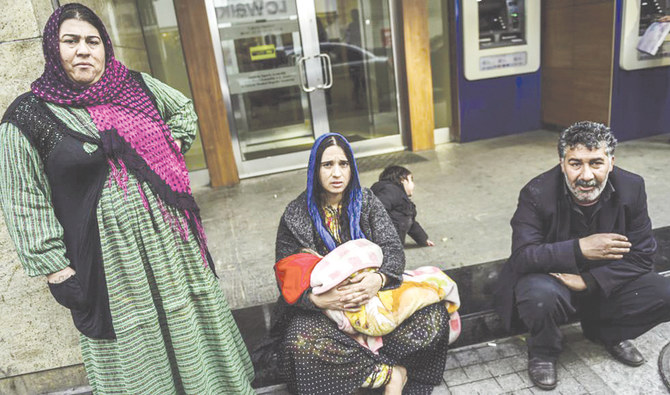

ANKARA: The deportation of about 1,000 Syrians in a week from Istanbul to Syria’s Idlib province has sparked a debate about Turkey’s refugee policy and the timing of the move. Syrian refugees who have illegally crossed into Turkey or committed a crime were sent to rebel-held Idlib, where Turkey has 12 observation posts and some safe zones.
Local authorities in Istanbul on Monday set a four-week deadline — until Aug. 20 — for Syrians living without authorization to return to provinces where they were registered or be forcefully dispatched to those regions, Reuters reported.
The number of refugees exceeds 4 million in Turkey, with Istanbul hosting about half-a-million Syrian refugees. More than 5,000 Syrian refugees in Istanbul were also reportedly detained by police because their residency permits were registered in another Turkish city.
They will be moved to those cities from the relocation centers because according to the law they should stay in the province where they are registered and obtain a special permit to travel elsewhere.
There are about 300,000 refugees in Istanbul who are registered in another Turkish city.
According to some experts, deporting unregistered refugees is understandable to a point, but sending them to a war zone is not acceptable. For other experts, the move is seen as being related to pleasing the ruling AKP government’s constituencies, who have complained about refugees allegedly taking their jobs.
A recent poll conducted by Turkish Piar research company revealed that Turkish citizens consider Syrian refugees as the second most critical issue the country faces.
Murat Erdogan, of the Migration and Integration Research Center at the German-Turkish University in Istanbul, said that the move appears to have two objectives.
“On the domestic front, the authorities intend to send a message to Turkish society to say that the flow of Syrian refugees is under their control. From the international perspective, it is a message to the European Union, which insists on not launching a visa-free Europe to Turkish citizens although Turkey has met the key criteria,” he told Arab News.
For Erdogan, sending Syrian refugees to a dangerous place such as Idlib, where the latest bombings have targeted civilians, is a tactical move to seriously disturb European officials.
“How those Syrians relocated to the city where they were registered will be accommodated by the local people from an integration point of view, and how they will find jobs to make ends meet, is another concern,” he said.
Erdogan said that the management of refugee flows from Syria was a significant soft power tool for Ankara.
HIGHLIGHTS
• The number of refugees exceeds 4 million in Turkey, with Istanbul hosting about half-a-million Syrian refugees.
• More than 5,000 Syrian refugees in Istanbul were reportedly detained by the police because their residency permits were registered in another Turkish city.
• They will be moved to those cities from the relocation centers because according to the law they should stay in the province where they are registered and obtain a special permit to travel elsewhere.
Halit Hoca, founder of the Solidarity with Syrian People Platform and ex-president of the Syrian National Coalition, said that the government’s latest move with Syrian refugees came as a surprise to them.
“There were some Syrians who came to Turkey under the guise of refugees over the past eight years, and some of them gained citizenship status but they were not refugees. However, we insistently advised the government to coordinate these refugee flows with the relevant civil society actors, but our calls remained unanswered,” he told Arab News.
Now the government had suddenly decided to send them back in an unsystematic manner, which had caused great panic and may create new wounds, Hoca said.
“The timing is also telling. These deportations occurred during the days when Russian planes heavily hit targets in Idlib,” he said.
Turkey had a similar deportation wave in 2017, which was criticized by Human Rights Watch. Last week, a 16-year-old teenager was reportedly sent back to Idlib because he had left his identity card at home.
“Although this time it is not the first wave of deportation, it is on a more massive scale than the previous one. But one thing is clear: This decision might be temporary, but there is a constant message that comes out: Turkey wants to show that it can host and send back guests whenever it wants,” Hoca said.
Syrian refugees who work without a work permit are also under close examination by police.
The Syrian High Negotiations Committee (HNC) recently announced its plan to address the situation of refugees in Turkey. During a press conference in Riyadh, Nasr Al-Hariri, head of the HNC, said that it was currently working with Turkish authorities on this issue.
For Omar Kadkoy, a Syrian-origin researcher on refugee integration at Ankara-based think tank TEPAV, the recent measures put both the mandate of temporary protection and the universal principle of non-refoulement (a principle of international law that forbids a nation returning asylum seekers to a country in which they would be in danger of persecution) at risk of violation.
“The former indicates an obligation of notification in case of removal and the latter requires verifying the aspect of voluntary return through a third-party — namely the UNHCR — and the presence of a safe country of origin. Unfortunately, recent actions don’t seem to meet the aforementioned conditions,” he told Arab News.
“The current bad turn of the economy is affecting everybody. Yet the reactionary behavior of the government reflects two bitter realities,” Kadkoy said.
“First, losing the megacity to the opposition in the re-run elections — but still telling the constituency that it is the AKP who calls the shots. Second, harvesting the bad fruits of the laissez-faire approach toward Syrians from the onset. After all, the subjects of unregistered Syrians, informal employment or businesses were not born yesterday.”


