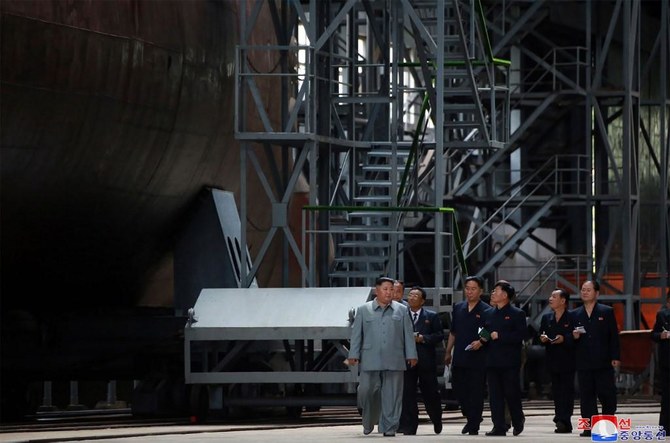
SEOUL: North Korean leader Kim Jong Un inspected a large newly built submarine, state news agency KCNA reported on Tuesday, potentially signaling continued development of a submarine-launched ballistic missile (SLBM) program.
Kim inspected the operational and tactical data and combat weapon systems of the submarine that was built under “his special attention,” and will be operational in the waters off the east coast, KCNA said.
KCNA said the submarine’s operational deployment was near.
“The operational capacity of a submarine is an important component in national defense of our country bounded on its east and west by sea,” Kim said.
KCNA did not describe the submarine’s weapon systems or say where and when the inspection took place.
North Korea has a large submarine fleet but only one known experimental submarine capable of carrying a ballistic missile.
Analysts said that based on the apparent size of the new submarine it appears designed to eventually carry missiles.
“We can clearly see that it is a massive submarine — much larger than the existing one that’s been well known since 2014,” said Ankit Panda, senior fellow at the US-based Federation of American Scientists.
“What I find significant about the political messaging here is that this is the first time since a February 2018 military parade that he has inspected a military system clearly designed to carry and deliver nuclear weapons.”
“I take that as an ominous signal that we should be taking Kim Jong Un’s end-of-year deadline for the implementation of a change in US policy with the utmost seriousness.”
A South Korean defense ministry spokesman said they were monitoring developments but could not confirm if the submarine was designed to carry missiles.
Kim Dong-yub, a military expert at Kyungnam University’s Institute of Far Eastern Studies in Seoul, said Kim likely also wanted to reassure North Koreans of his commitment to national defense at a time when he is focusing more on the economy.
“Announcing his inspection of the new submarine is also to build internal solidarity, to dispel people’s concerns about national security, reassure them, and boost military morale,” he said.
Submarine development
Kim has declared a moratorium on testing ICBM’s and nuclear weapons while engaging in denuclearization talks with the United States and South Korea.
The North’s submarine report comes amid another delay in dialogue between the United States and North Korea after Kim and US President Donald Trump agreed at a meeting at the Panmunjom Korean border on June 30 to working-level nuclear talks.
Trump said such talks could come in the following two to three weeks. His national security adviser, John Bolton, arrives in South Korea on Tuesday to meet security officials.
A summit between Trump and Kim, in Vietnam in February, broke down after they failed to narrow differences between a US demand for North Korea’s denuclearization and a North Korean demand for sanctions relief.
In April, Kim said he would wait until the end of the year for the United States to be more flexible.
North Korea maintains one of the world’s largest submarine fleets, but many vessels are aging and there are doubts over how many are operational, according to the Washington-based Nuclear Threat Initiative (NTI).
Most of North Korea’s fleet consists of small coastal submarines, but in recent years it has made rapid progress in the SLBM program, NTI said in a report released late last year.
In 2016, after a few years of development, North Korea successfully test-fired a ballistic missile from a submarine, while pursuing an intercontinental ballistic missile program (ICBM).
During the submarine inspection Kim was accompanied by Kim Jong Sik, an official who played a major role in North Korea’s missile program.
Another official on the tour was Jang Chang Ha, president of the Academy of the National Defense Science, which the US Treasury has said is in charge of the secretive country’s research and development of its advanced weapons systems, “including missiles and probably nuclear weapons.”
H.I. Sutton, a naval analyst who studies submarines, said judging by the initial photos the hull could be based on old Romeo Class submarines, which were originally acquired from China in the 1970s before North Korea began producing them domestically.
North Korea is believed to have about 20 Romeo submarines in its fleet, the newest of which was built in the mid 1990s, according to NTI.
Sutton told Reuters that the North Koreans appeared to have raised the deck on a Romeo-type design, possibly even modifying an existing Romeo to make a submarine larger than previous indigenous designs.
“I’d bet that this is indeed a missile submarine,” he said.
US-based monitoring group 38 North said in June 2018 that North Korea appeared to be continuing submarine construction at its Sinpo Shipyard of possibly another Sinpo-class ballistic missile submarine, based on commercial satellite imagery.
“This, to my eye, is the submarine that the US intelligence community has been calling the Sinpo-C, a successor to North Korea’s only known ballistic missile submarine,” Panda said.


![]()

North Korea’s Kim inspects new submarine, signals possible ballistic missile development
North Korea’s Kim inspects new submarine, signals possible ballistic missile development
- The new data and combat weapon systems of submarine was built under Kim’s “special attention”
- Experts said the size of the new submarine suggests it would eventually carry missiles


Latest updates


Recommended


© 2026 SAUDI RESEARCH & PUBLISHING COMPANY, All Rights Reserved And subject to Terms of Use Agreement.