WASHINGTON: Pakistan’s main spy agency provided the US with a lead that helped them find and kill Al-Qaeda leader Osama bin Laden, Prime Minister Imran Khan said Monday.
Pakistan has until now officially denied having any knowledge of the terror chief until he was shot dead in a night-time raid by US special forces on May 2, 2011, an incident that was a major national embarrassment and caused ties between the two countries to plummet.
Khan, who is visiting Washington on his first official trip, made his claim in an interview with Fox News when he was asked whether his country would release a jailed doctor whose fake immunization drive helped the US track and kill bin Laden in 2011.
“This is a very emotive issue because Shakeel Afridi in Pakistan is considered a spy,” he told host Bret Baier, referring to the doctor.
“We in Pakistan always felt that we were an ally of the US and if we had been given the information about Osama bin Laden, we should have taken him out.”
Baier then asked if Khan understood the skepticism around the Inter-Services Intelligence agency (ISI) for leaking key information, to which Khan replied:
“And yet it was ISI that gave the information which led to the location of Osama bin Laden.
“If you ask CIA it was ISI which gave the initial location through the phone connection.”
It was not immediately clear what Khan was referring to and he did not provide more detail.
The 9/11 mastermind was tracked down after a 10-year manhunt to Abbottabad, a garrison town north of Islamabad where Pakistan’s military academy is headquartered, sparking allegations authorities were colluding with the terror group.
A leaked Pakistani government report in 2013 said bin Laden arrived in Pakistan in the spring or summer of 2002 — after the 2001 US-led invasion of Afghanistan — and settled in Abbottabad in August 2005.
The report, which coined the term “governance implosion syndrome” to explain the extent of official failures to detect him, said he was once stopped for speeding and enjoyed wearing a cowboy hat.
Two former senior Pakistani military officials told AFP in 2015 that a defector from Pakistani intelligence assisted the US in its hunt for bin Laden, but denied the two countries had officially worked together.

Pakistani intelligence led CIA to bin Laden — Imran Khan
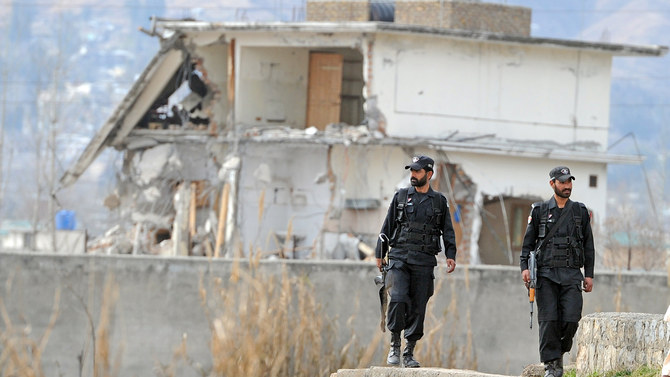
- Pakistan always felt that we were an ally of the US, says Khan
- 9/11 mastermind was tracked down after a 10-year manhunt to Abbottabad
Pakistan kills 11 militants in separate operations in western provinces
- Military says five Baloch separatist fighters were killed in an intelligence-based operation in Kohlu district
- Police say six Pakistani Taliban died in Lakki Marwat during a joint operation after drone attacks on homes
ISLAMABAD/PESHAWAR: Pakistani security forces and police killed at least 11 militants in separate counterterrorism operations in the country’s western provinces of Balochistan and Khyber Pakhtunkhwa, authorities said on Friday, highlighting the distinct insurgencies confronting the country along its border with Afghanistan.
In southwestern Balochistan, the military said it killed separatist militants in an intelligence-based operation in Kohlu District on Dec. 25, while police in the northwestern district of Lakki Marwat fought and killed the Pakistani Taliban.
Pakistan’s military said the Balochistan operation targeted fighters it identified as part of “Fitna al Hindustan,” a term authorities use for Baloch separatist outfits, including the Balochistan Liberation Army (BLA), which have waged a decades-long insurgency in the resource-rich province.
“During the conduct of operation, own forces effectively engaged the terrorists’ location, and after an intense fire exchange, five Indian sponsored terrorists were sent to hell,” the military’s media wing, Inter-Services Public Relations (ISPR), said in a statement, adding that weapons and explosives were recovered and follow-up clearance operations were underway.
In Lakki Marwat, police said counterterrorism units and local peace committees launched a coordinated operation against militants they described as “khwarij,” a term the Pakistani state uses for factions aligned with the Tehreek-e-Taliban Pakistan (TTP), an umbrella group of militants that primarily operates in Khyber Pakhtunkhwa.
According to police, six militants were killed and several others wounded during the operation, after authorities said militants had used drone-mounted devices to target residential homes, injuring civilians.
“Protection of life and property of the public is the police’s top priority, and strict, indiscriminate action against khwarij and other anti-peace elements will continue,” Bannu Region Deputy Inspector General Sajjad Khan said in a statement released by the regional police office.
The two operations highlight Pakistan’s parallel security challenges in its western regions.
In Balochistan, separatist groups accuse the federal government and military of marginalizing ethnic Baloch communities and denying them a fair share of the province’s mineral wealth, allegations Islamabad denies.
In Khyber Pakhtunkhwa, the TTP has intensified attacks on security forces and civilians since the Afghan Taliban’s return to power in Kabul in 2021.
Pakistan has repeatedly said these militant groups operating in both provinces receive backing from India and find shelter in Afghanistan, claims denied by New Delhi and Kabul.
Pakistani authorities said counterterrorism operations will continue nationwide under a campaign approved by the federal government to curb militancy and restore security.


