



LAHORE: As Prime Minister Imran Khan lands in Washington DC today, ahead of a Monday meeting at the White House with US President Donald Trump, one particularly unique gift for his host- a camel skin vase with an unlikely portrait- has arrived with his luggage.
For centuries, the art form called ‘Naqqash,’ which primarily involves engraving on metal, has been practiced in South Asia. In the historic city of Multan, in Pakistan’s Punjab province, it has been mastered by an indigenous family.
Artisan Malik Muhammad Abdur Rehman Naqqash is keeping the family tradition alive. Already, his art, in the form of camel skin vases, has been presented by Pakistan’s government to several dignitaries visiting the country, including former first lady and politician Hillary Clinton, Malaysian Prime Minister Dr. Mahathir bin Mohamad, Saudi Arabia’s Crown Prince Mohammad bin Salman and the Emir of Qatar among others.
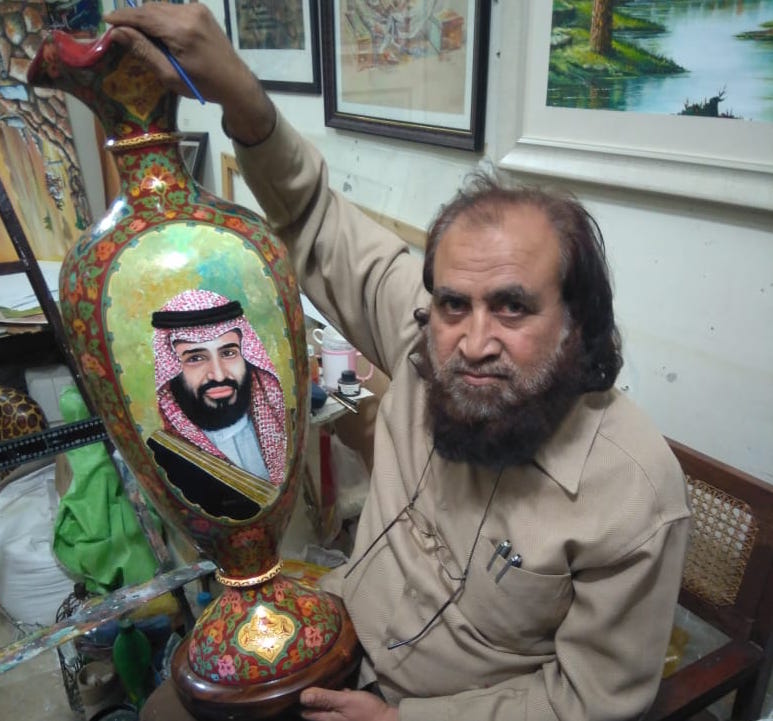
Hanifullah Khan holds the finished vase that was later gifted to Crown prince Mohammed bin Salman of Saudi Arabia during his visit to Pakistan in February 2019. (Photo Courtesy - Hanifullah Khan)
“In the past, the government of Pakistan presented (to dignitaries) vases made of camel skin crafted by me or my family, but now they have a new idea,” Abdur Rehman said.
And the idea is the marriage of two art forms. The finished camel skin vases are now the joint handiwork of artists in two cities. Abdur Rehman prepares the traditional vase but leaves a central frame blank which is then painted onto by an Islamabad-based artist, Hanifullah Khan.
Khan is an expert in painting brightly colored portraits of dignitaries on the vases, which are then presented as gifts to the State’s important guests and hosts. For Prime Minister Imran Khan’s meeting at the White House tomorrow, a smiling President Trump has been painted on a camel skin vase against the background of the US flag.
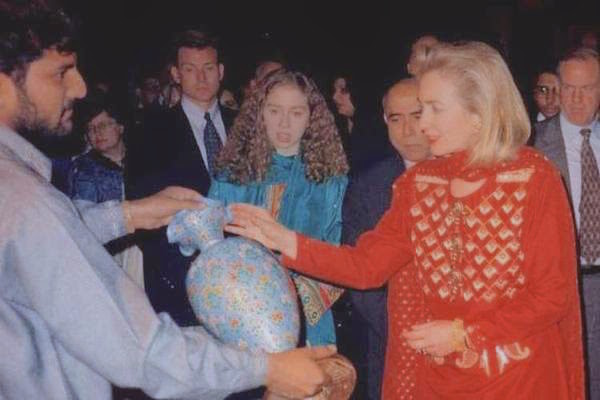
In this file photo, Abdur Rehman Naqqash presents a traditional vase, his own handiwork, to then first lady, Hillary Clinton, during her visit to Pakistan in 1995, with a young Chelsea Clinton in the background. (Photo Courtesy - Abdur Rehman Naqqash)
ReplyReply to allForward
“I learnt the art of making pictures on camel skin vases and now the government has presented those to several international personalities,” Hanifullah Khan told Arab News.
Despite the importance of the finished piece, there appears to be no competitiveness between the two artists, and Hanifullah Khan gives full credit to his counterpart in Multan.
“The Donald Trump vase is made in Multan by another artist,” he said, adding that the southern Punjabi city was the “only place in the world,” that could provide the perfect weather conditions, temperature and ambience required to craft the unique, delicate art onto camel skin.
Abdur Rehman’s father, Malik Ashiq, experimented successfully with creative forms of Naqqashi, and eventually grabbed the attention of Pakistan’s government who acknowledged his talents with a prestigious civilian award- the ‘pride of performance.’
“The family has been in the trade of Naqqashi for the last 900 years. The art has been transferred to us from generation to generation,” Abdur Rehman Naqqash told Arab News, and said that extending the ancient art form to camel skin, was first invented by his forefathers.
Now the baton is in the hands of Abdur Rehman, who has earned acclaim in Pakistan and around the world for Naqqashi on different mediums from walls to glass and wood. For this Multani artisan, it now seems his latest creation might just adorn the hallways of one of the world’s most important places.


