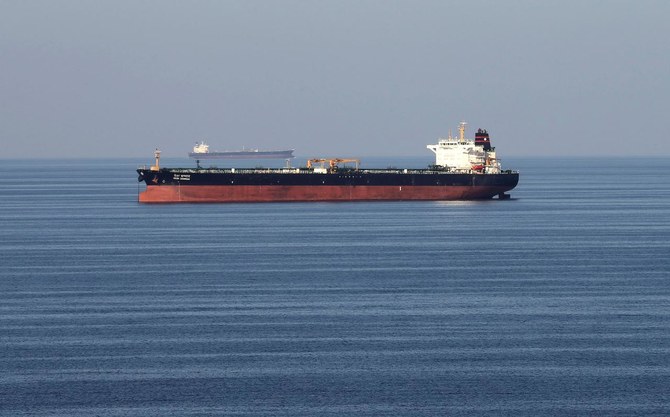
KARACHI: The first Saudi oil tanker carrying a shipment of light crude oil for Pakistan on deferred payments to the country, docked at Karachi harbor’s Oil Pier-1 on Saturday evening, officials said.
Last October, Saudi Arabia announced a $6 billion financial assistance package for Pakistan to help support its balance of payments crisis. Saudi Arabia deposited $3 billion directly with Pakistan while another one-year deferred payment facility of up to $3 billion for oil imports was agreed on, according to a memorandum of understanding signed by both countries.
“The MT Quetta carrying Arab Light crude has arrived at Karachi port from Saudi Arabia,” Mahmood Moulvi, adviser at the Maritime Affairs Ministry, told Arab News on Sunday.
“Under deferred payment facility, Pakistan will receive oil worth $275 million every month,” he said, and added that the oil tanker was owned by the Pakistan National Shipping Corporation.
For its first shipment, the MT Quetta has carried 58,118 metric tons of oil for the Pak-Arab Refinery (PARCO).
Saudi Arabia’s deferred payment facility for oil imports to Pakistan came into effect on July 1st under which the country will receive $9.6 billion worth of oil from the kingdom over a period of three years.
Furthermore, Saudi Arabia has pledged to invest $21 billion into Pakistan which includes the construction of a modern oil refining facility and petrochemical complex in the southwestern Balochistan province.
Though Pakistan has sought financial support from friendly countries including Saudi Arabia, UAE and China since the new government of Prime Minister Imran Khan came to power last year, mounting economic headwinds forced Khan’s government to turn to the International Monetary Fund.
Earlier this month, Pakistan secured the approval of a $6 billion bailout loan from the fund which has come with stringent reform conditions attached, primarily tough austerity measures.
Just as important as the package itself, the approval also unlocks an additional $38 billion from Pakistan’s international partners over the program period.
Following the approval of the loan program, last week Pakistan raised its key policy interest rates by 100 points to 13.25 percent, an eight-year high, due mainly to inflationary pressures and the impact of recent increases in utility prices.
Since the signing of the IMF deal, there has been a sharp drop in the value of the Pakistani rupee after the country’s central bank agreed to a flexible, market-determined exchange rate, a condition of the loan accord.


First tanker from Saudi Arabia carrying oil on deferred payments docks at Karachi port
First tanker from Saudi Arabia carrying oil on deferred payments docks at Karachi port

- MT Quetta discharges first shipment of 58,118 metric tonnes of oil under agreed payment facility
- For three years, Pakistan will receive $9.6 billion worth of oil from Saudi Arabia

Pakistan finance chief urges stronger reform implementation amid stabilizing economy
- Muhammad Aurangzeb calls for inter-ministerial coordination, data-driven policymaking
- He stresses the need to translate policy into execution in an address to civil servants
KARACHI: Federal Minister for Finance and Revenue Muhammad Aurangzeb on Friday urged senior civil servants to strengthen implementation of economic reforms and improve coordination across government, as the country seeks to consolidate gains made after a prolonged financial crisis.
Speaking to officers of the 124th National Management Course at the National School of Public Policy (NSPP) in Lahore, Aurangzeb emphasized the role of senior administrators in translating policy into execution, according to a statement issued by the Finance Division.
“Sustainable economic progress depends not only on sound policy formulation but also on effective implementation across tiers of government,” the statement quoted him as saying.
It added that Aurangzeb highlighted the importance of strategic thinking, data-driven decision-making and inter-ministerial coordination in addressing challenges including fiscal sustainability, energy sector reform and climate resilience.
Pakistan has stabilized its economy in recent years with support from the International Monetary Fund and financial backing from regional partners and has pledged to broaden the tax base, improve public financial management and strengthen transparency to sustain recovery.
The Finance Division said the session formed part of a “Strategic Policy Dialogue” initiative aimed at fostering engagement between national leadership and senior civil servants on governance and economic priorities.