

WEEKLY ENERGY RECAP: China distracts from Strait of Hormuz

In this May 5, 2019 photo issued by Karatzas Images, showing the British oil tanker Stena Impero at unknown location, which is believed to have been captured by Iran. (AP)
Updated 21 July 2019
Follow

WEEKLY ENERGY RECAP: China distracts from Strait of Hormuz

  • China’s economy slowed to the weakest pace since quarterly data began in 1992 amid the ongoing trade standoff with the US, while monthly indicators provided signs of some stabilization emerging

RIYADH: Crude oil prices deteriorated despite rising tensions in the Arabian Gulf toward the end of the week. Brent crude prices dropped to $62.47 and WTI dropped to $55.63 per barrel.
WTI recorded its biggest weekly decline in seven weeks, having fallen sharply earlier in the week on hopes that the situation in the Gulf would improve along with parallel worries about global demand. At the same time, a major storm hurt output in the Gulf of Mexico, where production was down by almost a fifth in its wake.
We saw a continuation of the theme of previous weeks where the oil price largely ignored events in and around the Strait of Hormuz, even after Iran seized two British-flagged oil tankers.
Instead, the market reacted to Iran’s potential nuclear deal with the US that would include permanent enhanced nuclear inspections in return for the lifting of sanctions.
China’s crude oil throughput rose to a record in June, up 7.7 percent from a year earlier, following the start-up of two large new refineries. Crude oil processing reached 13.07 million bpd, beating the previous record in April of 12.68 million bpd.
Despite strong oil demand from China, oil prices slipped after Beijing posted its slowest quarterly economic growth in at least 27 years, reinforcing concerns about demand in the world’s largest crude oil importer.
China’s economy slowed to the weakest pace since quarterly data began in 1992 amid the ongoing trade standoff with the US, while monthly indicators provided signs of some stabilization emerging.
The International Energy Agency pounced on that news and published a shaky oil demand outlook and reduced its 2019 oil demand forecast to 1.1 million bpd, down from its initial forecast of 1.5 million bpd, due to the slowing global economy and the US.-China trade war.
Yet the economic impact of the US-China trade argument is not an oil market-reflective. Surprisingly, some economists suggest that the trade dispute could spark a global recession, sending incremental oil demand lower. This has caused growing concern about supply and poor economic growth that has pushed oil prices lower, based purely on sentiment.
Arabian Gulf crude grades have further strengthened backed by demand uptick from North Asian refineries.
Norway’s crude oil production slipped to the lowest in three decades to 1.38 million bpd in April from 1.387 million bpd in March and 1.531 million bpd a year ago.

Faisal Faeq is an energy and oil marketing adviser. He was formerly with OPEC and Saudi Aramco. Twitter:@faisalfaeq

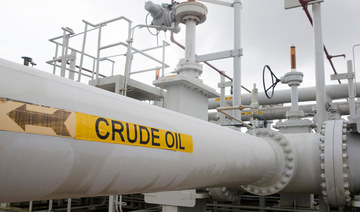
European gas prices soar almost 50% as Iran conflict halts Qatar LNG output

Updated 02 March 2026
Follow

European gas prices soar almost 50% as Iran conflict halts Qatar LNG output

  • Analysts warn prolonged disruption could push prices higher
  • Some shipments of oil, LNG through Strait of Hormuz suspended
  • Benchmark Asian LNG price up almost 39 percent

LONDON: ​Benchmark Dutch and British wholesale gas prices soared by almost 50 percent on Monday, after major liquefied natural gas exporter Qatar Energy said it had halted production due to attacks in the Middle East.

Qatar, soon to cement its role as the world’s second largest LNG exporter after the US, plays a major role in balancing both Asian and European markets’ demand of LNG.

Most tanker owners, oil majors and ‌trading houses ‌have suspended crude oil, fuel and liquefied natural ​gas shipments ‌via ⁠the ​Strait of ⁠Hormuz, trade sources said, after Tehran warned ships against moving through the waterway.

Europe has increased imports of LNG over the past few years as it seeks to phase out Russian gas following Russia’s invasion of Ukraine.

Around 20 percent of the world’s LNG transits through the Strait of Hormuz and a prolonged suspension or full closure would increase global competition for other ⁠sources of the gas, driving up prices internationally.

“Disruptions to ‌LNG flows would reignite competition between ‌Asia and Europe for available cargoes,” said ​Massimo Di Odoardo, vice president, gas ‌and LNG research at Wood Mackenzie.

The Dutch front-month contract at the ‌TTF hub, seen as a benchmark price for Europe, was up €14.56 at €46.52 per megawatt hour, or around $15.92/mmBtu, by 12:55 p.m. GMT, ICE data showed.

Prices were already some 25 percent higher earlier in the day but extended gains ‌after QatarEnergy’s production halt.

Benchmark Asian LNG prices jumped almost 39 percent on Monday morning with the S&P Global ⁠Energy Japan-Korea-Marker, widely used ⁠as an Asian LNG benchmark, at $15.068 per million British thermal units, Platts data showed.

“If LNG/gas markets start to price in an extended period of losses to Qatari LNG supply, TTF could potentially spike to 80-100 euros/MWh ($28-35/mmBtu),” Warren Patterson, head of commodities strategy at ING, said. The British April contract was up 40.83 pence at 119.40 pence per therm, ICE data showed.

Europe is also relying on LNG imports to help fill its gas storage sites which have been depleted over the winter and are currently around 30 percent full, the latest data from Gas Infrastructure ​Europe showed. In the European carbon ​market, the benchmark contract was down €1.10 at €69.17 a tonne
