Pakistani Twitterati roast Trump for tweeting Hafiz Saeed arrested after “ten year search“

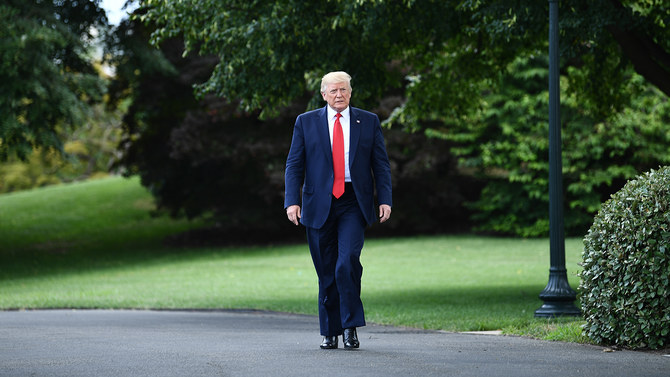
US President Donald Trump arrives to speak to the press as he departs the White House in Washington, DC, on July 17, 2019. (AFP)
Updated 18 July 2019
Follow

Pakistani Twitterati roast Trump for tweeting Hafiz Saeed arrested after “ten year search“

  • Notable Pakistanis take to Twitter to set record straight about the alleged Mumbai attacks’ mastermind
  • Saeed has been in and out of Pakistani prisons for years, addresses public rallies and heads a political party

ISLAMABAD: Pakistani Twitter users have slammed US President Donald Trump for saying Pakistan’s arrest this week of the alleged mastermind of the 2008 Mumbai attacks had come after a 10-year search, as the suspected militant leader has been in and out of Pakistan prisons for the last decade and even addressed public rallies.
Pakistani authorities arrested Hafiz Saeed on terrorism funding charges on Wednesday. Saeed, who founded the Lashkar-e-Taiba militant group, is accused by India and the United States of carrying out the Mumbai attacks which killed more than 160 people. Saeed has denied any involvement and Pakistani authorities say they have not found any evidence against him either.
“After a ten year search, the so-called “mastermind” of the Mumbai Terror attacks has been arrested in Pakistan. Great pressure has been exerted over the last two years to find him!” Trump tweeted.
Notable Pakistanis took to Twitter to set the record straight about Saeed who would often address public rallies and regularly give sermons at Pakistani mosques. He also leads a political party, which took part in the 2008 general elections.
“Finding him [Saeed] was never an issue,” former Pakistani envoy to the United States, Husain Haqqani, said. “He operated freely and was highly visible. He has been arrested and released many times over. @POTUS shd immediately fire whoever gave him the wrong information,” he added, referring to the US president.
In 2017, Saeed was put under house arrest by Pakistani authorities and subsequently released after being cleared of charges against him, drawing strong criticism from Washington and New Delhi. 
In February this year, Pakistan banned two charities linked to Saeed, just days before a global watchdog was due to vote on a US-backed motion to put Islamabad on a watchlist for failing to curb terrorist financing. Saeed is also designated a terrorist by the United States and the United Nations. 
Farhatullah Babar, a senior leader of the opposition Pakistan Peoples Party, said Saeed “has always been around, not ‘found’ now.”
“‘Arrested’ many times in past also in face of pressure and released when int’l pressure relented,” Babar said. “Again ‘arrested’ on eve of Imran visit to US, will be free soon for sure. So ill informed Pres of US. Unbelievable.”
Popular Pakistani TV anchor Hamid Mir wrote: “The tweet made by @realDonaldTrump about Hafiz Saeed is nothing but foolishness.” 
Wednesday’s arrest also comes days before a visit to Washington by Prime Minister Imran Khan, who has promised to crack down on militant groups operating in Pakistan.
“Trump will leave no opportunity to prove his ignorance time and again,” journalist Ansar Abbasi tweeted. “Yet thanks to him for telling us that Hafiz Saeed is arrested by IK [Imran Khan] govt following US pressure.”
Saeed has repeatedly denied his involvement in any terror activities and said his network, which includes 300 seminaries and schools, hospitals, a publishing house and ambulance services, has no ties to militant groups.


Pakistan rejects India’s ‘irresponsible assertions’ after FM Jaishankar’s ‘bad neighbors’ remarks

Updated 03 January 2026
Follow

Pakistan rejects India’s ‘irresponsible assertions’ after FM Jaishankar’s ‘bad neighbors’ remarks

  • Indian FM Jaishankar accused Pakistan of fomenting militancy, backed New Delhi’s decision to put Indus Waters Treaty in abeyance
  • Islamabad calls the remarks an attempt to deflect attention from India’s ‘troubling record as a neighbor,’ vows to safeguard rights

ISLAMABAD: Pakistan on Saturday rejected “irresponsible assertions” made by Indian External Affairs Minister S. Jaishankar after his remarks about “bad neighbors” and the 1960 Indus Waters Treaty (IWT) between the two countries.

Jaishankar mentioned about “bad neighbors” at an event in Madras on Friday and said that New Delhi had a right to defend itself. “When you have bad neighbors... if you look to the one to the West, if a country decides that they will deliberately, persistently, unrepentantly continue with terrorism, we have a right to defend our people,” he was quoted as saying by The Hindu newspaper.

The remarks came months after New Delhi blamed Pakistan for a militant attack in Indian-administered Kashmir and conducted missile strikes inside Pakistan. Islamabad, which denied involvement in the Kashmir attack, responded to the strikes, leading to a four-day military conflict that saw the use of armed drones, fighter jets and artillery between the neighbors in May.

In a statement, Pakistani foreign office spokesman Tahir Andrabi said Islamabad firmly rejects the irresponsible assertions made by the Indian external affairs minister, describing the remarks as an attempt to deflect attention from India’s own “troubling record as a neighbor that promotes terrorism and contributes to regional instability.”

“India’s documented involvement in promoting terrorist activities in the region, particularly in Pakistan, is well known. The case of Commander Kulbhushan Jadhav remains a stark example of organized, state-sponsored terrorism directed against Pakistan,” he said.

“Equally concerning are recurring instances of extraterritorial killings, sabotage through proxies, and covert support to terrorist networks.”

Jadhav, an Indian navy officer who Islamabad said had been working with Indian spy agency, RAW, when Pakistani agencies arrested him in Balochistan in 2016. He was later sentenced to death by a Pakistani military court for alleged espionage. India disputes the conviction and has challenged it at the International Court of Justice.

Pakistan and India routinely accuse each other of supporting militant groups waging attacks against the other. The two countries have fought multiple wars, including two of them over the disputed region of Kashmir, since their independence from British rule in 1947. Both rule the region in part but claim it in full.

Jaishankar also spoke on Friday about the IWT that divides control of the Indus basin rivers between the neighbors and ensures water for 80 percent of Pakistani farms. India announced in April, following the Kashmir attack, that it was putting the 1960 World Bank-mediated treaty in abeyance.

“Many years ago, we agreed to a water-sharing arrangement — the belief was it was gesture of goodwill — because of good neighborliness we were doing it … but if you have decades of terrorism, there is no good neighborliness and you don’t get the benefit of good neighborliness,” Jaishankar was quoted as saying.

Pakistan foreign office spokesman Andrabi said the IWT is an international agreement concluded in good faith and at a considerable cost.

“Any unilateral violation of the Treaty by India would undermine regional stability and call into question its credibility as a state that claims to respect international legal obligations,” he said.

“Pakistan will take all necessary measures to safeguard its legitimate rights under the Treaty.”