Ghosn sues Nissan and Mitsubishi for breach of contract: report

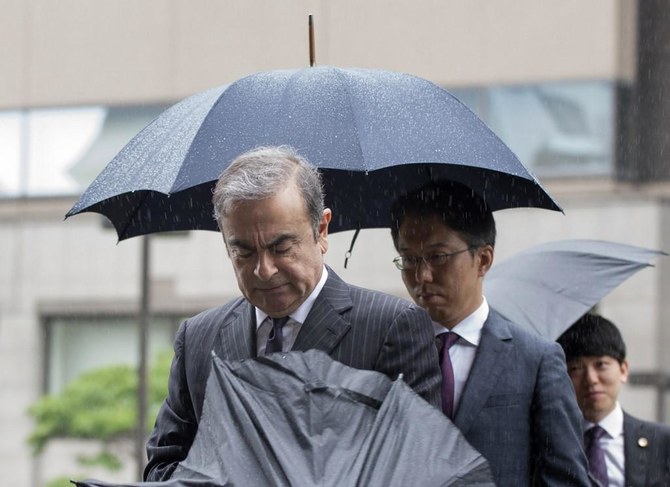
Carlos Ghosn is accused of under-reporting millions of dollars in income. (File/AFP)
Updated 18 July 2019
Follow

Ghosn sues Nissan and Mitsubishi for breach of contract: report

  • Ghosn is seeking up to $16.8 millions in damages
  • He spent over 100 days jailed in Japan over financial misconduct trials

PARIS: Former auto titan Carlos Ghosn, currently under house arrest in Tokyo, is suing Nissan and Mitsubishi in a Dutch court for “improper termination” of his contract, French newspaper Le Figaro reported Wednesday.
Ghosn is accusing the Japanese manufacturers of breaching his contract as an employee of NMBV, their joint subsidiary based in the Netherlands, and seeking up to $16.8 million in damages, it said.
The big-spending former chief of both Renault and its Japanese partner Nissan is awaiting trial in Japan on charges of financial misconduct.
He was kept behind bars for over 100 days before being granted bail and sacked from all his management roles.
Ghosn is accused of under-reporting millions of dollars in income at Nissan and of using company funds for personal expenses — charges he denies.
His lawyers argue that while Ghosn resigned from Renault-Nissan BV (RNBV), he had not done so from NMBV and “the breach of contract” was unwarranted, Le Figaro said.
Nissan and Mitsubishi argue that Ghosn’s contract was invalid as it would not have been submitted to NMBV’s board, according to the daily.
NMBV had thanked Ghosn after a meeting of his board of directors on March 12, the same day as the announcement of its dissolution.
Ghosn’s spokesperson and his lawyer both declined to comment when contacted by AFP.
Le Figaro said the manufacturers were seeking to recover some $8.79 million paid to Ghosn by NMBV between April and November 2018.
Renault announced in early June it was considering taking action against its former boss after it identified $12.36 million of “questionable expenses” linked to Ghosn at RNBV.
The 65-year-old Ghosn was arrested in Japan in November as he stepped off his private jet at Tokyo airport.
His dramatic downfall stunned the business world and laid bare tensions in the alliance between Renault, Nissan and their smaller Japanese partner Mitsubishi.
Ghosn has not been charged in connection with his activities at NMBV.


US Treasury welcomes reactivation of Syria central bank account at New York Fed

Updated 5 sec ago
Follow

US Treasury welcomes reactivation of Syria central bank account at New York Fed

RIYADH: The US Treasury said it welcomed the reactivation of the Central Bank of Syria’s account at the Federal Reserve Bank of New York, marking the first time it has been operational since 2011.

The account had effectively been frozen after the outbreak of Syria’s civil war in 2011, when Washington imposed sweeping targeting the Syrian government, state institutions and individuals associated with the regime, designed to isolate Damascus financially and restrict its access to international banking channels.

It is the latest step in efforts to reintegrate Syria into the international financial system. The country has also begun reconnecting to the Society for Worldwide Interbank Financial Telecommunication network, a move that would end roughly 14 years of financial isolation and restore access to global banking channels.

In a statement posted on social media, the US Treasury Department said it was working with Syria’s new authorities to “responsibly reintegrate Syria into the global financial system,” adding that it welcomed the Syrian central bank’s announcement that its account at the New York Fed had been restored. 

The post also stated: “Sanctions relief was just the first step to realizing the President of the United States’ historic vision of greatness and prosperity in Syria.”

The release added: “We welcome the Syrian Central Bank’s momentous announcement that its account at the Federal Reserve Bank of New York was officially reactivated for the first time since 2011.”

Over the course of the more than 13-year conflict, sanctions expanded to include broader economic restrictions, including the Caesar Syria Civilian Protection Act enacted in 2019, which targeted foreign entities conducting business with the Syrian government. 

The measures contributed to Syria’s deep financial isolation and complicated humanitarian and reconstruction efforts.

Efforts to restore financial channels have been discussed intermittently as international actors assess pathways for humanitarian assistance and potential economic stabilization.

However, broader sanctions frameworks remain in place, and significant political and regulatory hurdles continue to shape Syria’s reintegration into the global financial system.

In recent years, regional institutions have gradually renewed engagement with Syria as part of broader efforts to stabilize the country and support economic recovery after more than a decade of conflict.

Syria was readmitted to the Arab League in 2023 after a 12-year suspension, reopening diplomatic channels with several Arab states.