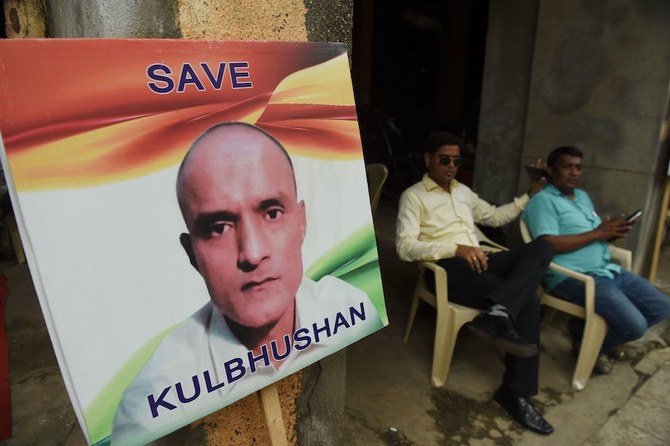
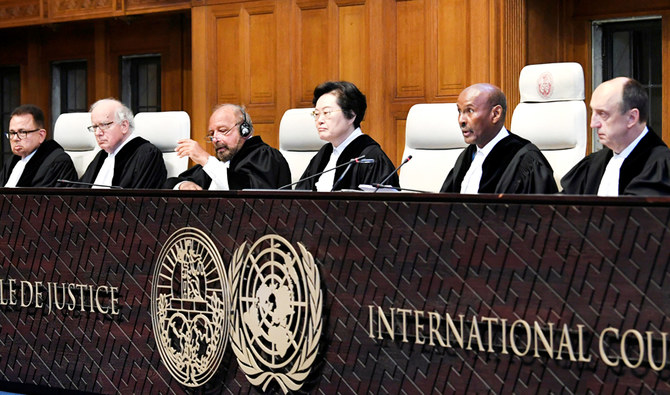

ISLAMABAD/NEW DELHI: Both Islamabad and New Delhi claimed victories on Wednesday after the World Court ordered Pakistan to review a death sentence handed down in 2017 by a military court to an Indian naval officer convicted of espionage. It is the latest development in a high-profile case that has put further pressure on strained relations between the nuclear-armed neighbors and rivals.
Kulbhushan Sudhir Jadhav was arrested by Pakistan in 2016 after allegedly entering the country from Iran. He was accused of fomenting “terrorist activities” in the restive southwest province of Baluchistan.
Pakistani authorities said that Jadhav’s arrest was evidence of India’s involvement in militancy in the volatile province, where Pakistan’s military is fighting a long-running separatist insurgency. India denies that Jadhav is a spy and raised his case with the International Court of Justice, the top UN legal authority for hearing disputes between states. They argued that the Indian citizen’s trial was unfair and he had been denied diplomatic assistance by Islamabad. Pakistan and India regularly convict each other’s citizens of espionage but executions are rare.
In May 2017, the ICJ ordered Pakistan to stay the execution of Jadhav until the 16-member court delivered its final decision. On Wednesday, the ICJ ordered Pakistan to review and reconsider the conviction and sentence “by the means of its own choosing…so as to ensure that full weight is given to the effect of the violation of the rights set forth in Article 36 of the Convention.” This was a reference to the 1963 Vienna Convention on Consular Relations. The decision was was made by 15 votes to one, with ad hoc judge Tassaduq Hussain Jillani from Pakistan delivering the sole dissenting vote.
The court also ordered Pakistan to grant India consular access to Jadhav, saying Islamabad had deprived their neighbors of the rights to communicate with him, to visit him in detention and arrange for legal representation. In addition, it ruled that Islamabad had breached its obligations by not notifying an Indian consul in Pakistan of Jadhav’s detention, “thereby depriving the Republic of India of the right to render the assistance provided for by the Vienna Convention.”
“The Islamic Republic of Pakistan is under an obligation to inform Mr. Kulbhushan Sudhir Jadhav without further delay of his rights and to provide Indian consular officers access to him in accordance with Article 36 of the Vienna Convention on Consular Relations,” the court said.
Indian Prime Minister Narendra Modi welcomed the court’s ruling.
“Truth and justice have prevailed,” he wrote on Twitter. “Congratulations to the ICJ for a verdict based on extensive study of facts. I am sure Kulbhushan Jadhav will get justice.”
India’s foreign ministry said the court had upheld the country’s claim that Pakistan had violated the Vienna Convention and “should review and reconsider the conviction and sentence.”
“Commander Jadhav shall remain in Pakistan,” Pakistani Foreign Minister Shah Mahmood Qureshi wrote in a Twitter post after the ruling. “He shall be treated in accordance with the laws of Pakistan. This is a victory for Pakistan.”
In a video recorded by Pakistani authorities, Jadhav can be seen confessing that he was assigned by India’s intelligence service to plan, coordinate and organize espionage and sabotage activities in Balochistan “aiming to destabilize and wage war against Pakistan.”
Islamabad had argued that the ICJ need not intervene in the case on the grounds that the Vienna Convention does not apply to “spies and terrorists,” and that a 2008 bilateral treaty with India, which Pakistan says supersedes the Vienna pact, allows the right to consular access to be waived in cases that place “national security” at risk. Pakistan also pointed out that Jadhav’s sentence was subject to appeal and he is in no immediate danger of being put to death.
Reema Omar, a legal adviser to human rights organization the International Commission of Jurists, said the International Court of Justice has no history of acquitting convicts in such cases, or of providing safe passage or any other actions that India had sought from the court.
“It was always very obvious that this would not be possible under international law and ICJ jurisdiction, so those reliefs were rejected,” she said. “An adequate reparation would be an effective review and reconsideration of the sentence, which is what the ICJ has ordered.”
Contrary to narratives spun by the Pakistani government and media, Omar said, the Jadhav case “was never about whether he was a spy, whether he was involved in terrorism activities, whether Pakistan convicted him correctly or whether he should have been given the death sentence. This case had a very specific legal question as its basis, which is whether Jhadav was entitled to consular access and notification under the Vienna Convention.
“Pakistan’s argument was that because he is a spy and a terrorist, this right was not applicable to him. But this was always going to be a weak ground because this right applies from the moment you are arrested; to begin with there is an allegation against you that needs to be proven — how can you be denied consular access when a charge has not yet been proved?”
She added that Pakistan’s argument that a 2008 bilateral treaty between Pakistan and India allowed them to waive the right to consular access if national security was involved was rejected by the court because under settled principles of international law, bilateral treaties can improve on or add to the rights granted in multilateral treaties, but they cannot deny or reject those rights.
“In terms of merit, India has won the case and the court has accepted India’s argument that Pakistan breached the Vienna Convention,” she said.
The question now is whether the decision to sentence Jadhav to death would have been different had he been given consular access before and during his trial; hence the court’s order that the death sentence be reviewed. It did not specify who should review the judgment, leaving the decision to Pakistani authorities, but legal experts said the high court and supreme court would be appropriate forums to consider the case.
“If Pakistan delivers on the judgment, then it will open diplomatic space for both India and Pakistan to engage each other,” said Harsh V Pant from the Observer Research Foundation, a think tank in New Delhi.
He described the court’s decision as “a big diplomatic victory.” Pakistan had repeatedly denounced India’s decision to take its case to the UN court as “political theater.”
The Vienna Convention is a frequent source of disputes at the ICJ, often in cases involving the United States. ICJ rulings are binding, though occasionally flouted; in 1999, for example, US authorities ignored a court injunction and executed a German national.