

Brother of 2017 Ariana Grande concert bomber extradited from Libya to Britain

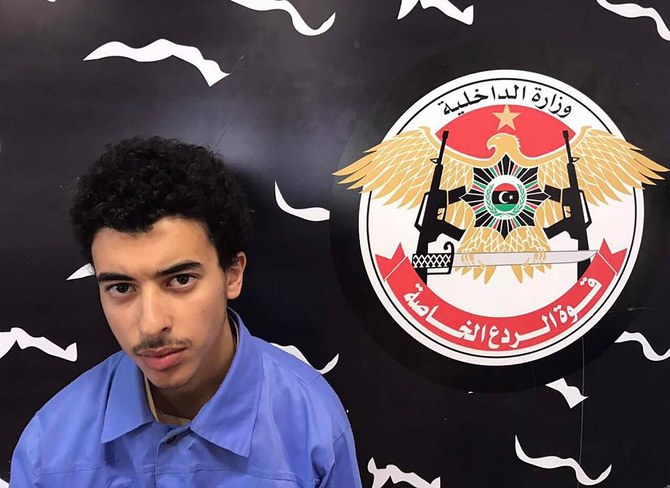
The Tripoli government's Special Deterrence Force said Hashem Abedi was being flown back to the UK. (AFP/File photo)
Updated 17 July 2019
Follow

Brother of 2017 Ariana Grande concert bomber extradited from Libya to Britain

  • Salman Abedi blew himself up at the end of a show by US singer Ariana Grande in 2017, killing 22 people
  • Hashem Abedi was handed over to British officials and then flown to Britain where he was arrested for murder

LONDON: Libya on Wednesday extradited to Britain the brother of a suicide bomber who attacked an Ariana Grande concert in Manchester in May 2017 and killed 22 people, officials said.
Salman Abedi's brother Hashem, who was arrested in Libya days after the bombing, was handed over to British officials and then flown to Britain where he was arrested for murder, Greater Manchester Police said in a statement.
"He has today been successfully extradited for offences relating to the Manchester Arena attack," it said.


Asked about the arrest, British Prime Minister Theresa May said it was "an important moment in the investigation.
"I hope it is a welcome step for the loved ones of all the victims," she said, condemning the "appalling" and "senseless" attack.
Manchester police said Abedi was also being arrested for attempted murder and "conspiracy to cause an explosion likely to endanger life".
He is expected to appear in a London court on Thursday.
A spokesman for the Libyan force which had held him earlier told AFP that Abedi was "in the plane headed for Britain".
Ahmed Ben Salem of the Special Deterrence Force (Radaa), an armed group which serves as the capital's police, said he was being extradited in line with a decision of the Libyan judiciary following a request from Britain.
According to Radaa, the brother has allegedly acknowledged that he was in Britain as the attack was being prepared and was "fully aware of the details".


His father was also detained in Libya but released a few weeks later.
Salman Abedi carried out the bloodiest terror attack in Britain in more than a decade when he detonated a suicide bomb after a concert by Grande, leaving many children among the dead.
Libya's internationally recognised Government of National Accord (GNA), which is based in Tripoli, said in April that Hashem Abedi's case was being determined by the North African country's courts.
Libya has been mired in chaos since the ouster and killing of dictator Moamer Kadhafi in a NATO-backed uprising 2011.

The Abedi family, originally from Libya, had fled to Britain during the dictatorship, but the brothers returned to the country along with their father when the uprising began in 2011.
There has been a surge in fighting since military strongman General Khalifa Haftar launched an offensive on Tripoli, seat of the GNA, on April 4.



Ankara city hall says water cuts due to ‘record drought’

Updated 59 min ago
Follow

Ankara city hall says water cuts due to ‘record drought’

  • Dam reservoir levels have dropped to 1.12 percent and taps are being shut off for several hours a day in certain districts on a rotating schedule in Ankara

ANKARA: Water cuts for the past several weeks in Turkiye’s capital were due to the worst drought in 50 years and an exploding population, a municipal official told AFP, rejecting accusations of mismanagement.
Dam reservoir levels have dropped to 1.12 percent and taps are being shut off for several hours a day in certain districts on a rotating schedule in Ankara, forcing many residents to line up at public fountains to fill pitchers.
“2025 was a record year in terms of drought. The amount of water feeding the dams fell to historically low levels, to 182 million cubic meters in 2025, compared with 400 to 600 million cubic meters in previous years. This is the driest period in the last 50 years,” said Memduh Akcay, director general of the Ankara municipal water authority.
Turkish President Recep Tayyip Erdogan has called the Ankara municipal authorities, led by the main opposition party, “incompetent.”
Rejecting this criticism, the city hall says Ankara is suffering from the effects of climate change and a growing population, which has doubled since the 1990s to nearly six million inhabitants.
“In addition to reduced precipitation, the irregularity of rainfall patterns, the decline in snowfall, and the rapid conversion of precipitation into runoff (due to urbanization) prevent the dams from refilling effectively,” Akcay said.
A new pumping system drawing water from below the required level in dams will ensure no water cuts this weekend, Ankara’s city hall said, but added that the problem would persist in the absence of sufficient rainfall.
Much of Turkiye experienced a historic drought in 2025. The municipality of Izmir, the country’s third-largest city on the Aegean coast, has imposed daily water cuts since last summer.