

India-Pakistan spy case ruling due at world court

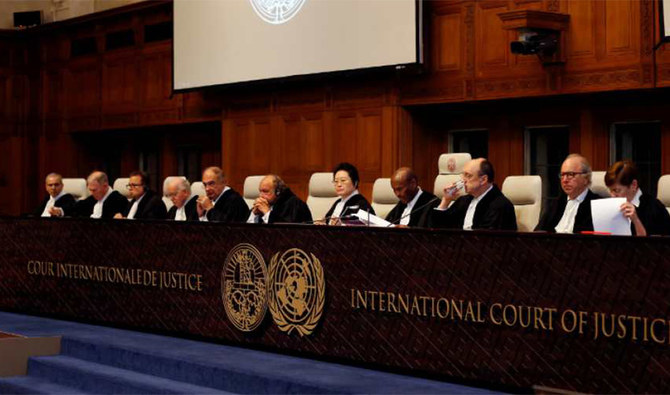
International Court of Justice hearing the Kulbhushan Jadhav case Photograph:( Reuters )
Updated 17 July 2019
Follow

India-Pakistan spy case ruling due at world court

  • Jadhav was accused of working for the Indian intelligence services in Baluchistan
  • Pakistan military court sentenced him to on April 10, 2017,

The Hague: The International Court of Justice will decide Wednesday on India’s bid to remove an alleged spy from death row in Pakistan, in a case that has stoked tensions between the South Asian rivals. Kulbhushan Sudhir Jadhav, a former Indian navy officer, was arrested in Pakistan’s restive southwestern province of Baluchistan in March 2016 on charges of espionage. The 48-year-old was then sentenced to death by a Pakistani military court in 2017, sparking outrage in India. The Hague-based ICJ, which is the UN’s top court, said it “will deliver, on Wednesday 17 July 2019, its Judgment in the Jadhav case (India v. Pakistan)” at 1300 GMT. India insists that Jadhav was not a spy and says he was kidnapped in Pakistan. New Delhi is asking the ICJ to order Islamabad to annul the sentence. India’s lawyers told the court in February that it was a “farcical case” based on “malicious propaganda,” while Pakistan’s lawyers hit back by accusing Jadhav of “terrorism.” The last hearing coincided with a sharp spike in tensions between the two nuclear-armed neighbors after a suicide bombing in restive Kashmir, although relations have since improved. The ICJ was set up in 1946 to rule in disputes between countries. The court has already intervened previously in the case, issuing an urgent order in 2017 telling Pakistan to stay Jadhav’s execution while it dealt with the issue in more detail.

Jadhav was accused of working for the Indian intelligence services in Baluchistan, a province bordering Afghanistan, where Islamabad has long accused India of backing separatist rebels. In February Pakistan’s attorney general told the ICJ that Jadhav’s “unlawful activities were directed at creating anarchy in Pakistan and particularly targeted the China-Pakistan corridor.” China and Pakistan are close allies and Beijing has funded a huge port at Gwadar on the Baluchistan coast. After a closed trial he was sentenced to death by a Pakistani military court on April 10, 2017, on charges of “espionage, sabotage and terrorism.” New Delhi alleges that Islamabad violated the Vienna Convention by failing to provide him with consular access, as well as breaking human rights law. India has also accused Pakistan of harassing Jadhav’s family in 2017 during a meeting that was held in an “atmosphere of coercion.” It said Jadhav’s conversation with his mother and wife was “tutored and designed to perpetuate the false narrative of his alleged activities in Pakistan.” The two neighbors routinely accuse one another of sending spies into their countries. Jadhav joined India’s prestigious National Defense Academy in 1987 and was commissioned as an engineer in the Indian Navy in 1991 before reportedly starting a business in Iran.


Peace can only prevail if Afghanistan renounces support for ‘terrorism’— Pakistan defense chief

Updated 04 March 2026
Follow

Peace can only prevail if Afghanistan renounces support for ‘terrorism’— Pakistan defense chief

  • Pakistan’s chief of defense forces visits South Waziristan district bordering Afghanistan
  • Pakistan says has killed 481 Afghan Taliban operatives since clashes began last Thursday

ISLAMABAD: Pakistan’s Chief of Defense Forces Field Marshal Syed Asim Munir said on Wednesday that peace with Afghanistan can only prevail if Kabul renounces support for “terrorism” and “terrorist” organizations, the military’s media wing said as the two countries remain locked in conflict. 

Fighting between the two neighbors, the worst in decades, broke out last Thursday night after Afghan forces attacked Pakistan’s military installations along their shared border. Afghanistan said its attacks were in response to earlier airstrikes by Pakistan against alleged militant hideouts in its country. 

Pakistan accuses Afghanistan of sheltering militant outfits such as the Tehreek-e-Taliban Pakistan (TTP) on its soil who have launched attacks against Pakistani civilians and security forces in recent years. Kabul denies the allegations. 

Munir visited Wana town in Pakistan’s South Waziristan district to review the security situation and troops’ operational preparedness at the Afghan border, the Pakistani military’s media wing said in a statement. 

“The Field Marshal reiterated that peace could only prevail between both sides if the Afghan Taliban renounced their support for terrorism and terrorist organizations,” the Inter-Services Public Relations (ISPR) said. 

The military chief said the use of Afghan soil by militant outfits to launch attacks against Pakistan was unacceptable, vowing that “all necessary measures” would be taken to neutralize cross-border threats. 

During the visit, Munir was briefed by military commanders about ongoing intelligence-based operations and measures being taken by the military to manage the border with Afghanistan.

He was also briefed about “Operation Ghazab Lil Haq” or “Wrath for the Truth,” the name Pakistan has given to its military operation against Afghan forces, the ISPR said. 

The Pakistani military chief spoke to troops deployed in the area, praising their vigilance, professional conduct and high morale, the ISPR said. 

Pakistan’s Information Minister Attaullah Tarar said on Wednesday that the military has killed 481 Taliban operatives, injured more than 690 and destroyed 226 Afghan checkposts since clashes began. 

Arab News has been unable to verify claims by both sides about the damages they claim to have inflicted on each other.

Afghanistan has signaled it is open for dialogue but Pakistan rejected the offer, saying it would continue its military operations till its objectives were achieved. 

Since the conflict began, diplomatic efforts have intensified with several countries, including global bodies such as the European Union and United Nations, urging restraint and calling for talks.

Turkish President Recep Tayyip Erdogan told Pakistani Prime Minister Shehbaz Sharif that ⁠Ankara would help ⁠reinstate a ceasefire, the Turkish Presidency said on Tuesday, as other countries that had offered to mediate have since been hit by the conflict in the Gulf.