

Pakistan, UAE mull expanding cooperation in aviation sector

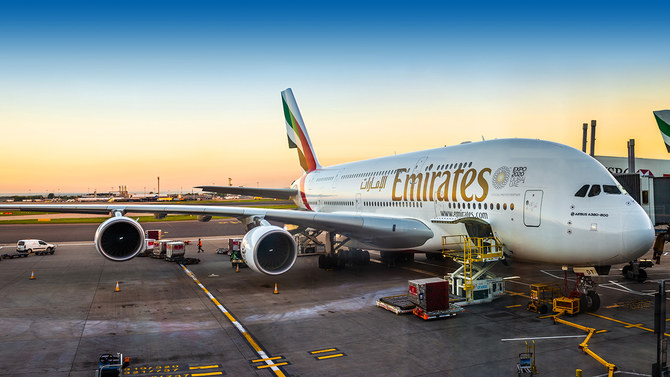
The Emirates A380 touched down in Islamabad on July 08, 2019. This was the first time ever that the iconic double- decker aircraft has landed in Pakistan. (Shutterstock)
Updated 16 July 2019
Follow

Pakistan, UAE mull expanding cooperation in aviation sector

  • UAE airlines seek to start flight operations to new destinations in Pakistan
  • Pakistan-UAE’s aviation strategy a plus for expats, minister says

ISLAMABAD: Sound bilateral relations between Islamabad and Abu Dhabi, particularly in the aviation sector, have helped a large number of Pakistani expatriates residing in the UAE, the country’s aviation minister told Arab News on Tuesday.
In talks with the UAE Ambassador to Pakistan, Hamad Obaid Ibrahim Salim Al-Zaabi on Monday, Ghulam Sarwar Khan discussed matters of mutual interest, including the promotion of ties between the two countries in the aviation sector.
A statement released after the meeting said that airlines in the UAE had also expressed a desire to start flight operations to new destinations in Pakistan.
Both Khan and Al-Zaabi “discussed bilateral relations between the two countires,” the UAE embassy tweeted on Monday.
According to the Air Service Agreement (ASA) between Pakistan and the Gulf states – which the UAE is a part of – Emirates Airlines, Fly Dubai, Etihad Airways, Air Arabia and Ras Al Khaimah Airways are the designated airlines of the UAE.
“Designated airlines of UAE also want to start flight operation between Dubai and Turbat, Gwadar and Panjgur, with unrestricted 5th freedom traffic rights through any intermediate points and to any beyond points,” excerpts from the statement said.
It added that Fly Dubai has requested for four additional frequencies for Multan which had been vacated by Emirates, adding that the request is being considered by the Civil Aviation Authority (CAA) and Pakistan’s national carrier, the PIA.
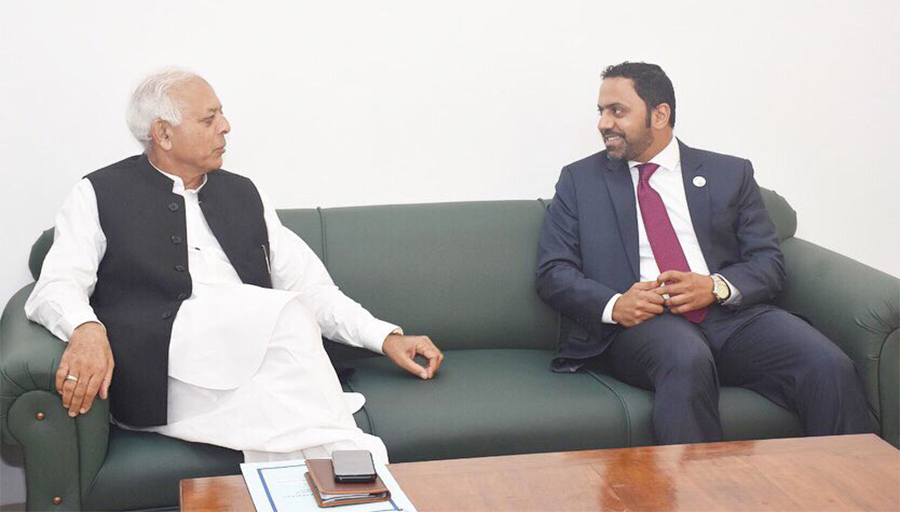


UAE Ambassador to Pakistan Hamad Obaid Ibrahim Salim Al-Zaabi, right, met with Pakistan’s aviation minister Ghulam Sarwar Khan in Islamabad on July 15, 2019. (Photo courtesy: UAE Embassy/Twitter)

PIA, Air Blue and Shaheen Air are the designated airlines of Pakistan and according to the memorandum of understanding (MoU) signed between the two countries on June 02, 2015 the three are entitled to operate unlimited number of frequencies between specific points in Pakistan and the UAE.
“Currently PIA is having 32 flight operations from Pakistan to Dubai,15 flight operations to Abu Dhabi and 9 flight operations to Sharjah. Similarly, Air Blue is currently having 20 flights to Dubai, 11 flight operations to Abu Dhabi and 18 flight operations to Sharjah,” the statement read.
Currently, Emirates and Air Dubai currently operate 134 flights between Dubai and Karachi, Islamabad, Lahore, Peshawar, Multan, Sialkot, Faisalabad and Quetta, while Etihad services 39 flight operations between Abu Dhabi and Karachi, Islamabad, Lahore, Peshawar, Sialkot and Multan; and Air Arabia operates 52 flights between the main cities of Pakistan.
According to official statistics, more than 1.6 million Pakistani expatriates live in the UAE and work in various fields in the public and private sectors.
In July last year, the Airbus A380 – the world’s largest passenger plane operated by Emirates airlines – landed at the Islamabad International Airport.
According to Emirates, the airline and Pakistan have a long-standing relationship that spans over 30 years, when the airline’s first flight flew from Dubai to Karachi on 25 October, 1985.
“Emirates also employs over 5,000 Pakistani nationals as Flight Deck crew, Cabin Crew and in various others positions across the airline,” the airline said in a statement.



Pakistan’s Afghan salvo risks turning ‘open war’ into long crisis

Updated 3 sec ago
Follow

Pakistan’s Afghan salvo risks turning ‘open war’ into long crisis

  • Nuclear-armed Pakistan has a formidable military of 660,000 active personnel, backed by a fleet of 465 combat aircraft
  • But the Taliban have the option to lean on insurgent groups like the TTP and the BLA to move beyond border skirmishes

KARACHI: Weeks after the Taliban’s lightning offensive in 2021 wrested control of Afghanistan from a US-led military coalition, Pakistan’s then intelligence chief flew into the capital Kabul for talks, where the serving lieutenant general told a reporter: “Don’t worry, everything will be okay.”

Five years on, Islamabad — long seen as a patron of the Taliban — is locked in its heaviest fighting with the group, which Pakistan’s Defense Minister Khawaja Muhammad Asif described on Friday (February 27) as an “open war.”

The turmoil means that a wide swathe of Asia — from the Gulf to the Himalayas — is now in flux, with the United States building up a military deployment against Afghanistan’s neighbor Iran even as relations between Pakistan and arch rival India remain on edge after four days of fighting last May.

At the heart of the conflict with Afghanistan is Pakistan’s accusation that the Afghan Taliban provides support to militant groups, including the Tehreek-e-Taliban Pakistan (TTP), that have wreaked havoc across inside the South Asian country.

The Afghan Taliban, which has previously fought alongside the TTP, denies the charge, insisting that Pakistan’s security situation is its internal problem.

The disagreement is a reflection of starkly incompatible positions taken by both sides, as Pakistan expected compliance after decades of support to the Taliban, which did not see itself beholden to Islamabad, analysts said.

“We all know that the government in Pakistan supported the Taliban, the Afghan Taliban for many years, in the 90s and the 2000s, and provided havens to them during the period where the US and NATO were in Afghanistan.

So there’s a very close relationship between the Taliban and Pakistan,” said Jennifer Brick Murtazashvili, a political scientist at the University of Pittsburgh and an Afghanistan expert.

“It’s really surprising and shocking to many of us to see how quickly this relationship deteriorated,” she said.

Although tensions have simmered along their rugged 2,600-km (1,615-mile) frontier for months, following clashes last October, Friday’s fighting is notable because of Pakistan’s use of warplanes to hit Taliban military installations instead of confining the attacks to the militants it allegedly harbors.

These include targets deep inside the country in Kabul, as well as the southern city of Kandahar, the seat of Taliban supreme leader Hibatullah Akhundzada, according to Pakistan military spokesman Lt. Gen. Ahmed Sharif Chaudhry.

The clashes are unlikely to end there.

“I think in the immediate aftermath, I think hostilities will subside. There will be, I hope there will be a ceasefire through mediation. But I do not see these tensions subsiding in the foreseeable future,” said Abdul Basit,  an expert on militancy and violent extremism at Singapore’s S. Rajaratnam School of International Studies.

Nuclear-armed Pakistan has a formidable military of 660,000 active personnel, backed by a fleet of 465 combat aircraft, several thousand armored fighting vehicles and artillery pieces.

Across the border, the Afghan Taliban has only around 172,000 active military personnel, a smattering of armored vehicles and no real air force.

But the battle-hardened group, which took on a phalanx of Western military powers in 2001 and outlasted them, has the option to lean on insurgents like the TTP and the Baloch Liberation Army (BLA), moving beyond border skirmishes.

Based in Pakistan’s largest and poorest province of Balochistan that borders both Iran and Afghanistan, the BLA has been at the center of a decades-long insurgency, which in recent years has staged large coordinated attacks.

Pakistan has long accused India of backing the insurgents, a charge repeatedly denied by New Delhi, which has retained a robust military deployment along the border since last May.

Although a raft of countries with influence — including China, Russia, Turkiye and Qatar — have indicated an openness to help mediate the conflict, all such efforts have been met with limited success so far.
