

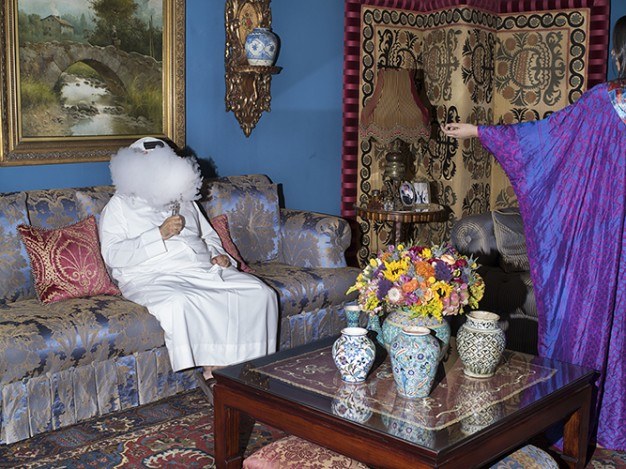
Emirati artist Farah Al-Qasimi’s first solo US show set to open

Farah Al-Qasimi’s ‘Living Room Vape’ (2017). (Supplied)
Updated 16 July 2019
Follow

Emirati artist Farah Al-Qasimi’s first solo US show set to open

DUBAI: Emirati artist Farah Al-Qasimi’s first solo exhibition at a US institution is set to open on July 30 at the MIT List Visual Arts Center in Cambridge, Massachusetts.

Working in photography, video, and performance, Al-Qasimi’s work explores themes of gender, nationality and class. Her photographs subvert ingrained expectations of how images are constructed and understood and she is known for borrowing conventions from various sources, including documentary photography and Renaissance paintings.


Um Al Naar (Mother of Fire) (still), 2019. (Supplied)

Camouflage and concealment play a central role in the artist’s work. In a recent series of portraits, Al-Qasimi obscures the faces of her subjects while capturing intimate images, despite the lack of a clear, engaging face. Various compositional strategies hide identifying features — behind plumes of smoke, a well-placed hand, or sumptuously patterned textiles and drapery — while she still manages to accentuate the opulent interiors her subjects inhabit.

Alongside a group of recent photographs, the exhibition will include a screening of Al-Qasimi’s new film, “Um Al Naar (Mother of Fire)” (2019), which was recently unveiled at Art Basel Statements.


M Napping on Carpet, 2016. (Supplied)

The 40-minute video is structured like a television documentary following a jinn — a ghost-like entity in Islamic tradition. Delivering a confessional, reality TV-style monologue, the jinn appears on camera beneath a patterned sheet. The video interweaves her thoughts on centuries of Portuguese and British colonial meddling in the modern-day emirate of Ras Al-Khaimah in the UAE. The video also explores the influence of the European presence in the region and the use of Euro-centric practices for the display of historical artifacts.

Curated by Henriette Huldisch, the director of exhibitions at the MIT List Visual Arts Center, the exhibition marks the first time Al-Qasimi’s work has been shown in a solo exhibition in the US — it is set to wrap up on Oct. 20.  

The artist lives and works between New York and Dubai and has seen her work exhibited in The Third Line gallery in Dubai, Jameel Arts Centre in Dubai and the San Francisco Arts Commission, among other locations.

Al-Qasimi received her MFA from the Yale School of Art and has participated in residencies at the Delfina Foundation in London; the Skowhegan School of Painting and Sculpture in Maine; and is a recipient of the New York NADA Artadia Prize and the Aaron Siskind Individual Photographer’s Fellowship.


Riyadh celebrates Sudanese heritage in cultural week finale

Updated 15 December 2025
Follow

Riyadh celebrates Sudanese heritage in cultural week finale

  • Visitors experience sounds of dalooka, rababa in lively spectacle
  • Global Harmony 2 initiative has offered an integrated cultural experience highlighting 14 cultures

RIYADH: The Sudanese Culture Week continues in Riyadh until Dec. 20, attracting visitors from a variety of nationalities to diverse cultural performances, the Saudi Press Agency reported.

The Ministry of Media has organized the events as part of the Global Harmony 2 initiative, in cooperation with the General Entertainment Authority and the Quality of Life Program.

Held at Al-Suwaidi Park, one of Riyadh Season’s zones, the week began with a celebratory parade featuring traditional Sudanese music which included the sounds of the dalooka and the rababa. A traditional Sudanese bridal procession was the subject of a tableau that also engaged visitors.

Sudanese Culture Week also includes musical concerts, entertainment sections, and cultural pavilions, with participation from Sudanese singers and influencers presenting activities that reflect the cultural diversity of the country’s regions and communities.

The event’s stage hosted the opening concerts, which were attended by thousands who enjoyed rababa performances and popular Sudanese songs.

Citizens and residents explored Sudanese culture through its folk arts, traditional music, and customs.

The celebration marks the final week of the Global Harmony 2 initiative’s cultural events. These have built on the program’s success in promoting cultural exchange and showcasing the cultures of communities residing in the Kingdom, reflecting the values of coexistence and cultural openness.

Over more than 40 days the Global Harmony 2 initiative has offered an integrated cultural experience highlighting 14 cultures.

Indian Culture Week was the first in a series featuring countries from Asia, Africa, and the Arab world.

Other weeks have placed the spotlight on regions such as the Philippines, Egypt, Pakistan, Jordan, Lebanon, Palestine, Bangladesh, Yemen, Uganda, and Ethiopia, providing traditional arts and music, cuisine, and social activities.

The initiative has included more than 100 artists and creators presenting artistic and musical performances, along with areas showcasing traditional cuisine, clothing, handicrafts, and family-friendly interactive activities.

It has received wide acclaim for highlighting the lives of residents in the Kingdom and the services provided to them.