

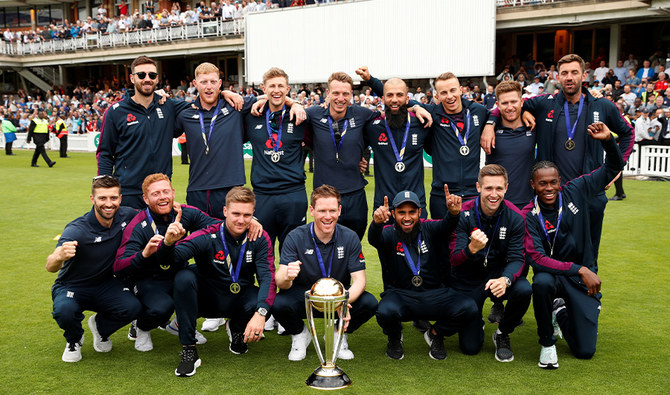

KARACHI: It is often said that we are currently living in the era of Prestige TV, where many serialized television shows have reached a pinnacle of creative and critical acclaim. The 2019 cricket World Cup, which concluded with a finale on Sunday that even the best scriptwriters would struggle to conceive, can be seen as an intensely bingeable, occasionally overwrought, consistently engaging season of television that lines up with the best.
If Game of Thrones was about power and what drives people to seek it; if The Wire was about how abstract institutions determine so much of our lives; then this World Cup was about the essential fickleness of life. For months if not years, this World Cup had been advertised as the one where we’d see a team cross 500 runs in a match. It’s teasers and trailers focused on the awesome batting prowess on display, and teams picked their casts accordingly, looking to plug batters wherever they could. But few sports are as capricious to the whims of nature — as wind, as rain, as earth and grass — than cricket is. And a more than usually wet English summer converted four years of expensive planning and building on its head, as teams found themselves under-resourced to deal with a ‘Stranger Things’ type of tournament where batting like the late 80s was what was needed.
This central theme of fickleness, which upended all the conventional wisdom teams had brought to the World Cup, gave a chance to poorer teams to compete. Yes, these were the weaker teams, but describing them as poorer feels more relevant because their players lacked the high degree of training, attention and exposure to quality cricket that the top sides did. Flatter batting pitches might well have overwhelmed their limited talents, but in these new, stickier conditions they were back in the game. Pakistan’s narrative thread within the larger story of the World Cup was the best example of this, as the team delivered repeated episodes of unforgettable, or at least remarkable matches. It’s bowling largely led this charge, and boisterous fans competed for some of the best in the tournament. Ultimately, in a superb usage of Chekov’s gun, Pakistan’s terrible net run rate (NRR) from their first match was the reason they were eliminated by their last one. It was the sort of mature, complex and satisfying character arc that Prestige TV made its cornerstone.
Any celebrated television show comes with its own ecosystem of extended lore, complex and obscure references, sources and rules. Obsessive fans spend more time arguing over the nuances of this content than they do watch the show, and the content-cycle churn about these arguments sustains even when the show isn’t working. In this World Cup, it was initially the vagaries of the NRR but by the end, it was proper otaku season as fans deliberated the philosophy behind boundary-count as a tie-breaker and what needed to be done with deflected overthrows. The ‘losing’ captain in the final, Kane Williamson, was remarkably able to articulate just the sheer remoteness of what brought the boundary-count rule into play: “The rules are there I guess, aren’t they, and certainly something you don’t consider going into the match that maybe if we could have an extra boundary and then tied two attempts at winning it we will get across the line and they didn’t think that either.”
All great TV shows are built off previous great TV shows — Atlanta borrows from Twin Peaks but also The Cosby Show, both inspirations from the distant past. This World Cup’s format, borrowed directly from 1992 one, ended up working out in a similar way as well. It is again a reflection of the inherent fickleness that one can’t say if the format would have necessarily worked, but that it did. England’s upset losses, a spate of washouts, and the generally close nature of results meant that there were stakes to all the matches right until the end. Despite that, the top four teams weren’t a total surprise and did reward audience expectations, but the World Cup made sure that how we got to the cliche was enthralling throughout.
Indeed, the pacing is at the heart of good television. Game of Thrones lost much of the credibility it had built over years of masterful television with a poorly paced final season that wildly polarized audiences. The World Cup can’t be said to have had blockbuster episodes all the time, but it did pace its best matches very well. Other than a two week-stretch of rain and one-sided fixtures, there was an exciting match about every other day. Afghanistan and Bangladesh were two teams in particular who were unlucky to not have ended up with better positions, losing out on several close matches. Both the semifinals were then truly masterful episodes, providing huge shockers as the main characters were unceremoniously slayed. India’s defeat to New Zealand was only the third time that the lowest ranking qualifier had knocked out the top ranking one. Australia’s defeat to England was the first time ever (!) the Australians had lost a semifinal.
But then came the finale. Many great shows — Battlestar Galactica, Lost, Game of Thrones (again) — have utterly bombed their finales, and previous editions of the World Cup have been particularly notorious for doing so. But this tournament provided a final so sublime, it left the conversation of just World Cup matches to some of the best of all time. In some ways, it reminded me of Bojack Horseman. On the face of it, the finale had its colorful clothes and celebrity guest appearances and constant switches between the cerebral and the farcical. But at its heart was a deeply nihilistic worldview which stated that an arbitrary measure would provide victory when the two teams had been equal in every test. It was memorable, multilayered and replete with cliffhangers — you just can’t script it better.
Like any good season, it gave us compelling, captivating narratives: The emergence — and what a story this was — of the Internet’s own Jofra Archer as a legitimate star. The establishment of Kane Williamson operating at a higher level of clutch than his competitors in the Big Four of batting. The remarkable all-round, consistent performances of Shakib al Hasan and Ben Stokes. The undeniable reality that India choking in the knockouts is a real problem now. The unarguable fact that South Africa’s choking has become an endemic problem now. The takeaway that cricket needs more equitable tours and calendars for the weaker sides here as well as the ones beyond to be able to compete.
But all of that is for the future. The now demands celebrating something so epic, so remarkable and compelling. Indian editor Sambit Bal captured it best, writing in the aftermath of the final that “walking onto the field later in the evening, you can still feel your senses tingle. You can hear the players celebrating indoors. Even if cricket were to die tomorrow, we would still have this game.”


