

Protests augur murky outlook for Hong Kong

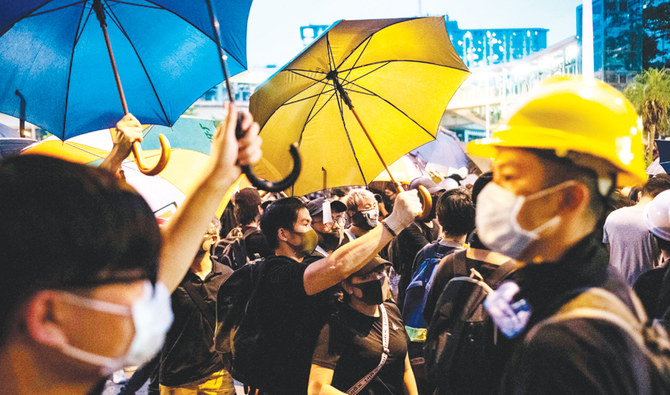
Protesters cover themselves with umbrellas as others spray graffiti on the gate of a store during an anti-parallel trading protest in Sheung Shui district in Hong Kong on Saturday. (AFP)
Updated 14 July 2019
Follow

Protests augur murky outlook for Hong Kong

  • Heritage Foundation has ranked Hong Kong the “freest economy” for 25 straight years

HONG KONG: It is still the world’s “freest” economy, one of the biggest global financial centers and a scenic haven for tycoons and tourists, but the waves of protests rocking Hong Kong are exposing strains unlikely to dissipate as Beijing’s influence grows.
The end of the former British colony’s 50-year grace period after China took control in 1997 is years away, and the protests have made only a minor dent in day-to-day business. But they point to issues clouding the outlook, as investors and residents fret that the city will lose its Western-style freedoms.
Many in Hong Kong believe their future hinges on keeping the civil liberties, independent courts and other advantages Beijing promised to preserve for at least a half-century after Britain ceded control under an arrangement dubbed “one-country, two systems.”
“We’re still talking about 28 years,” said Grant Strudwick, vice president for Asia for Pinkerton, which provides risk management services. “The spotlight is on China as to how they treat this transition period.”
Hong Kong’s economy once was about a fifth the size of China’s. Now, it is a tiny fraction of that, thanks in no small part to an industrial boom driven by Hong Kong tycoons who set up factories across the border after China opened to outside investment in the 1970s.
The territory’s success as a center for trade and investment is grounded in its independent legal system and the free flow of information, said Joseph Cheng, a political analyst and leader of a pro-democracy coalition, the Alliance for True Democracy.
“These are two important assets enabling Hong Kong to have a distinct edge over major coastal cities in China, like Shanghai, like Shenzhen,” he said.
He believes that, without further moves toward democracy, Hong Kong will likely become more unstable.
Confidence in the “one country, two systems” experiment was already feeble when the top local leader, Chief Executive Carrie Lam, put forward legislation that would allow authorities to send suspects held in Hong Kong to face trial in mainland Chinese courts that provide no assurances of independent judges, due process and other Western legal protections.
As tens and sometimes hundreds of thousands of Hong Kong residents took to the streets in protests and business groups and foreign governments registered their concerns, Lam suspended the proposed legislation.
Pro-democracy activists have pressed on with the protests, demanding she permanently withdraw the bill, order an independent inquiry into heavy-handed police tactics and resign.
On Tuesday, Lam insisted that the extradition bill was “dead.” Hong Kong’s government also issued a statement saying it does not plan to implement the “social credit” system used in the mainland to penalize and reward behavior measured using various technologies including data processing and facial recognition that critics have described as Orwellian.
Most of the demonstrations have been peaceful, though some have turned violent. Protesters vandalized the local legislative building earlier this month. Such sights might deter some investors, but they also show the city is a world apart from the rest of China, where public dissent is banned.
The protests are “part of the checks and balances in place in Hong Kong that support institutional strength,” the ratings agency Moody’s said in a recent update.
Heritage Foundation has ranked Hong Kong the “freest economy” for 25 straight years.

The city is the No. 3 financial center, according to an international survey of bankers, behind New York and London. It plays a pivotal role in financing for China and was the top location for initial public offerings in 2018, with nearly $37 billion raised.
As small as it is relative to China as a whole, Hong Kong retains an outsized strategic role for Beijing, said Ken Courtis, chairman of Starfort Investment Holdings.
If trade tensions between the US and China worsen further, leading Washington to curb financial activities of mainland companies in American markets, Hong Kong’s role for launching IPOs could grow further, he notes.
For now, it’s Hong Kong’s proximity to China, and its special status, that make it such an important location for businesses, analysts said.
Strudwick said Beijing’s efforts to build a “Greater Bay area” encompassing Hong Kong and other parts of the manufacturing-heavy Pearl River Delta are helping to integrate the territory more closely with neighbors such as Guangzhou and Shenzhen. That might help revitalize its economy, which expanded at an anemic 0.6 percent annual rate in the last quarter, battered by slowing demand and trade tensions.
While unemployment is low, bread-and-butter issues such as how to afford to live in a city with the world’s priciest real estate are adding to frustrations.
Salaries come nowhere close to matching the territory’s per capita gross domestic product of nearly $50,000 a year — a reflection of the vast disparities in wealth between those living in villas on Victoria Peak and the majority occupying tiny apartments that sell for about $24,000 per square meter.


Over 3k flights cancelled across the Middle East after attack on Iran by the US, Israel

Updated 01 March 2026
Follow

Over 3k flights cancelled across the Middle East after attack on Iran by the US, Israel

RIYADH: US and Israeli strikes on Iran led to widespread airspace shutdowns in the Middle East, canceling and rerouting thousands of flights and paralyzing key international travel corridors.

Flight cancellations affected seven airports across the Middle East, including Dubai and Abu Dhabi in the UAE, Doha in Qatar, and Manama in Bahrain.

Emirates Airlines said in a statement: “Due to multiple regional airspace closures, Emirates has temporarily suspended all operations to and from Dubai, up until 1500 hrs UAE time on Monday, 2 March.”

A flydubai spokesperson said the situation is evolving, and the airline is closely monitoring developments while coordinating with authorities to adjust its flight schedule.

“Our teams are working diligently to implement comprehensive welfare for all affected customers. The safety of our passengers and crew remains our highest priority,” the spokesperson said.

He added: “We are currently experiencing a high volume of calls and appreciate our customers’ patience while our teams work to assist everyone as quickly as possible.”

Qatar Airways announced that the airport will remain closed until at least the morning of March 2.

“Qatar Airways flights to, and from, Doha have been temporarily suspended due to the closure of Qatari airspace,” the airline said.

It added: “Qatar Airways will resume operations once the Qatar Civil Aviation Authority announces the safe reopening of Qatari airspace.”

Saudia also said in an official statement that it had canceled a number of flights due to developments in the region and the closure of airspace.

The organization said the decision was taken in line with aviation safety and security standards, noting that its Emergency Coordination Center is closely monitoring developments with relevant authorities.

Saudia urged passengers to verify the status of their flights before heading to the airport and said guests would be notified of updates through the contact details associated with their bookings.

The carrier added that further information would be announced in a subsequent statement if available.

Air Arabia also said its flights were experiencing cancellations, delays, or rerouting as a result of the evolving situation and airspace closures.

Airlines cited airspace closures and safety concerns as the main reasons for flight disruptions, urging passengers to check official channels for updates as the situation develops.

Israeli airspace also remained closed on March 1st. Israeli airline El Al said it was preparing a recovery effort to bring home Israelis stranded abroad once the airspace reopened.

Travelers were either stranded or diverted to other airports on Feb. 28 after Israel, Qatar, Syria, and Iran as well as Iraq, Kuwait and Bahrain, closed their airspace.

After the UAE announced a temporary partial airspace closure, FlightRadar24 recorded no flights over the country.

The closures affected key hub airports in Dubai, Abu Dhabi, and Doha. Emirates, Qatar Airways, and Etihad, airlines that operate from these hubs, normally handle around 90,000 passengers daily, with even more traveling to other Middle Eastern destinations, according to aviation analytics firm Cirium.

Airports hit by attacks

Two airports in the UAE reported incidents as the government there condemned what it called a “blatant attack involving Iranian ballistic missiles” on Feb.28.

Dubai International Airport, the UAE’s largest and one of the world’s busiest, reported four injuries, while Abu Dhabi’s Zayed International Airport said a drone attack killed one person and injured seven others. Strikes were also reported at Kuwait International Airport.

Though Iran did not publicly claim responsibility, the scope of retaliatory strikes that Gulf nations attributed to Iran extended beyond the US bases that it previously said it would target.

Flight delays, cancellations are likely to continue

“For travelers, there’s no way to sugarcoat this,” said Henry Harteveldt, an airline industry analyst and president of Atmosphere Research Group.

“You should prepare for delays or cancellations for the next few days as these attacks evolve and hopefully end,” he added.

To avoid conflict zones, airlines are rerouting Middle East flights over Saudi Arabia, adding hours and fuel costs, which could push ticket prices higher if the tensions persist.

The extra flights will strain air traffic controllers in the Kingdom, who may need to slow traffic for safety. Meanwhile, countries that closed their airspace will lose out on overflight fees from passing airlines.

Mike McCormick, former head of air traffic control at the FAA and now a professor at Embry-Riddle Aeronautical University, said some countries may reopen parts of their airspace in the coming days once US and Israeli officials provide airlines with details on military flight zones and Iran’s missile capabilities.

“Those countries then will be able to go through and say, ok, we can reopen this portion of our space but we’ll keep this portion of our airspace closed,” McCormick said.

“So, I think what we’ll see in the next 24 to 36 hours is how the use of airspace evolves as the kinetic activity gets more well-defined and as the capability of Iran to actually shoot missiles and create additional risk is diminished due to the attacks,” he added.

But it is unclear how long the disruption to flight operations could last. For comparison, the Israeli and US attack on Iran in June 2025 lasted 12 days.