Traders on strike across Pakistan over new IMF-proposed taxes

1 / 4
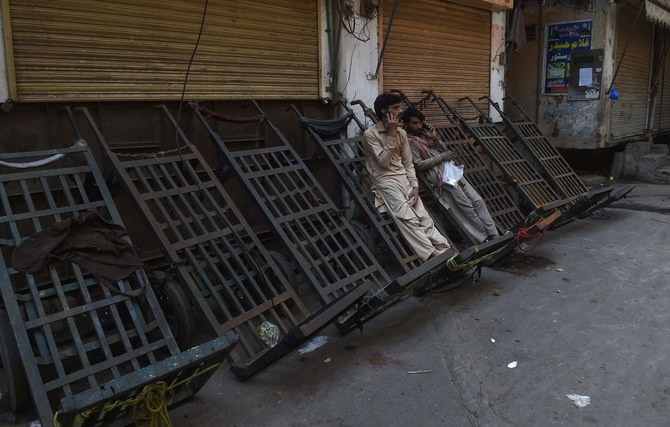
Pakistani labourers speak on a mobile phone in a shuttered market during a traders countrywide strike against the prices hike, in Lahore on July 13, 2019. (AFP)
2 / 4
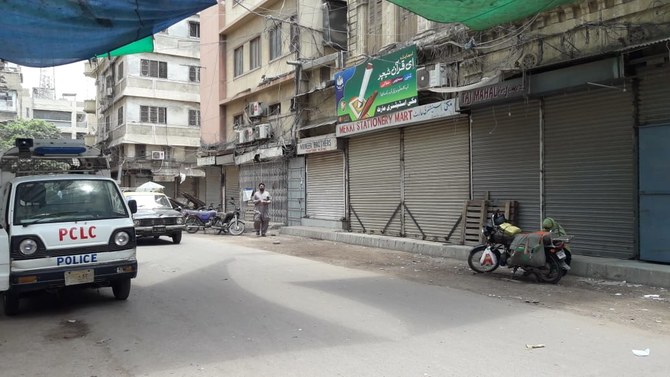
A wholesale market located in Bolton Market is photographed with shutters down during a strike called by traders against what they say is a harsh federal budget for the fiscal year 2019-20 and imposition of taxes by the Federal Board of Revenue (FBR) in Karachi, Pakistan July 13, 2019. (Photo AN)
3 / 4
Wholesale shops located in Bolton Market photographed with shutters down during a strike called by traders and the business community against what they say is a harsh federal budget for the fiscal year 2019-20 and imposition of taxes by the Federal Board of Revenue (FBR) in Karachi, Pakistan July 13, 2019. (Photo AN)
4 / 4
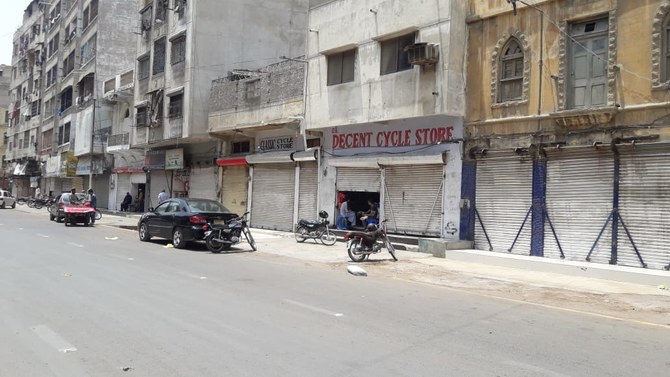
A hardware market on Karachi’s MA Jinnah Road is closed during a shutter down strike called by the business community against what they say is a harsh federal budget for the fiscal year 2019-20, and imposition of new taxes by the Federal Board of Revenue (FBR) in Karachi, Pakistan July 13, 2019. (Photo AN)
Updated 15 July 2019
Follow

Traders on strike across Pakistan over new IMF-proposed taxes

  • Almost 90% wholesale markets remained shut in Karachi, strikes in Islamabad, Rawalpindi, Lahore, and Multan
  • Protests underline pressures on government which has had to impose strict austerity measures to bolster public finances

KARACHI: Markets and wholesale merchants across Pakistan remained shut on Saturday in a strike against what traders have called ‘unjustified measures’ taken in the federal budget announced by the government last month, ostensibly as part of prior actions prescribed by the International Monetary Fund’s recent $6 billion bailout package.
While not all business associations joined the strike, the shutdown highlights the pressures facing Prime Minister Imran Khan’s government, which came to power last year promising millions of new jobs and welfare measures to help the poor. Instead, it is having to impose tough austerity measures after being forced to turn to the IMF.
Kashif Chaudhry, the president of the Markazi Tanzeem-e-Tajran Pakistan (Central Organization of Traders), called the strike a “historical” one, saying markets were closed from the northwestern Khyber Pakhtunkhwa province all the way to Karachi, the capital of the southern Sindh province.
“Closure [of markets] on a single day costs the country Rs4 billion only in the city of Karachi,” said Atiq Mir, chairman of the Karachi Tajir Itehad, an umbrella group of the city’s trade associations. “Accumulated losses would be around Rs50 billion across the country.”
Traders say they are striking against a complex new system of value added taxes, discretionary powers of tax officials, a complicated income tax system and unreal tax rates. Under the measures proposed by the IMF, the government has also agreed to close loopholes and preferential rates in sales tax on sugar, steel, edible oils and medium and large retailers, hitting many businesses.
Traders are also protesting a new condition imposed by the government that customers who spend more than Rs50,000 will have to present National Identity cards.
Shabbar Zaidi, the chairman of the Federal Board of Revenue, Pakistan’s main tax collecting agency, said on Friday the condition to present ID cards would help the government identify tax dodgers in a nation where less than 1 percent of the population of 208 million even files income tax returns.
Responding to the protests, de facto information minister Firdous Ashiq Awan said the government was ready for negotiations and considered traders its partners, but warned those who were protesting due to a “political agenda.”
“We have no political ambitions, our cause is only the traders’ cause,” Kashif Chaudhry of the Markazi Tanzeem-e-Tajran Pakistan said. “We have offered talks many times and we are still ready to talk.”
Traders in Karachi, the main commercial hub of the country, said 90 percent of the city’s wholesale markets were closed, causing the city billions in losses.
Similar strikes were called in other big business centers including the eastern city of Lahore, Rawalpindi, near the capital Islamabad, and Multan, home to a major ceramics industry.


Pakistan, global crypto exchange discuss modernizing digital payments, creating job prospects 

Updated 8 sec ago
Follow

Pakistan, global crypto exchange discuss modernizing digital payments, creating job prospects 

  • Pakistani officials, Binance team discuss coordination between Islamabad, local banks and global exchanges
  • Pakistan has attempted to tap into growing crypto market to curb illicit transactions, improve oversight

ISLAMABAD: Pakistan’s finance officials and the team of a global cryptocurrency exchange on Friday held discussions aimed at modernizing the country’s digital payments system and building local talent pipelines to meet rising demand for blockchain and Web3 skills, the finance ministry said.

The development took place during a high-level meeting between Finance Minister Muhammad Aurangzeb, Pakistan Virtual Assets Regulatory Authority (PVARA) Chairman Bilal bin Saqib, domestic bank presidents and a Binance team led by Global CEO Richard Teng. The meeting was held to advance work on Pakistan’s National Digital Asset Framework, a regulatory setup to govern Pakistan’s digital assets.

Pakistan has been moving to regulate its fast-growing crypto and digital assets market by bringing virtual asset service providers (VASPs) under a formal licensing regime. Officials say the push is aimed at curbing illicit transactions, improving oversight, and encouraging innovation in blockchain-based financial services.

“Participants reviewed opportunities to modernize Pakistan’s digital payments landscape, noting that blockchain-based systems could significantly reduce costs from the country’s $38 billion annual remittance flows,” the finance ministry said in a statement. 

“Discussions also emphasized building local talent pipelines to meet rising global demand for blockchain and Web3 skills, creating high-value employment prospects for Pakistani youth.”

Blockchain is a type of digital database that is shared, transparent and tamper-resistant. Instead of being stored on one computer, the data is kept on a distributed network of computers, making it very hard to alter or hack.

Web3 refers to the next generation of the Internet built using blockchain, focusing on giving users more control over their data, identity and digital assets rather than big tech companies controlling it.

Participants of the meeting also discussed sovereign debt tokenization, which is the process of converting a country’s debt such as government bonds, into digital tokens on a blockchain, the ministry said. 

Aurangzeb called for close coordination between the government, domestic banks and global exchanges to modernize Pakistan’s payment landscape.

Participants of the meeting also discussed considering a “time-bound amnesty” to encourage users to move assets onto regulated platforms, stressing the need for stronger verifications and a risk-mitigation system.

Pakistan has attempted in recent months to tap into the country’s growing crypto market, crack down on money laundering and terror financing, and promote responsible innovation — a move analysts say could bring an estimated $25 billion in virtual assets into the tax net.

In September, Islamabad invited international crypto exchanges and other VASPs to apply for licenses to operate in the country, a step aimed at formalizing and regulating its fast-growing digital market.