


Mobile app aims to make life easier for young parents in Egypt

The Orcas app: helping parents connect with tutors and babysitters. (Supplied photo)
Updated 13 July 2019
Follow

Mobile app aims to make life easier for young parents in Egypt

  • Since its launch in 2016, Orcas has been helping parents while also providing students with part-time work
  • The app specializes in providing tutoring, language acquisition coaching, and babysitting

CAIRO: Traditionally, couples in the Middle East feel pressured into having children early in their marriage, but it is a responsibility not many are ready for.

Quite often, parents find themselves making sacrifices, such as quitting fulltime work, in order to take care of a child.

Hossam Taher’s dream is to make life easier for young parents in Egypt through his start-up Orcas. 

Since its launch in 2016, the mobile app has been helping parents, while providing students or new graduates with part-time work.

“We’re basically an online marketplace that acts as a connector between tutors/babysitters and mothers looking for some help,” said Taher, 28, the company’s CEO and cofounder.

Orcas specializes in providing tutoring, language acquisition coaching and babysitting. The user signs up and searches by whichever language or subject they require help with. They get a host of profiles of potential candidates, with images, featuring an About Me section, ratings, reviews, and availability of the tutor, who directly accepts requests.
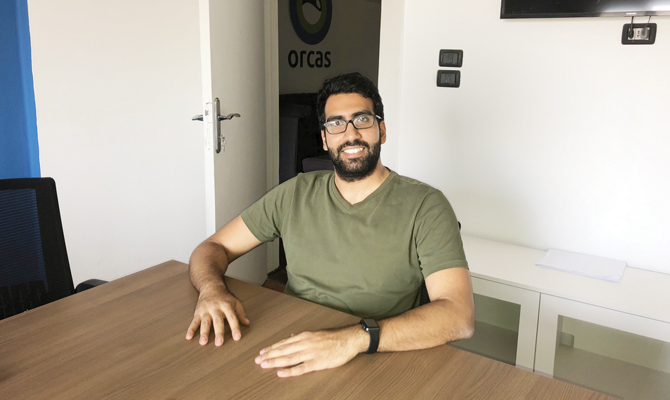


Hossam Taher, the brains behind the Orcas app. (Supplied photo)

But the service is not just for parents; students can also use it. In fact, Orcas currently has more than 20,000 students on its database.

“We started Orcas because there aren’t many job opportunities for youth in Egypt, and the culture of part-time jobs doesn’t really exist,” said Taher. “We’re sort of providing a part-time job similar to what Uber does, only this one relies more on intellect rather than the user’s own time.”

If someone is good at a subject or knows how to handle kids, and can provide a few hours per week to work as a tutor or babysitter, he or she can work with Orcas.

“We want to provide an easy solution for every father and mother out there who needs help at home with their kids, so they can focus on their careers if they want,” Taher said. 

“Couples around us with young kids might have parents living far away, and they’ll probably both be working, so they don’t really have someone to take care of the kids,” he added. “Plus no one can afford to get a fulltime nanny in this economy, so we’re trying to outsource this service.”

Users should not expect fully qualified teachers on the app; it is more about having hands-on help where playtime can be combined with educational elements.

“We’re a marketplace with a huge variety of options, and they’re all vetted. We conduct background checks and training programs for our tutors to elevate their quality,” said Taher.

“Our tutors are handpicked, and we carefully select those who are good with kids and know how to communicate a message, not to mention really good with the subject at hand.”

With a loyal and growing user base, Orcas now has its sights set beyond Egypt, and investors are taking notice of the app’s potential.

So far, the company — which currently operates in Cairo, Alexandria, El-Gouna and the North Coast — has raised $500,000 in funding, most recently from Algebra Ventures in June 2019.

“We want all young people in Egypt, and later in sub-Saharan Africa and Arab countries with similar demographics, between the ages of 17 and 24 to have gone through Orcas and taught a language or babysat for a family, making an income for themselves,” Taher said.


• This report is being published by Arab News as a partner of the Middle East Exchange, which was launched by the Mohammed bin Rashid Al Maktoum Global Initiatives and the Bill and Melinda Gates Foundation to reflect the vision of the UAE prime minister and ruler of Dubai to explore the possibility of changing the status of the Arab region.


Robert Duvall: understated actor’s actor, dead at 95

Updated 16 February 2026
Follow

Robert Duvall: understated actor’s actor, dead at 95

  • One of his most memeorable characters was the maniacal, surfing-mad Lt. Gen. William Kilgore in Francis Ford Coppola’s 1979 Vietnam War epic ‘Apocalypse Now’
  • One regret was turning down the lead part in ‘Jaws’ (which went to Roy Scheider) because he instead wanted to play the salty fisherman, a role that went to Robert Shaw

LOS ANGELES: Robert Duvall, a prolific, Oscar-winning actor who shunned glitz and won praise as one of his generation’s greatest and most versatile artists, has died at age 95.
Duvall’s death on Sunday was confirmed by his wife Luciana Duvall in a statement posted Monday on Facebook.
Duvall shone in both lead and supporting roles, and eventually became a director over a career spanning six decades. He kept acting in his 90s.
His most memorable characters included the soft-spoken, loyal mob lawyer Tom Hagen in the first two installments of “The Godfather” and the maniacal, surfing-mad Lt. Gen. William Kilgore in Francis Ford Coppola’s 1979 Vietnam War epic “Apocalypse Now.”
The latter earned Duvall an Oscar nomination and made him a bona fide star after years playing lesser roles. In it he utters what is now one of cinema’s most famous lines.
“I love the smell of napalm in the morning,” his war-loving character — bare chested, cocky and sporting a big black cowboy hat — muses as low-flying US warplanes strafe a beachfront tree line with the incendiary gel.
That character was originally created to be even more over the top — his name was at first supposed to be Col. Carnage — but Duvall had it toned down in a show of his nose-to-the-grindstone approach to acting.
“I did my homework,” Duvall told veteran talk show host Larry King in 2015. “I did my research.”
Duvall was a late bloomer in the profession — he was 31 when he delivered his breakout performance as the mysterious recluse Boo Radley in the 1962 film adaptation of Harper Lee’s novel “To Kill a Mockingbird.”
He would go on to play myriad roles — a bullying corporate executive in “Network” (1976), a Marine officer who treats his family like soldiers in “The Great Santini” (1979), and a washed-up country singer in “Tender Mercies” (1983), for which he won the Oscar for best actor. Duvall was nominated for an Oscar six other times as well.
Duvall often said his favorite role, however, was one he played in a 1989 TV mini-series — the grizzled, wise-cracking Texas Ranger-turned-cowboy Augustus McCrae in “Lonesome Dove,” based on the novel by Larry McMurtry.
Film critic Elaine Mancini once described Duvall as “the most technically proficient, the most versatile, and the most convincing actor on the screen in the United States.”
In her statement Luciana Duvall said, “to the world, he was an Academy Award-winning actor, a director, a storyteller. To me, he was simply everything. His passion for his craft was matched only by his deep love for characters, a great meal, and holding court.”

‘A lot of crap’ 

Born in 1931, the son of a Navy officer father and an amateur actress mother, Duvall studied drama before spending two years in the US Army.
He then settled in New York, where he shared an apartment with Dustin Hoffman. The pair were friends with Gene Hackman as all three worked their way up in showbiz. These were lean times for the future stars.
“Hoffman, me, my brother, three or four other actors and singers had a place on 107th and Broadway in Manhattan, uptown,” Duvall told GQ in 2014.
Duvall said he had few regrets in his career.
But one was turning down the lead part in “Jaws” (which went to Roy Scheider) because he instead wanted to play the salty fisherman, a role that went to Robert Shaw.
Director Steven Spielberg told Duvall he was too young for that part.
Duvall also admitted he took some jobs just for the money.
“I did a lot of crap,” he told The Wall Street Journal in 2017. “Television stuff. But I had to make a living.”
Duvall made his home far from the glitz and chatter of Hollywood — in rural Virginia, where his family had roots.
He and his fourth wife, Argentine-born Luciana Pedraza, 40 years his junior, lived in a nearly 300-year-old farmhouse. Duvall never had children.
He said he went to New York and Los Angeles only when necessary.
“I like a good Hollywood party,” he told the Journal. “I have a lot of friends there. But I like living here.”
And of all his storied roles, Duvall says his favorite was indeed that of the soft-hearted cowboy McCrae in “Lonesome Dove.”
“That’s my ‘Hamlet,’” he told The New York Times in 2014.
“The English have Shakespeare; the French, Moliere. In Argentina, they have Borges, but the Western is ours. I like that.”