

Greece, Turkey spar over offshore drilling in Cyprus

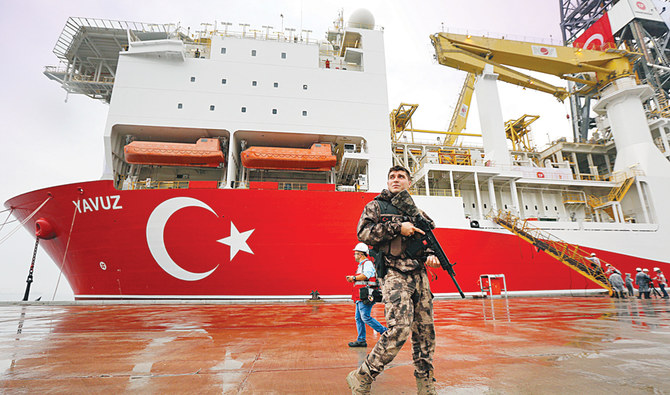
A Turkish police officer patrols the dock, backdropped by the drilling ship ‘Yavuz’ that was dispatched to the Mediterranean, at the port of Dilovas. (AP)
Updated 11 July 2019
Follow

Greece, Turkey spar over offshore drilling in Cyprus

  • In June, EU leaders warned Ankara to end drilling waters around the island or face action from the bloc

ISTANBUL: Turkey said on Wednesday it rejected Greek and EU assertions that Turkish drilling for gas and oil off Cyprus was illegitimate, and said they showed the EU could not be an impartial mediator on the Cyprus problem.
The Foreign Ministry said Turkey’s Fatih ship had started drilling to the west of the Mediterranean island at the start of May and its Yavuz ship had recently arrived east of Cyprus and would also carry out drilling.
Cyprus says Turkey’s actions are contrary to international law. Turkey and the internationally recognized government of the divided island have overlapping claims in that part of the Mediterranean, an area thought to be rich in natural gas.
The Yavuz drillship dropped anchor on Monday to the south of Cyprus’ Karpasia peninsula, a jutting northeastern panhandle. It triggered a strong protest from Nicosia and a rebuke from the EU.
In June, EU leaders warned Turkey to end drilling in waters around the island or face action from the bloc.
“We reject the statements by the Greek Foreign Ministry and EU officials which describe these activities of our country as illegitimate,” the Turkish Foreign Ministry statement said.
Cyprus was divided in 1974 after a Turkish invasion triggered by a brief Greek-inspired coup. Several peacemaking efforts have failed and the discovery of offshore resources has complicated the negotiations.
“It has become clear that the European Union is incapable of taking on a role as an impartial mediator in negotiation processes regarding a resolution to the Cyprus problem,” the ministry said.
Ankara, which does not have diplomatic relations with Cyprus, says that certain areas in Cyprus’ offshore maritime zone fall under the jurisdiction of Turkey or of Turkish Cypriots, who have their own breakaway state in the north of the island which is only recognized by Turkey.

BACKGROUND

Cyprus was divided in 1974 after a Turkish invasion triggered by a brief Greek-inspired coup. Several peacemaking efforts have failed and the discovery of offshore resources has complicated the negotiations.

Referring to the presence of Turkish drillships in the region, Cypriot government spokesman Prodromos Prodromou told Greek state television: “The Republic of Cyprus will certainly not quit its sovereign rights, and our government is mobilizing the legal and diplomatic means we have.”
Israel and Egypt also expressed unease about Turkey’s moves.
“Israel follows with serious concern recent steps taken by Turkey in the waters off Cyprus’s northeast coast," said Foreign Ministry spokesman Emmanuel Nahshon, reiterating full support for Cyprus in exercising its sovereign rights.
On Tuesday, the Egyptian Foreign Ministry said Turkey’s intention to drill “represents a continuation of unilateral measures that serve to increase tension in the Eastern Mediterranean region,” stressing the need to avoid escalation.
Israel and Egypt are among eastern Mediterranean countries that agreed this year to set up a forum to create a regional gas market and cut infrastructure costs.
Turkey’s Foreign Ministry said the Fatih ship was drilling in fields within the continental shelf that Turkey declared to the UN, and for which Turkish state energy company Turkish Petroleum (TP) had issued licenses in 2009 and 2012.
The Yavuz vessel was drilling on behalf of Cypriot Turks in a field for which TP had issued a license in 2011, it said.
It said Greece deserved the title of “Europe’s spoiled child” and that EU member Cyprus had together with Athens for years violated international law and dragged the eastern Mediterranean towards instability.
“Being a member of the European Union does not give them the right to usurp the legitimate rights and interests of Cypriot Turks,” the ministry said.


Lebanon ex-central bank chief's corruption case being sent to top court, officials say

Updated 10 sec ago
Follow

Lebanon ex-central bank chief's corruption case being sent to top court, officials say

BEIRUT: The corruption case of Lebanon's former central bank governor, who is widely blamed for the country’s economic meltdown, has been transferred to the country's highest court, judicial officials told The Associated Press on Tuesday.
Riad Salameh was released on $14 million bail in September after a year in prison while awaiting trial in Lebanon on corruption charges, including embezzlement and illicit enrichment.
The trial of Salameh, 75, and his two legal associates, Marwan Khoury and Michel Toueini, will now be heard at the Court of Cassation, according to a copy of the notice obtained by the AP. Salameh and the others will be issued with arrest warrants if they don't show up for trial at the court.
No trial date has been set yet. Salameh denies the charges. The court’s final ruling can't be appealed, according to the four officials who spoke on condition of anonymity, because they weren't authorized to speak with the media.
In September 2024, he was charged with the embezzlement of $42 million, with the court later adding charges of illicit enrichment over an apartment rented in France, supposedly to be a substitute office for the central bank if needed. Officials have said that Salameh had rented from his former romantic partner for about $500,000 annually.
He was once celebrated for steering Lebanon’s economic recovery, after a 15-year civil war, upon starting his long tenure in 1993 and keeping the fragile economy afloat during long spells of political gridlock and turmoil.
But in 2023, he left his post after three decades with several European countries investigating allegations of financial crimes. Meanwhile, much of the Lebanese blame his policies for sparking a fiscal crisis in late 2019 where depositors lost their savings, and the value of the local currency collapsed.
On top of the inquiry in Lebanon, he is being investigated by a handful of European countries over various corruption charges. In August 2023, the United States, United Kingdom and Canada imposed sanctions on Salameh.
Salameh has repeatedly denied allegations of corruption, embezzlement and illicit enrichment. He insists that his wealth comes from inherited properties, investments and his previous job as an investment banker at Merrill Lynch.
Lebanon’s current central bank governor, Karim Souaid, announced last week that he's filing legal complaints against a former central bank governor and former banking official who diverted funds from the bank to what he said were four shell companies in the Cayman Islands. He didn't name either individual.
But Souaid said that Lebanon's central bank would become a plaintiff in the country's investigation into Forry Associates. The U.S. Treasury, upon sanctioning Salameh and his associates, described Forry Associates as “a shell company owned by Raja (Salameh’s brother) in the British Virgin Islands” used to divert about $330 million in transactions related to the central bank.
Several European countries, among them France, Germany, and Luxembourg, have been investigating the matter, freezing bank accounts and assets related to Salameh and his associates, with little to no cooperation from the central bank and Lebanese authorities.
Souaid said that he will travel later this month to Paris to exchange “highly sensitive” information as France continues its inquiries.