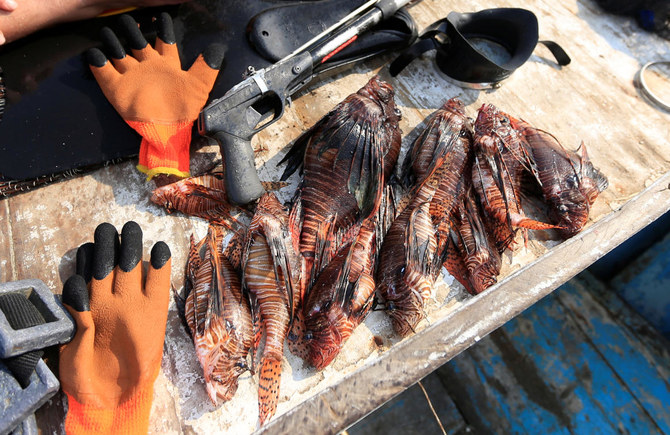
SARAFAND: Lebanese fisherman Hassan Younes has been diving the same waters off his coastal hometown for three decades but has never seen anything like this year as native species disappear and invasive lionfish take their place.
Gone are the days when he used to boast an abundant catch of red lobster, sea urchin and red mullet. Now he counts himself lucky if he catches a sea bass.
What is abundant, however, are lionfish: a predatory venomous fish native to the Red Sea, and Indo-Pacific region that eat smaller fish, crustaceans and even each other.
Environmentalists and marine biologists say because of the 2015 expansion and deepening of the Suez Canal, which connects the Red Sea and the Mediterranean, and warming waters resulting from global climate change, lionfish have made a new home for themselves in the Mediterranean.
The rapid expansion of the lionfish is also being felt more widely, threatening coral reefs and fish stocks.
The United States’ National Oceanic and Atmospheric Administration (NOAA), said their populations have swelled dramatically in the past 15 years, partly as a result of people releasing unwanted fish from home aquariums, and they are harming native coral reefs in the Atlantic, Gulf of Mexico and Caribbean.
“This sea is not the sea we grew up with,” Younes said on a recent morning out on his boat.
“Many times, we go out to sea and come back emptyhanded. We don’t even make enough to cover the price of diesel,” he said.
The fish, with venomous wing-like fins and spines, was first sighted in the Mediterranean in 1991, then not again until 2012 off the coast of southern Lebanon. Since 2015 it has steadily spread across the region, said marine biologist Jason Hall-Spencer.
“Like genocide”
Fisherman Atallah Siblini, who specializes in spearhunting, said he started seeing the fish three years ago but it was rare.
“Now it is like 30 to 50 of them in one place. They started to scare away the other fish including sea bass which we depend on and they eat everything.”
“It is like genocide.”
Environmentalists in Lebanon say the livelihoods of the fishermen and the survival of the marine ecosystem maybe depend on people eating lionfish.
The spread of the fish has been especially hard on Lebanon’s marine ecosystem already weakened by decades of overfishing, pollution and urbanization
“It eats a lot and breeds all year long so it is very easy for it to disturb the ecological balance,” said Jina Talj, an environmentalist.
“But luckily for us, it is also one of the tastiest types of fish,” added Talj, who runs a campaign to encourage people to eat lionfish, which tastes like sea bass. So far, it is mainly the fishermen who have heeded the call but Talj hopes her campaign can help.
Her NGO, Diaries of the Ocean, has government recognition but receives no funding and relies on volunteers.
“The biggest problem we face is lack of knowledge among the public about the sea. So how can we save it if we don’t know what we have?” she said.
The invasive fish spawn every four days and can lay up to two million eggs every year capable of surviving ocean drifts.
Hall-Spencer says the spread this year has been in “plague-like proportions” across the Eastern Mediterranean including Greece, Turkey, Israel and Cyprus which has just launched a cull.
To curb the problem in the long term, he would like to see the construction of a salt water lock in the Suez Canal — an area of very salty water which would stop species moving from one sea to the other.
But until then, the best thing to do is to catch the lionfish “and also celebrate the fact that they are good to eat,” he said.


![]()
![]()
![]()

As waters warm, lionfish invasion strains Lebanon’s seas


As waters warm, lionfish invasion strains Lebanon’s seas
- Lionfish have made a new home for themselves in the Mediterranean
Latest updates


Recommended


© 2026 SAUDI RESEARCH & PUBLISHING COMPANY, All Rights Reserved And subject to Terms of Use Agreement.