Saudi Aramco awards $18bn in contracts to expand offshore capabilities

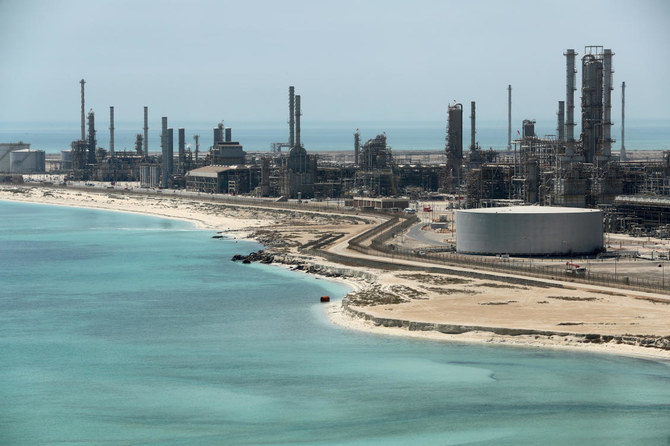
File photo of Saudi Aramco's Ras Tanura oil refinery and oil terminal in Saudi Arabia May 21, 2018. (Reuters/File Photo)
Updated 09 July 2019
Follow

Saudi Aramco awards $18bn in contracts to expand offshore capabilities

  • Aramco says 16 local and international companies were chosen out of 90 invited to bid
  • Contractors working on the projects will be required to maximize their purchases of material and equipment from Saudi suppliers and manufacturers

RIYADH: Saudi Arabia’s oil company Aramco has awarded $18 billion in contracts to expand oil and gas capacity at two of its fields, with Saudi companies being granted half of the awarded contracts.

Aramco said in a statement on Tuesday it had awarded 34 contracts for engineering, procurement and construction at the Majran and Berri offshore fields to expand crude oil production by 550,000 barrels per day and gas by 2.5 billion standard cubic feet per day.

Aramco says 16 local and international companies were chosen out of 90 invited to bid on the packages.

Contractors working on the projects will be required to maximize their purchases of material and equipment from Saudi suppliers and manufacturers. Aramco says the projects are also expected to create thousands of local jobs.

“These two programs will significantly enhance Saudi Aramco’s oil production and gas processing capabilities, both strengthening our position as the leading integrated energy supplier and meeting growing long-term demand for petroleum,” said Amin H. Nasser, president and CEO of Saudi Aramco.

“These investments will support our continued focus on employing best-in-class technologies, well completion, and reservoir management practices. It will enable Saudi Aramco to further reduce the carbon intensity of our crude oils, supporting our strategy of reducing emissions while providing energy to those who need it,” he added.

The Marjran program is an integrated development project for oil, associated gas, non-associated gas and cap gas from offshore fields, while the Berri increment program plans to add 250,000 barrels of Arabian Light Crude per day from its offshore oilfield.

(With AP)


Saudi ministry launches private sector tender to operate sports venues in Makkah region

Updated 7 sec ago
Follow

Saudi ministry launches private sector tender to operate sports venues in Makkah region

RIYADH: New investment opportunities in athletic facilities across the Makkah region have been launched as Saudi Arabia looks to expands private sector participation in the sports economy and improve the commercial performance of its stadiums.

The Kingdom’s Ministry of Sport announced the offering under its “Sports Facilities Investment” initiative, inviting qualified companies to bid for a three-year contract to operate and manage multiple venues, including King Abdullah Sports City Stadium in Jeddah, Prince Abdullah Al-Faisal Stadium in Jeddah, King Abdulaziz Stadium in Makkah, and the indoor arena at King Abdullah Sports City.

The initiative comes amid a wider push by Saudi Arabia to maximize the commercial value of its sports infrastructure as the Kingdom prepares for major international tournaments and expands its domestic sports economy.

Under the proposed arrangement, the selected operator will manage matches, events, and daily venue services to enhance fan experiences and operational quality, while the ministry will retain responsibility for maintenance and oversight. The model is designed to expand partnerships with the private sector and improve the year-round utilization of sports infrastructure.

The investment opportunity offers multiple revenue streams, including ticket sales, food and beverage concessions, and hospitality services, as well as advertising and venue naming rights, excluding King Abdullah Sports City Stadium, and the ability to host non-sporting events and community activities.

Francesca Petriccione, an international sports lawyer and professor at the University of Milan, said the initiative reflects a broader strategy to transform stadiums into long-term economic assets rather than facilities used only for sporting competitions.

“These stadiums are being developed as long-term economic assets rather than simply event venues,” Petriccione told Arab News. “The infrastructure strategy is not only about match-day capacity but also about commercial activation outside football.”

Petriccione advises leading international football clubs on strategic expansion projects in the Middle East, particularly in Saudi Arabia. Her work focuses primarily on football club acquisitions and cross-border investment in the sports sector.

She explained that the Kingdom’s broader sports infrastructure program, linked to its 2034 FIFA World Cup bid, demonstrates a portfolio approach to stadium development.

“Saudi Arabia’s plan is built around 15 proposed stadiums across five cities, including four existing venues, three already under construction and eight planned new builds,” Petriccione said. “The ministry is trying to avoid the classic white elephant problem by embedding stadiums within a broader utilization model.”

According to the professor, the Kingdom’s stadium program is designed to support both international tournament hosting and long-term infrastructure development.

“The ministry is not simply refurbishing legacy stock but selectively creating a next-generation venue network for top-tier international events,” she said.

Petriccione added that the nation’s approach emphasizes multi-purpose venues capable of hosting concerts, conferences and other large-scale events in addition to football matches, improving utilization rates and strengthening the financial model of sports infrastructure.

“Modern stadiums are financially stronger when they function as experience and events platforms rather than simply football grounds,” she said.

Some venues are also being integrated into larger urban development strategies and tourism ecosystems rather than built as standalone athletic projects, aligning sports infrastructure with broader real estate and destination planning. 

Petriccione noted that the ministry’s decision to invite private companies to operate and manage facilities signals a gradual shift toward commercially driven management structures. 

“The value is not only in construction — it also lies in operations, facility management, venue technology, hospitality, naming rights, premium seating and non-match-day monetization,” Petriccione said.

The ministry said the investment initiative aims to create a scalable operating model that could later be applied to additional sports facilities across the Kingdom, while increasing financial efficiency, enhancing commercial rights activation and generating new revenue streams for the sports sector.