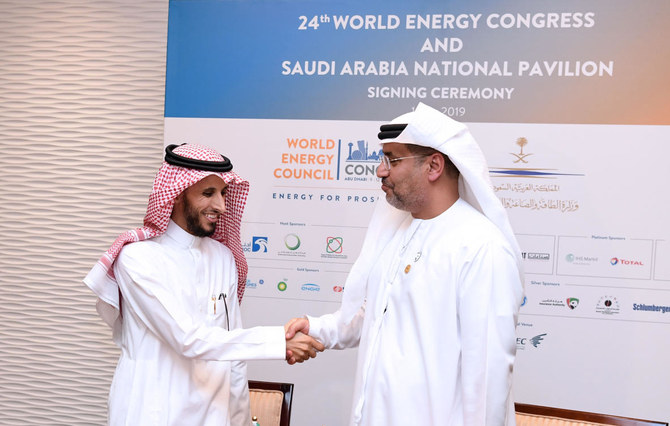
Saudi Arabia to stage largest pavilion at 24th World Energy Congress in Abu Dhabi 

Saudi Arabia will host a 1,400 square meter pavilion, presenting the services of over 20 organizations from the energy sector. (Emirates News Agency)
Updated 05 July 2019
Follow

Saudi Arabia to stage largest pavilion at 24th World Energy Congress in Abu Dhabi 

  • Saudi organizations including Saudi Aramco, SABIC, Saudi Electricity, ACWA Power, KAPSARC, SAGIA, the King Abdul Aziz City for Science and Technology and KACARE are expected to participate
  • Saudi Arabia will host a 1,400 square meter pavilion, presenting the services of over 20 organizations from the energy sector

RIYADH: Saudi Arabia will have the largest pavilion at the 24th World Energy Congress in Abu Dhabi, the UAE.
The minister of energy, industry and mineral resources, Khalid Al-Falih, will lead the Kingdom’s delegation.
Saudi Arabia will host a 1,400 square meter pavilion, presenting the services of over 20 organizations from the energy sector.
Saudi organizations including Saudi Aramco, SABIC, Saudi Electricity, ACWA Power, KAPSARC, SAGIA, the King Abdul Aziz City for Science and Technology and KACARE are expected to participate.
The congress, which will be be held between 9-12 Sept at the Abu Dhabi National Exhibition Center, will see a range of high-profile speakers from Saudi Arabia share their expertise with delegates.
These speakers include industry leaders such as Abdul-Aziz bin Salman, state minister for energy affairs, Khalid Al-Falih, minister of energy, industry and mineral resources, Amin Nasser, president and CEO of Saudi Aramco, Amin Bin Mohammed Al-Shibani, general director of the Saudi National Renewable Energy Program, Mohammad Abunayyan, chairman of ACWA Power International, Khalid bin Saleh Al-Sultan, president of KACARE and Adam Edward Sieminski, president of the King Abdullah Petroleum Studies and Research Center. 
The congress will be attended by more than 10,000 energy stakeholders from around the world. 
Being held under the theme “Energy for Prosperity,” the congress will be a global leadership forum that drives dialogue on critical issues facing the energy sector and defines the strategy for a sustainable energy future.


Saudi Arabia’s KAUST named FIFA’s first research institute in MENA

The canal in the King Abdullah University of Science and Technology campus. (Shutterstock)
Updated 10 February 2026
Follow

Saudi Arabia’s KAUST named FIFA’s first research institute in MENA

  • KAUST President Prof. Sir Edward Byrne said that the university’s selection as the fifth FIFA Research Institute in the world — and the first in the region — marks a significant achievement, reflecting Kingdom’s growing presence in international football

RIYADH: FIFA has designated the King Abdullah University of Science and Technology as its first research institute in the Middle East and Asia to support the development of innovative football research, the Saudi Press Agency reported on Tuesday.

The recognition highlights KAUST’s commitment to integrating sports, academic research and industry through advanced, high-level initiatives grounded in rigorous scientific methodologies, contributing to the advancement of football studies.

KAUST President Prof. Sir Edward Byrne said that the university’s selection as the fifth FIFA Research Institute in the world — and the first in the region — marks a significant achievement, reflecting Saudi Arabia’s growing presence in international football.

The accreditation aligns with national efforts to invest in research and development and promote the knowledge economy, supporting Saudi Vision 2030’s goals of building an advanced sports system based on innovation and sustainability.

The collaboration’s first project focuses on developing advanced AI algorithms to analyze historical FIFA World Cup broadcast footage, transforming decades of match videos into structured, searchable data, according to the KAUST website.

This work opens new opportunities to apply state-of-the-art computer vision techniques and deepen understanding of how football has evolved over time.

The second project uses player and ball tracking data from the FIFA World Cup 2022 in Qatar and the FIFA Women’s World Cup 2023 in Australia and New Zealand to compile comprehensive datasets capturing in-game dynamics.

These datasets provide deeper insights into human movement, playing techniques and performance dynamics through AI-driven analysis.