GENEVA: The Red Cross warned Thursday that displaced people in and around Syria's Al-Hol camp were facing an "apocalyptic" conditions, urging countries to quickly repatriate family members of suspected foreign fighters.
The International Committee of the Red Cross warned of the extreme difficulties facing those left behind after the last vestige of the Daesh self-proclaimed caliphate collapsed in northeastern Syria in March.
Around 100,000 people in Al-Hol and surrounding camps, "are kept in a kind of legal limbo in an unstable place, in a disputed area", Fabrizio Carboni, who heads the ICRC's Near and Middle East operations, told reporters in Geneva.
"One hundred thousand people who spent the last months, if not years, under the bombs, starved, wounded, sick, traumatised," he said, adding: "It is just apocalyptic."
The Red Cross is one of the main humanitarian organisations providing assistance inside the overfilled Al-Hol camp, which is housing more than 70,000 people, including more than 11,000 family members of suspected Daesh fighters from dozens of countries.
The issue of whether to repatriate nationals who are family members of suspected jihadists has been a thorny one for Western nations, which have experienced attacks by homegrown extremists and have little interest in seeing more return.
Britain has gone so far as stripping Daesh members of citizenship, while France has said it will only repatriate children and evaluate cases individually.
"Our position is to say to states ' take your nationals back'," Carboni said, condemning the stigmatisation of people, especially children, and efforts to create "categories of good victims and bad victims".
"As if kids can be something else than just victims."
Carboni said two thirds of the residents in Al-Hol were children, mainly under 12, insisting it was unconscionable to leave them there.
"You don't leave kids in the middle of nowhere exposed to extreme heat, extreme cold, violence," he said.
He warned that countries needed to recognise that "at one stage there will be a price to pay," and that if they put off dealing with this issue, "it is going to be higher".
ICRC, which runs a field hospital in Al-Hol, provides food, water and builds latrines, is doing its best to address the needs of the people stuck in a desperate situation in and around the camp, Carboni said.
"But nobody should expect the ICRC to deal with 100,000... for the next 25-30 years," he said. "This is states' responsibility."
He acknowledged that for many countries, repatriating family members of suspected jihadists is "politically toxic", but urged government to take responsibility.
Some of the countries which today are reluctant to bring home children in Al-Hol "have for decades defended (the principle) that kids are victims and cannot be considered as combatants", he said.
Their foot-dragging on the issue today, he said, "doesn't look good".

Conditions in Syria’s Al-Hol camp ’apocalyptic’: Red Cross
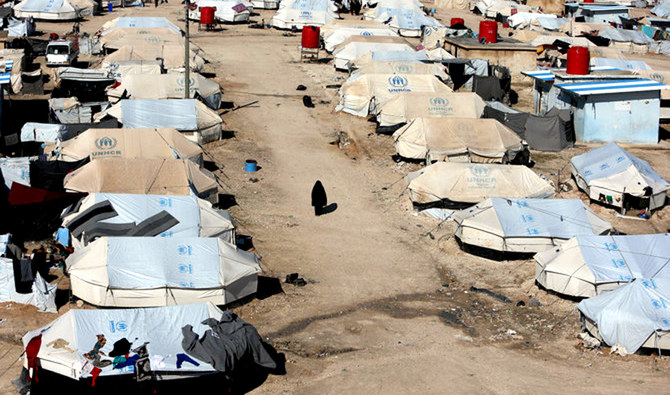
- The issue of whether to repatriate nationals who are family members of suspected jihadists has been a thorny one for Western nations
Syria’s Kurdish fighters agree to leave Aleppo after deadly clashes
- Syria’s official SANA news agency reported that “buses carrying the last batch of members of the SDF organization have left the Sheikh Maqsud neighborhood in Aleppo, heading toward northeastern Syria”
ALEPPO: Syria’s Kurdish fighters said Sunday that they agreed under a ceasefire to withdraw from Aleppo after days of fighting government forces in the city.
Hours earlier, Syria’s military said it had finished operations in the Kurdish-held Sheikh Maqsud neighborhood with state television reporting that Kurdish fighters who surrendered were being bused to the north.
The military had already announced its seizure of Aleppo’s other Kurdish-held neighborhood, Ashrafiyeh.
Kurdish forces had controlled pockets of Syria’s second city Aleppo and operate a de facto autonomous administration across swathes of the north and northeast, much of it captured during the 14-year civil war.
The latest clashes erupted after negotiations to integrate the Kurds into the country’s new government stalled.
“We reached an understanding that led to a ceasefire and secured the evacuation of the martyrs, the wounded, the trapped civilians and the fighters from Ashrafiyeh and Sheikh Maqsud neighborhoods to northern and eastern Syria,” the Kurdish-led Syrian Democratic Forces (SDF) wrote in a statement.
Syria’s official SANA news agency reported that “buses carrying the last batch of members of the SDF organization have left the Sheikh Maqsud neighborhood in Aleppo, heading toward northeastern Syria.”
The SDF initially denied its fighters were leaving, describing the bus transfers as forced displacement of civilians.
An AFP correspondent saw at least five buses on Saturday carrying men out of Sheikh Maqsud, but could not independently verify their identities.
According to the SDF statement, the ceasefire was reached “through the mediation of international parties to stop the attacks and violations against our people in Aleppo.”
The United States and European Union both called for the Syrian government and Kurdish authorities to return to political dialogue.
The fighting, some of the most intense since the ousting of long-time ruler Bashar Assad in December 2024, has killed at least 21 civilians, according to figures from both sides, while Aleppo’s governor said 155,000 people fled their homes.
Both sides blamed the other for starting the clashes on Tuesday.
Children ‘still inside’
On the outskirts of Sheikh Maqsud, families who had been trapped by the fighting were leaving, accompanied by Syrian security forces.
An AFP correspondent saw men carrying children on their backs board buses headed to shelters.
Dozens of young men in civilian clothing were separated from the crowd, with security forces making them sit on the ground before transporting them to an unknown destination, according to the correspondent.
A Syrian security official told AFP on condition of anonymity that the young men were “fighters” being “transferred to Syrian detention centers.”
At the entrance to the district, 60-year-old Imad Al-Ahmad was heading in the opposite direction, trying to seek permission to return home.
“I left four days ago...I took refuge at my sister’s house,” he told AFP. “I don’t know if we’ll be able to return today.”
Nahed Mohammad Qassab, a 40-year-old widow also waiting to return, said she left before the fighting to attend a funeral.
“My three children are still inside, at my neighbor’s house. I want to get them out,” she said.
A flight suspension at Aleppo airport was extended until further notice.
‘Return to dialogue’
US envoy Tom Barrack met Syrian President Ahmed Al-Sharaa on Saturday, and afterwards called for a “return to dialogue” with the Kurds in accordance with the integration framework agreed in March.
The deal was meant to be implemented last year, but differences, including Kurdish demands for decentralized rule, stymied progress as Damascus repeatedly rejected the idea.
The fighting in Aleppo raised fears of a regional escalation, with neighboring Turkiye, a close ally of Syria’s new Islamist authorities, saying it was ready to intervene. Israel has sided with the Kurdish forces.
The clashes have also tested the Syrian authorities’ ability to reunify the country after the brutal civil war and commitment to protecting minorities, after sectarian bloodshed rocked the country’s Alawite and Druze communities last year.


