Iran Guards chief says enemy focused on economic conflict

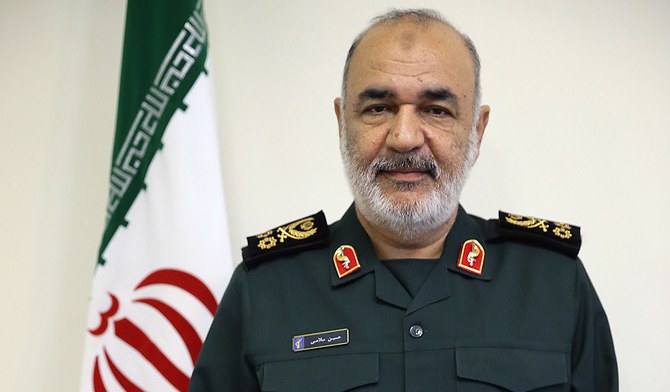
Major General Hossein Salami has been quoted as saying that the path for the enemy has been completely closed in the military sphere. (File/AFP)
Updated 03 July 2019
Follow

Iran Guards chief says enemy focused on economic conflict

  • Tensions between the United States and Iran have increased since Trump pulled Washington out of a nuclear deal last year
  • Last month the United States came as close as it has ever come to bombing Iran

GENEVA: The head of Iran’s elite Revolutionary Guards said on Wednesday the enemy was worried about the prospect of war and was focused instead on an economic conflict, according to the semi-official Fars news agency.
Tensions between the United States and Iran have increased since Trump pulled Washington out of a nuclear deal last year and moved to bar all international sales of Iranian oil.
Last month the United States came as close as it has ever come to bombing Iran, when President Donald Trump aborted a retaliatory air strike minutes before impact. Trump said he decided the strike, to punish Iran for shooting down a drone, would have killed too many people.
“In the military sphere, we have completely closed the path for the enemy,” Major General Hossein Salami was quoted as saying.
“In the current situation it is the enemies who are worried about the outbreak of war and this worry is apparent in their physical and tactical behavior ... At the current crossroads, economic war is the main field for the enemy to confront us,” he added.


Second US aircraft carrier is being sent to the Middle East, AP source says

Updated 57 min 57 sec ago
Follow

Second US aircraft carrier is being sent to the Middle East, AP source says

  • Move by the USS Gerald R. Ford, first reported by The New York Times, will put two carriers and their accompanying warships in the region
  • Trump told Axios earlier this week that he was considering sending a second carrier strike group to the Middle East

WASHINGTON: The world’s largest aircraft carrier has been ordered to sail from the Caribbean Sea to the Middle East, a person familiar with the plans said Thursday, as US President Donald Trump considers whether to take possible military action against Iran.
The move by the USS Gerald R. Ford, first reported by The New York Times, will put two carriers and their accompanying warships in the region as Trump increases pressure on Iran to make a deal over its nuclear program. The person spoke on condition of anonymity to discuss military movements.
The USS Abraham Lincoln aircraft carrier and three guided-missile destroyers arrived in the Middle East more than two weeks ago.
It marks a quick turnaround for the USS Ford, which Trump sent from the Mediterranean Sea to the Caribbean last October as the administration build up a huge military presence in the leadup to the surprise raid last month that captured then-Venezuelan President Nicolas Maduro.
It also appears to be at odds with Trump’s national security strategy, which put an emphasis on the Western Hemisphere over other parts of the world.
Trump on Thursday warned Iran that failure to reach a deal with his administration would be “very traumatic.” Iran and the United States held indirect talks in Oman last week.
“I guess over the next month, something like that,” Trump said in response to a question about his timeline for striking a deal with Iran on its nuclear program. “It should happen quickly. They should agree very quickly.”
Trump told Axios earlier this week that he was considering sending a second carrier strike group to the Middle East.
Trump held lengthy talks with Israeli Prime Minister Benjamin Netanyahu on Wednesday and said he insisted to Israel’s leader that negotiations with Iran needed to continue. Netanyahu is urging the administration to press Tehran to scale back its ballistic missile program and end its support for militant groups such as Hamas and Hezbollah as part of any deal.
The USS Ford set out on deployment in late June 2025, which means the crew will have been deployed for eight months in two weeks time. While it is unclear how long the ship will remain in the Middle East, the move sets the crew up for an usually long deployment.
The White House didn’t immediately respond to a request for comment.