Airstrike on Libyan migrant center kills 44 sparking international condemnation

1 / 4
Military officers of the Libyan Government of National Accord inspect debris at a migrant detention center in Tripoli's Tajoura suburb after an airstrike killed dozens of people. (AFP)
2 / 4
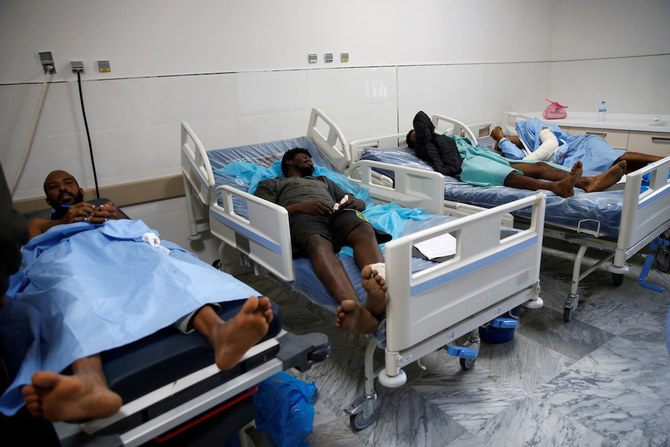
Wounded migrants lie on hospital beds after an air strike hit a detention center for mainly African migrants in Tajoura. (Reuters)
3 / 4
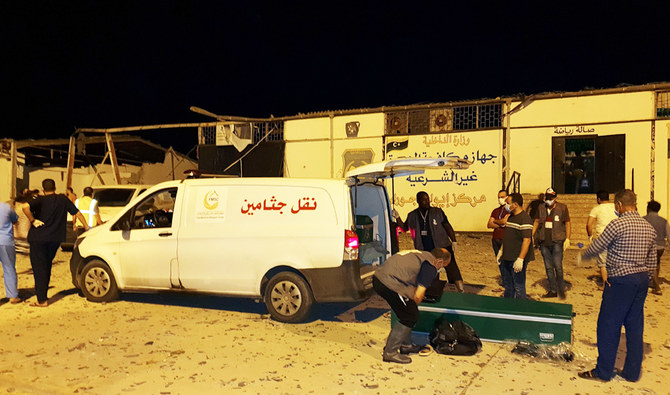
Emergency workers arrive to the scene were an airstrike killed nearly 40 at Tajoura Detention Center, east of Tripoli on early July 3, 2019. (AFP)
4 / 4
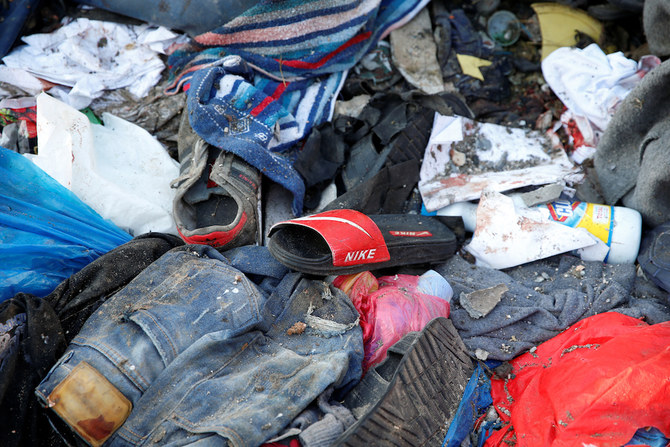
Belongings of migrants are seen at a detention center hit by an airstrike in the Tajoura suburb of Tripoli. (Reuters)
Updated 03 July 2019
Follow

Airstrike on Libyan migrant center kills 44 sparking international condemnation

  • The airstrike on the detention center in Tripoli’s Tajoura neighborhood also wounded 80 migrants
  • The Arab league, UN and European Union all condemn the attack, which tool place as fighting continues in Libya's capital

TRIPOLI: Outrage and calls for an independent probe mounted Wednesday as 44 migrants were killed in an air strike on a detention center in Libya that the UN said could constitute a war crime.
UN chief Antonio Guterres denounced the “horrendous” attack and demanded an independent investigation as the Security Council said it would hold urgent talks about the situation in the country.
Libya’s internationally-recognized government and rival commander Khalifa Haftar traded blame for the deadly assault, which the European Union called a “horrific” attack.
Bodies were strewn on the floor of a hangar in the Tripoli suburb of Tajoura, mixed with the blood-soaked clothes of migrants, an AFP photographer said.
“There were bodies, blood and pieces of flesh everywhere,” a survivor, 26-year-old Al-Mahdi Hafyan from Morocco, told AFP from his hospital bed where he was being treated for a leg wound.
Hafyan said he had been detained in the center for three months, after coming to Libya with a fellow Moroccan hoping to reach Europe across the Mediterranean.
His friend survived the attack unscathed, but his T-shirt was stained with other people’s blood. “We were lucky. We were at the back of the hanger.”
Tuesday night’s strike left a hole around three meters (10 feet) in diameter in the hangar, surrounded by debris ripped from the metal structure by the force of the blast.
At least 44 people were killed and more than 130 severely wounded, the UN said.
The UN shared the coordinates of the Tajoura center east of Tripoli with the warring sides to ensure that civilians sheltering there were safe, Guterres said.
UN envoy to Libya Ghassan Salame said the “attack clearly could constitute a war crime, as it killed by surprise innocent people whose dire conditions forced them to be in that shelter.”
The Arab League secretary general Ahmed Aboul Gheit stressed the need "of sparing civilians from the ongoing military actions around Tripoli, and maintaining the safety of civilians facilities and infrastructure."
Around 600 migrants and refugees were held in the Tajoura center, the compound’s head Noureddine Al-Grifi said, adding that people were wounded in another hangar.
There was no immediate claim of responsibility.
But the Tripoli-based Government of National Accord (GNA) denounced the attack as a “heinous crime” and blamed it on the Haftar, who in early April launched an offensive to seize the capital.
Wednesday evening a spokesman for Haftar’s Libyan National Army (LNA) said: “The (pro-Haftar) forces deny their responsibility in the attack on the migrant center of Tajoura.”
Ahmad Al-Mesmari blamed the attack on the GNA, accusing it of “plotting” against the LNA.
“We never target civilians. Our armed forces are professional and accurate in their strikes,” Mesmari said, calling for an investigation into the carnage.
The United States condemned an “abhorrent” attack and urged a “de-escalation,” the State Department said.
The European Union — echoing many countries and international organizations — called for an independent probe.
“Those responsible should be held to account,” an EU statement said.
The suburb of Tajoura, which has several military sites belonging to pro-GNA armed groups, is regularly targeted in air raids by Haftar’s forces.
The UN refugee agency deplored the attack.
“Migrants and refugees must NOT be detained; civilians must NOT be a target; Libya is NOT a safe place of return” for migrants and refugees, UNHCR head Filippo Grandi tweeted.
Charlie Yaxley, a spokesperson in Geneva, said the UNHCR had asked that the center be evacuated a few weeks ago after “a near miss from a similar air strike.”
The center was thought to have been used to store weapons, he added.
The UN’s mission in Libya has said around 3,500 migrants and refugees held in detention centers near the combat zone are at risk.
Wracked by chaos since the 2011 uprising against dictator Muammar Qaddafi, Libya has become a major conduit for migrants seeking to reach Europe and remains prey to numerous militias vying for control of the country’s oil wealth.
Also on Wednesday, air traffic was halted at the Libyan capital's only functioning airport, Mitiga, after an air strike, according to a post on the airport authorities' Facebook page.
Rights groups say migrants face horrifying abuses in Libya, and their plight has worsened since Haftar launched the offensive against Tripoli.
More than 700 people have been killed and 4,000 wounded since the assault began in early April, while nearly 100,000 have been displaced, according to UN agencies.
The two rival camps accuse each other of using foreign mercenaries and enjoying military support — especially air backing — from foreign powers.
Late Wednesday flights were suspended at Mitiga, Tripoli’s only functioning airport, a statement by airport authorities said, after Haftar’s forces launched an air strike on the facility.
A security source said the raid caused no casualties or damage.
LNA spokesman Mesmari said a “drone command center” at Mitiga was destroyed in the raid.



Hamas says it will dissolve its Gaza government when new Palestinian body takes over

Updated 1 sec ago
Follow

Hamas says it will dissolve its Gaza government when new Palestinian body takes over

CAIRO: Hamas said Sunday it will dissolve its existing government in Gaza once a Palestinian technocratic leadership committee takes over the territory, as mandated under the US-brokered peace plan. But the group gave no specifics on when the change will occur.
Hamas and the rival Palestinian Authority, the Palestinians’ internationally recognized representative, have not announced the names of the technocrats, who are not supposed to be politically affiliated, and it remains unclear if they will be cleared by Israel and the US
The “Board of Peace,” an international body led by Trump, is supposed to oversee the government and other aspects of the ceasefire that took effect on Oct. 10, including disarming Hamas and deploying an international security force. The board’s members have not been announced.
Meanwhile, the post-ceasefire death toll continued to rise in Gaza, with Israeli gunfire killing three Palestinians, according to Palestinian hospital officials.
The ceasefire began with a halt in fighting and the release of hostages held in Gaza in exchange for thousands of Palestinians held by Israel. The deal is still in its first phase as efforts continue to recover the remains of the final hostage left in Gaza.
An Egyptian official, who spoke on condition of anonymity to discuss closed-door information, said Hamas was sending a delegation to talks with Egyptian, Qatari and Turkish officials about moving to the second phase.
Future Gaza governance in flux
In comments posted on his Telegram channel Sunday, Hazem Kassem, a Hamas spokesperson, called for speeding up the establishment of the technocratic committee.
The Egyptian official said Hamas will meet with other Palestinian factions this week to finalize the committee’s formation. The Hamas delegation will be chaired by top negotiator Khalil Al-Hayya, the official said.
Trump has said the “Board of Peace ” will monitor the committee and handle the disarmament of Hamas, the deployment of an international security force, additional pullbacks of Israeli troops and Gaza’s reconstruction. The US has reported little progress on any of these fronts, though the members of the board are expected to be announced this week.
Israeli Prime Minister Benjamin Netanyahu said Thursday that Bulgarian diplomat Nickolay Mladenov has been selected as the board’s director-general. Mladenov is a former Bulgarian defense and foreign minister who served as UN envoy to Iraq before being appointed as the UN Mideast peace envoy from 2015 to 2020. During that time, he had good working relations with Israel and frequently worked to ease Israel-Hamas tensions.
Also Sunday, Israel’s Foreign Minister Gideon Saar met in Jerusalem with Japanese Foreign Minister Toshimitsu Motegi. Saar said Israel was committed to enforcing Trump’s plan, while Motegi expressed Japan’s willingness to play an active role in the ceasefire.
According to Japan’s Foreign Ministry, Motegi visited the Civil-Military Coordination Center, where the ceasefire is being monitored. He was also set to meet Netanyahu and Palestinian officials in the Israeli-occupied West Bank.
Violence in Gaza continues
In Gaza, two men were shot dead in the southern town of Bani Suhaila, according to Nasser Hospital, which received the bodies. Earlier Sunday, a man was killed by Israeli gunfire in the Tuffah neighborhood of Gaza City, according to Al-Ahly hospital, which received the body.
In response to questions about the Tuffah incident, Israel’s military said it had fired at and hit a “terrorist” in northern Gaza who had approached troops. In a later statement, the military said it had killed a “terrorist” in southern Gaza who approached troops.
Israel and Hamas have accused each other of violating the ceasefire. Continued Israeli strikes in Gaza have killed more than 400 Palestinians, according to local health officials.
The Israeli military says any actions since the ceasefire began have been in response to violations of the agreement.
Israeli police detain top official
Israeli police said Sunday they were questioning a top official from Netanyahu’s office over possible obstruction of an investigation into last year’s leak of classified military information to a German tabloid.
Israeli media identified the official as Tzachi Braverman, Netanyahu’s chief of staff, who is expected to start as the next ambassador to the United Kingdom in the coming months.
He’s the latest official to be caught up in the scandal, in which Netanyahu’s inner circle is accused of leaking confidential information to German tabloid Bild to improve public perception of the prime minister following the killing of six hostages in Gaza in 2024.
It comes after an explosive interview by Kan News with former Netanyahu spokesperson Eli Feldstein, who described a clandestine meeting with Braverman in an underground parking lot in the middle of the night in connection with the leak. Feldstein, who has been indicted, said Braverman offered to “shut down” the probe into the leaked information.
Opposition leader Yair Lapid immediately called for the suspension of Braverman as ambassador. “It is unacceptable that a person suspected of involvement in obstructing a serious security investigation should be the face of Israel in one of Europe’s most important countries,” Lapid wrote on X.
In response, Saar defended Braverman’s appointment and said he would not be removed from it until formally charged or tried.