Jury resumes deliberations in US Navy SEAL’s Iraq war crimes trial

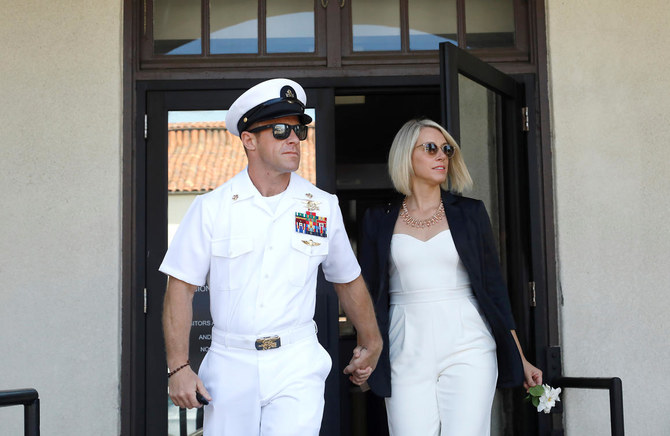
US Navy SEAL Special Operations Chief Edward Gallagher leaves for a lunch break with his wife from his court-martial trial in San Diego. (Reuters)
Updated 03 July 2019
Follow

Jury resumes deliberations in US Navy SEAL’s Iraq war crimes trial

  • Special Operations Chief Edward Gallagher could face life in prison if found guilty of the most serious charge against him
  • Gallagher is charged with murdering a wounded Daesh prisoner and shooting unarmed civilians

SAN DIEGO: A military jury in San Diego resumed deliberations on Tuesday in the war crimes trial of a US Navy SEAL charged with murdering a wounded Daesh prisoner in his custody and shooting unarmed civilians during a 2017 deployment in Iraq.
The case against Special Operations Chief Edward Gallagher, whose prosecution has drawn White House attention, went to the seven-member jury of US Marines and Navy personnel on Monday as the trial phase of his court-martial entered its third week.
A verdict requires agreement of at least five of the seven jurors, all but one of whom have served in combat. If Gallagher is convicted, the panel also will determine the sentence.
Gallagher could face life in prison if found guilty of the most serious charge against him, premeditated murder. Several fellow SEAL team members testified that he fatally stabbed the captured Iraqi prisoner in the neck with a custom-made knife after the teenage fighter was brought to Gallagher’s outpost for medical treatment.
Some of the same witnesses also said they saw Gallagher, who was originally trained as a medic, perform a number of emergency procedures on the detainee before he died.
At the jury’s request on Tuesday, the judge allowed playback of audio from testimony of the trial’s first prosecution witness, Navy Lt. Thomas McNeil, who was the second-ranking officer in charge of Gallagher’s platoon.
In the portion requested by jurors, MacNeil recounted hearing Gallagher saying over the radio, “He’s mine,” when notified that the captured Iraqi, wounded in an air strike, was being brought in from the battlefield.
Gallagher also is charged with attempted murder in the wounding of two noncombatants — a schoolgirl and an elderly man — shot from a sniper’s perch, as well as with obstruction of justice and unlawfully posing for photos with the detainee’s corpse.
Gallagher, 39, a platoon leader, has denied all charges, insisting that disgruntled subordinates with no prior battlefield experience fabricated allegations against him over grievances with his leadership style and tactics.
US President Donald Trump intervened in Gallagher’s case months ago, ordering that he be moved from pretrial detention in a military brig to confinement at a Navy base. The presiding judge later released Gallagher from custody altogether.
The chief petty officer, a decorated career combat veteran, was arrested in 2018, more than a year after returning from his eighth overseas deployment in Mosul, in northern Iraq.
In a surprise twist during the first week of the trial at a military court at US Naval Base San Diego, a Navy SEAL medic testified that it was he, not Gallagher, who caused the death of the gravely injured prisoner by blocking his breathing tube, calling it a mercy killing.
Two defense witnesses — an Iraqi general and a US Marine staff sergeant — testified they never saw the Iraqi captive mistreated by anyone while alive in American custody.
The senior prosecutor, Navy Commander Jeffrey Pietrzyk, said in his closing arguments on Monday that Gallagher had implicated himself. He cited a photo that Gallagher sent to a friend in May 2017 showing him posed with the Iraqi detainee’s corpse, with the text message: “I got a cool story for you when I get back. I got him with my hunting knife.”
Gallagher’s civilian defense lawyer, Timothy Parlatore, said prosecutors and Navy investigators succumbed to “tunnel vision” in their determination to build a case against Gallagher, rather than conducting an impartial inquiry.
“No body, no evidence, no science, no forensics, no case,” Parlatore said. “The ship has run aground.”


US and Ukraine ‘a lot closer’ on peace deal, Trump says after meeting with Zelensky

Updated 58 min 14 sec ago
Follow

US and Ukraine ‘a lot closer’ on peace deal, Trump says after meeting with Zelensky

  • Zelensky sees agreement on security guarantees for Ukraine
  • Hurdles to a comprehensive peace deal remain
  • Trump spoke with Putin ahead of meeting on Sunday

PALM BEACH, Florida: US President Donald Trump said on Sunday that he and Ukrainian President Volodymyr Zelensky were “getting a lot closer, maybe very close” to an agreement to end the war in Ukraine, though both leaders acknowledged that ​some of the thorniest details remain unresolved.
The two leaders spoke at a joint press conference late Sunday afternoon after meeting at Trump’s Mar-a-Lago resort in Florida. Trump said it will be clear “in a few weeks” whether negotiations to end the war will succeed.
Zelensky said an agreement on security guarantees for Ukraine has been reached. Trump was slightly more cautious, saying that they were 95 percent of the way to such an agreement, and that he expected European countries to “take over a big part” of that effort with US backing.
Zelensky has said previously that he hopes to soften a US proposal for Ukrainian forces to withdraw completely from the Donbas region of eastern Ukraine, a Russian demand that would mean ceding some territory held by Ukrainian forces.
Both Trump and Zelensky said on Sunday the future of the Donbas had not been settled. “It’s unresolved, but it’s getting a lot ‌closer. That’s a ‌very tough issue,” Trump said.
Just before Zelensky and his delegation arrived at Trump’s Florida residence, Trump ‌and ⁠Russian ​President Vladimir ‌Putin spoke in a call described as “productive” by the US president and “friendly” by Kremlin foreign policy aide Yuri Ushakov.
Ushakov, in Moscow, said Putin told Trump a 60-day ceasefire proposed by the European Union and Ukraine would prolong the war. The Kremlin aide also said Ukraine needs to make a decision regarding the Donbas “without further delay.” And he said the Russian government had agreed to establish working groups to resolve the conflict that will focus on economic and security concerns.


Meeting follows Russian attacks on Kyiv
Zelensky arrived at Mar-a-Lago early Sunday afternoon, as Russian air raids pile pressure on Kyiv. Russia hit the capital and other parts of Ukraine with hundreds of missiles and drones on Saturday, knocking out power and heat in parts of Kyiv. Zelensky has described the weekend attacks ⁠as Russia’s response to the US-brokered peace efforts, but Trump on Sunday said he believes Putin and Zelensky are serious about peace.
The US president said he will call Putin again after meeting with Zelensky. Zelensky ‌had previously told journalists he plans to discuss the fate of the contested Donbas ‍region with Trump, as well as the future of the Zaporizhzhia nuclear ‍power plant and other topics.

Russia claims more battlefield advances 
Putin said on Saturday Moscow would continue waging its war if Kyiv did not seek ‍a quick peace. Russia has steadily advanced on the battlefield in recent months, claiming control over several more settlements on Sunday.
While Kyiv and Washington have agreed on many issues, the issue of what territory, if any, will be ceded to Russia remains unresolved. While Moscow insists on getting all of the Donbas, Kyiv wants the map frozen at current battle lines.
The US, seeking a compromise, has proposed a free economic zone if Ukraine leaves the area, although it remains unclear ​how that zone would function in practical terms.
US negotiators have also proposed shared control over the Zaporizhzhia nuclear plant. Power line repairs have begun there after another local ceasefire brokered by the International Atomic Energy Agency, the agency said on ⁠Sunday.
Russia controls all of Crimea, which it annexed in 2014, and since its invasion of Ukraine nearly four years ago has taken control of about 12 percent of its territory, including about 90 percent of the Donbas, 75 percent of the Zaporizhzhia and Kherson regions, and slivers of the Kharkiv, Sumy, Mykolaiv and Dnipropetrovsk regions, according to Russian estimates.
Putin said on December 19 that a peace deal should be based on conditions he set out in 2024: Ukraine withdrawing from all of the Donbas, Zaporizhzhia and Kherson regions, and Kyiv officially renouncing its aim to join NATO. Zelensky’s past encounters with Trump have not always gone smoothly, but Sunday’s meeting follows weeks of diplomatic efforts. European allies, while at times cut out of the loop, have stepped up efforts to sketch out the contours of a post-war security guarantee for Kyiv that the United States would support.
On Sunday, ahead of the Mar-a-Lago visit, Zelensky said he held a detailed phone call with British Prime Minister Keir Starmer. Trump and Zelensky will hold a phone call with European leaders at some point during the Florida meeting, Trump said. The 20-point plan was spun off from a Russian-led 28-point plan, which emerged from talks between US special envoy Steve Witkoff, Trump’s son-in-law Jared Kushner ‌and Russian special envoy Kirill Dmitriev, and which became public in November.
Subsequent talks between Ukrainian officials and US negotiators have produced the more Kyiv-friendly 20-point plan.