Pakistani man kills wife, two children, six others in alleged honor killing

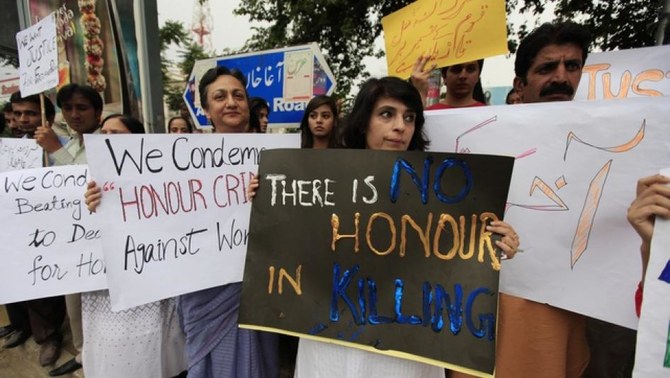
Members of civil society protest against a recent "honor" killing in Islamabad, Pakistan on May 29, 2014. (Reuters / File)
Updated 02 July 2019
Follow

Pakistani man kills wife, two children, six others in alleged honor killing

  • The deaths add to hundreds of honor killing cases reported each year
  • Pakistan adopted legislation against honor killings in 2016, closing legal lacunae and introducing tough punishment

LAHORE: A man shot his wife, their two children, and six of her family members on Monday and then burned the bodies when he set her family’s home on fire in an alleged honor killing in central Pakistan, police said.
Muhammad Ajmal committed the attack as revenge for a suspected affair by his wife Kiran, said Imran Mehmood, a District Police Officer for the city of Multan, where the killings occurred. Ajmal returned to Pakistan from Saudi Arabia, where he worked as a tailor, 25 days ago intending to carry out the killings, he said.
Mehmood said Ajmal confessed to the killings.
“This is clearly an honor killing. He saw a picture of his wife with another man and believed she was having an affair,” Mehmood said. “He does not repent his actions.”
In addition to killing his wife and their two children, Ajmal also killed his three sisters-in-law, two of their children, and his mother-in-law.
Ajmal and his father, who was with him at the time of the murder, are both in custody and have been charged with murder, Mehmood said. Police are searching for his brother, who is also believed to be involved.
The deaths add to the hundreds of women and girls killed in Pakistan each year, according to human rights groups, by family members angered at the perceived damage to their honor, which may involve eloping, fraternizing with men or any infringement of conservative values regarding women.
Kiran’s brother Ali Raza told Reuters that Ajmal and his sister were having marital problems and she had recently moved back to Pakistan and was living with her family.
“I am left with just my father, my whole family is gone,” he said.
Mehmood said Ajmal has not been assigned an attorney yet and Reuters was unable to contact any of his family members for a comment.
Pakistan adopted legislation against honor killings in 2016, introducing tough punishment and closing a legal loophole that allowed killers to walk free if pardoned by family members.
Police in Pakistan’s most populous province of Punjab, where honor crimes have been rampant, said recently that the number of such killings had fallen since the law was introduced but rights groups estimate that nearly 1,000 such killings take place annually.


Pakistan discovers new oil, gas reserves in push to cut costly imports

Updated 5 sec ago
Follow

Pakistan discovers new oil, gas reserves in push to cut costly imports

  • Exploration firm announces modest discovery of 225 barrels of oil, 1.01 MMSCFD of gas per day
  • Multiple discoveries together could boost domestic production and reduce reliance on imports

ISLAMABAD: Pakistan has announced a modest discovery of new oil and gas reserves in its northwestern Khyber Pakhtunkhwa (KP) province, state media reported on Friday, amid the country efforts to boost exploration to cut costly imports.

Pakistan faces a widening energy gap due to rising demand and limited domestic output, forcing reliance on costly fuel imports that expose the economy to global price swings. Its petroleum, oil, and lubricants import bill fell 4.39 percent to $9.046 billion in July 2025-January 2026.

The discovery was made at Lumshiwal Formation of Baragzai X-01 exploratory well. During Cased Hole Drill Stem Test (CHDST-04) conducted in the Hangu and Lumshiwal formations, the well produced 225 barrels of oil per day (BOPD) and 1.01 million standard cubic feet per day (MMSCFD) of gas through a 32/64’’ choke at a wellhead flowing pressure of 190 psig.

“Baragzai X-01 (Slant) was spudded on December 30, 2024, as an exploratory well to assess the hydrocarbon potential of multiple formations, including Lockhart, Hangu, Lumshiwal, Samana Suk, Shinawari, Datta and Kingriali.

The well was successfully drilled to a total depth of 5,170 meters into the Kingriali Formation,” the state-run APP news agency reported, citing the Oil and Gas Development Company (OGDC).

“Based on wireline log evaluations, three earlier cased hole drill stem tests were conducted in the Kingriali, Datta, and Samana Suk plus Shinawari formations, which also resulted in oil and gas discoveries. The latest test over Lumshiwal further confirms the commercial viability and hydrocarbon prospectivity of the block.”

The discovery was made under the Nashpa Exploration License. OGDC has a 65 percent working interest in the license, in partnership with Pakistan Petroleum Limited (30 percent) and Government Holdings Private Limited (5 percent).

“This discovery will strengthen Pakistan’s energy security by enhancing indigenous hydrocarbon production,” the exploration firm said. “It will add to the reserves base of OGDC and its joint venture partners while contributing toward narrowing the country’s energy supply-demand gap.”

Pakistan has reported several oil and gas discoveries recently. Although modest individually, their combined potential could boost domestic production and reduce reliance on imported energy.

In January, a discovery regarding an exploratory well, flowing at the rate of 4,100 barrels of oil per day (BOPD) and 10.5 million standard cubic feet per day (MMSCFD) of gas, was made in Kohat. In September 2025, Pakistan Petroleum Limited announced a discovery in Attock district, while Mari Energies reported a new gas find in North Waziristan.

Pakistan’s Sindh province dominates gas production with a 62 percent share and contributes 40 percent to oil output, while Khyber Pakhtunkhwa accounts for 41 percent of crude oil production. Punjab produces 18 percent of the nation’s oil, and Balochistan contributes just one percent, according to Topline Securities.