

UN wants US, Russia to move Syria peace process

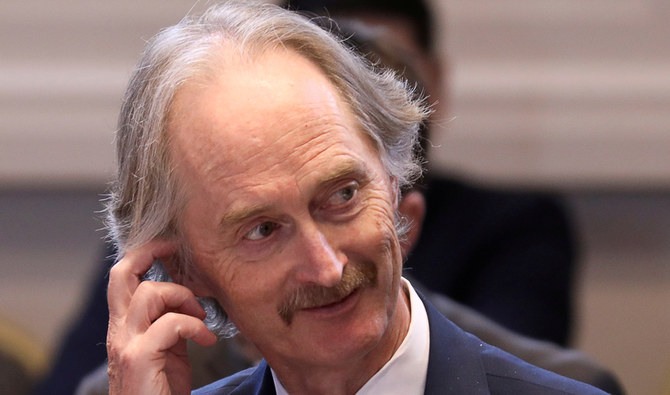
United Nations Special Envoy to Syria Geir Pedersen. (File/Reuters)
Updated 28 June 2019
Follow

UN wants US, Russia to move Syria peace process

  • UN envoy trying to arrange a body to reform Syria’s constitution

GENEVA: “A deeper understanding” between Russia and the US is needed to move the Syrian peace process forward, UN Syria envoy Geir Pedersen said in an interview published on Thursday.

Successive UN envoys have failed to stop Syria’s eight-year war, which has caused hundreds of thousands of deaths and led to an exodus of refugees.

Pedersen, the fourth man in the job, is trying to arrange a committee to oversee the reform of Syria’s constitution — a modest effort, compared with former UN Secretary-General Kofi Annan’s attempt to reach a peace agreement at an international conference in 2012.

“Obviously, a Constitutional Committee in itself will not change much,” Pedersen said in an interview published by the Geneva-based Center for Humanitarian Dialogue. “But if handled correctly, and if there is political will, it could be a door-opener for a broader political process.

HIGHLIGHTS

Successive UN envoys have failed to stop Syria’s eight-year war, which has caused hundreds of thousands of deaths and led to an exodus of refugees.

He told the key players that he needed “a different international setup,” Pedersen said, and wanted to convene a group of influential states alongside the Constitutional Committee meeting.

It would include the five permanent UN Security Council members and two groups of countries that have been politically active on Syria: The “Astana Group” comprising Iran and Turkey as well as Russia, and the “Small Group,” which includes Egypt, Germany, Jordan, Saudi Arabia, France, Britain and the US.

“This is indicative of the fact that we are in a new phase ... this has been going on for too long, and it should be possible to move forward. This would, of course, require a deeper understanding between Russia and the US on how to move forward,” he said. “We are also working on that.”

The UN envoy said he had pressed the Syrian regime and the opposition Syrian National Commission on the importance of tackling the issue of people who had been detained or abducted or were missing, and he had appealed to them for “bigger unilateral steps on this.”


Main donor US unclear on UNRWA future, jettisoning it would leave black hole: Agency chief

Updated 6 sec ago
Follow

Main donor US unclear on UNRWA future, jettisoning it would leave black hole: Agency chief

  • US President Trump’s administration has accused UNRWA staff of having links with Hamas

MUNICH: The ‌United States is still not clear about how it sees the future role of the UN Palestinian refugee agency, its chief said ​on Friday, warning that jettisoning it would create a black hole similar to Iraq after 2003.

US President Donald Trump’s administration has accused UNRWA staff of having links with Palestinian Islamist group Hamas, allegations UNRWA has vigorously disputed.

Washington was long UNRWA’s biggest donor, but froze funding in January 2024 after Israel accused about a dozen ‌UNRWA staff of ‌taking part in the deadly ​Oct. ‌7, ⁠2023 Hamas ​attack ⁠that triggered the war in Gaza.

“There is no definitive answer, because the interest of the US is also to be successful in this process and if you get rid of an agency like ours before you have an alternative, you are also creating a huge black hole,” ⁠UNRWA head Philippe Lazzarini told Reuters on ‌the sidelines of the Munich ‌Security Conference.

“Remember what happened in ​Iraq in 2003 when ‌the entire administration had been dismantled (following the US-led invasion). There ‌was no alternative and people were left without any services,” he said in an interview.

UNRWA has functioned for decades as the main international agency providing for the welfare of millions of ‌Palestinian descendants of those who fled or were driven from homes during the war around ⁠Israel’s 1948 ⁠founding.

Lazzarini, who leaves his post at the end of March, said UNRWA did not foresee any more cuts in the immediate term and it continued to offer public health and education services that no one else was really providing.

He urged Gulf Arab countries to increase their support because their contribution did not match their strong expression of solidarity with Palestinian refugees.

Israel accuses UNRWA of bias, and the Israeli parliament passed a ​law in October 2024 ​banning the agency from operating in the country and prohibiting officials from having contact with it. (Reporting by John Irish; editing by ​Mark Heinrich)