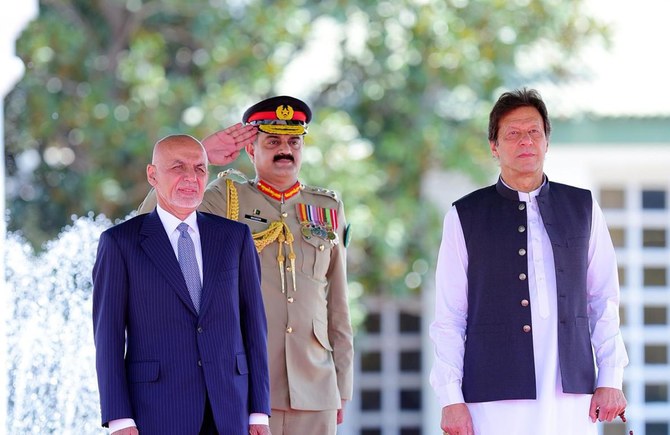
ISLAMABAD: Pakistan’s prime minister Imran Khan and Afghan president Ashraf Ghani on Thursday agreed to open a new chapter of friendship and cooperation between the two countries based on mutual trust and harmony for the benefit of the two peoples and for advancing the cause of peace, stability and prosperity in the region.
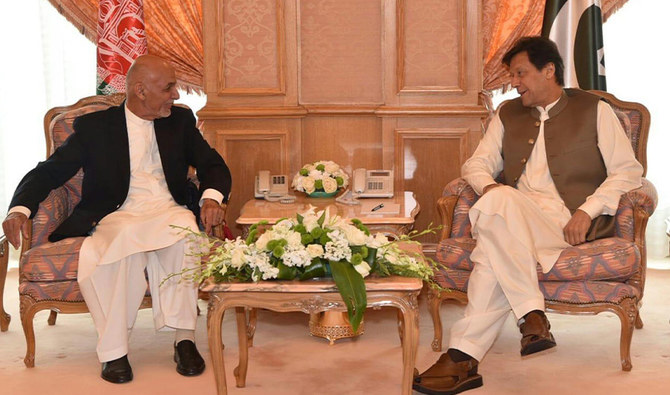
According to an official handout circulated by the country’s foreign office, the two leaders had a one-on-one meeting that was followed by delegation-level talks.
The prime minister affirmed that Pakistan wanted a qualitative transformation in its relations with Afghanistan as part of his vision of a “peaceful neighborhood.” He also said that an Afghan-led and Afghan-owned peace process was the only viable option to end decades-long conflict in Afghanistan, adding that his country supported a result-oriented intra-Afghan dialogue.
The prime minister underscored Pakistan’s respect for the sovereignty and territorial integrity of Afghanistan and its commitment to stand by the Afghan people at this crucial juncture.
The two leaders agreed that enduring peace in Afghanistan would bring rich economic dividends to both countries and reaffirmed their commitment to work together to broaden and deepen bilateral trade, streamline transit trade, and strengthen efforts for connectivity.
“It was recognized that early completion of major energy connectivity projects such as Central Asia-South Asia (CASA 1000) electricity transmission line and Turkmenistan-Afghanistan-Pakistan-India (TAPI) gas pipeline will bring long-term economic benefits to the countries involved,” said the foreign office statement.
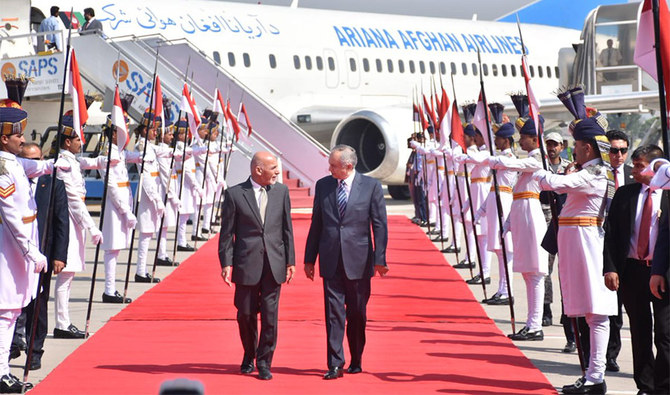
Earlier in the day, Afghan president Ashraf Ghani arrived in Islamabad on a two-day, just days after Islamabad hosted a conference of Afghan tribal and political leaders to discuss ways to end conflict in Afghanistan.
President Ghani was received by Prime Minister’s Adviser on Commerce Abdul Razak Dawood and other officials at Rawalpindi’s Nur Khan air base during a traditional welcome reception.
This is Ghani’s third visit since 2014 and comes at a time when the United States is engaged in talks with the Taliban and has picked up effort to reach a political settlement to end decades of war in Afghanistan.
“On the invitation of Prime Minister Imran Khan, President of Afghanistan Ashraf Ghani will be visiting Pakistan on 27-28 June 2019,” Pakistan’s foreign office said in another statement released prior to the visit.
The Afghan president is accompanied by a high-level delegation of ministers, advisers, senior officials and business people.
Ghani is also expected to meet President Dr. Arif Alvi and hold “wide ranging talks” focusing on “strengthening bilateral cooperation in diverse areas – including political, trade, economic, security, peace and reconciliation, education and people-to-people exchanges,” the foreign office said.
The Afghan president will also travel to Lahore, Pakistan’s second largest city, where he will participate in a business forum attended by representatives from both countries.
In an exclusive interview with Arab News last week, Afghan ambassador to Pakistan Atif Mashal said the Kabul government was “cautiously optimistic” that Ghani’s visit would open a new chapter in bilateral relations.
Taliban and US officials have held several rounds of talks since December and say they are close to agreeing a timeline for the withdrawal of foreign troops and guarantees that Afghanistan would not be used as a base for militant attacks on US targets.
But Ghani’s government has been shut out of negotiations by the Taliban’s refusal to deal with what they consider an illegitimate “puppet” regime.
Islamabad says its influence over the Taliban has waned in recent years and that it strongly favors a political settlement to maintain stability in Afghanistan. Afghan officials remain cautious.
US special envoy for Afghanistan Zalmay Khalilzad, who is leading the push to broker a peace deal with the Afghan Taliban, has held several rounds of talks with Pakistani officials to smooth the way.
Last week, dozens of Afghan politicians and opposition leaders gathered in Pakistan to discuss ways to achieve peace.


![]()
![]()
![]()

Pakistan, Afghanistan agree to strengthen bilateral relations, work for regional peace and stability
Pakistan, Afghanistan agree to strengthen bilateral relations, work for regional peace and stability
- PM Khan and Afghan President Ghani agree enduring peace in Afghanistan would bring rich economic dividends to both countries
- Pakistan underscores respect for Afghan sovereignty and territorial integrity
Latest updates


Recommended


© 2026 SAUDI RESEARCH & PUBLISHING COMPANY, All Rights Reserved And subject to Terms of Use Agreement.