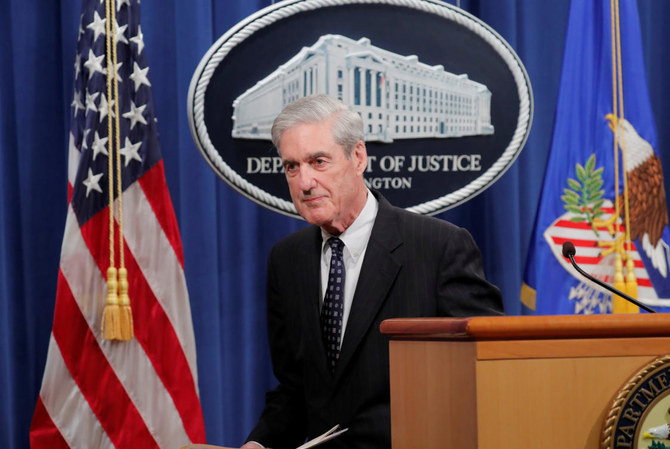
WASHINGTON: Special counsel Robert Mueller has agreed to testify publicly before Congress on July 17 after Democrats issued subpoenas to compel him to appear, the chairmen of two House committees announced Tuesday.
Mueller’s unusual back-to-back testimony in front of the House Judiciary and Intelligence committees is likely to be the most highly anticipated congressional hearing in years, particularly given Mueller’s resolute silence throughout his two-year investigation into Russian contacts with President Donald Trump’s campaign. Mueller never responded to angry, public attacks from Trump, nor did he ever personally join his prosecutors in court or make announcements of criminal charges from the team.
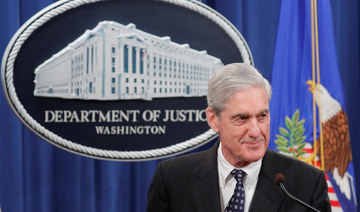
His sole public statement came from the Justice Department podium last month as he announced his departure, when he sought to explain his decision to not indict Trump or to accuse him of criminal conduct. He also put lawmakers on notice that he did not ever intend to say more than what he put in the 448-page report.
“We chose those words carefully and the work speaks for itself,” Mueller said May 29. “I would not provide information beyond what is already public in any appearance before Congress.”
Those remarks did little to settle the demands for his testimony. The two committees continued negotiations that had already been going on for weeks, saying they still wanted to hear from Mueller no matter how reluctant he was.
“When you accept the role of special counsel in one of the most significant investigations in modern history you’re going to have to expect that you’re going to be asked to come and testify before Congress,” House Intelligence Committee Chairman Adam Schiff, D-Calif., told reporters shortly after the announcement.
Trump himself simply tweeted, “Presidential Harassment!”
In the report issued in April, Mueller concluded there was not enough evidence to establish a conspiracy between Trump’s presidential campaign and Russia, which was the original question that started the investigation. But he also said he could not exonerate Trump on obstruction of justice. The report examined several episodes in which Trump attempted to influence the investigation.
Democrats say it is now the job of Congress to assess the report’s findings. Lawmakers are likely to confront Mueller on why he did not come to a firm conclusion on obstruction of justice. They are also likely to seek his reaction to a drumbeat of incessant criticism from the president and ask for his personal opinion about whether Trump would have been charged were he not the commander-in-chief.
Schiff and House Judiciary Committee Chairman Jerrold Nadler said they issued the subpoenas Tuesday, and Mueller agreed to testify pursuant to those subpoenas. In a letter to Mueller accompanying the subpoenas, the committee chairmen said “the American public deserves to hear directly from you about your investigation and conclusions.”
Schiff said there will be two hearings “back to back,” one for each committee, and they will also meet with Mueller’s staff in closed session afterward.
The Justice Department declined to comment.
Republicans have criticized Democrats for their continuing investigations of the president. House Minority Leader Kevin McCarthy, R-Calif., questioned why they would still want to hear from Mueller after the lengthy report was issued. “He said he didn’t want to talk to us anymore, didn’t he?”
But Georgia Rep. Doug Collins, the top Republican on the Judiciary panel, has said he has no objections to Mueller’s testimony.
“May this testimony bring to House Democrats the closure that the rest of America has enjoyed for months, and may it enable them to return to the business of legislating,” Collins said.


Special counsel Mueller to testify publicly before US House committees

Special counsel Mueller to testify publicly before US House committees
- Robert Mueller’s unusual back-to-back testimony likely to be the most highly anticipated congressional hearing in years
- Mueller earlier said there was not enough evidence to establish a conspiracy between Donald Trump’s presidential campaign and Russia
US paused bomb shipment to Israel to signal concerns over Rafah invasion, official says
- The State Department is separately considering whether to approve the continued transfer of Joint Direct Attack Munition kits, which place precision guidance systems onto bombs, to Israel, but the review didn’t pertain to imminent shipments
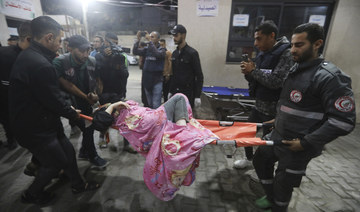
- Israel has killed more than 34,700 Palestinians in Gaza, mostly women and children, according to the health ministry in the Hamas-run territory
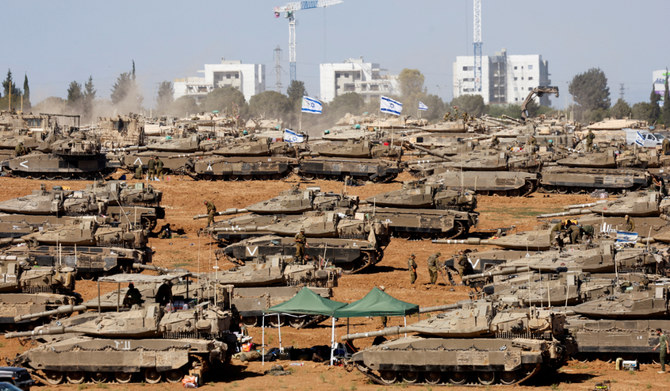
WASHINGTON: The US paused a shipment of bombs to Israel last week over concerns that Israel was approaching a decision on launching a full-scale assault on the southern Gaza city of Rafah against the wishes of the US, a senior administration official said Tuesday.
The shipment was supposed to consist of 1,800 2,000-pound bombs and 1,700 500-pound bombs, according to the official, who spoke on the condition of anonymity to discuss the sensitive matter, with the focus of US concern being the larger explosives and how they could be used in a dense urban setting. More than 1 million civilians are sheltering in Rafah after evacuating other parts of Gaza amid Israel’s war on Hamas, which came after the militant group’s deadly attack on Israel on Oct. 7.
President Joe Biden’s administration in April began reviewing future transfers of military assistance to Israel as Prime Minister Benjamin Netanyahu’s government appeared to move closer toward an invasion of Rafah, despite months of opposition from the White House. The official said the decision to pause the shipment was made last week and no final decision had been made yet on whether to proceed with the shipment at a later date.
The State Department is separately considering whether to approve the continued transfer of Joint Direct Attack Munition kits, which place precision guidance systems onto bombs, to Israel, but the review didn’t pertain to imminent shipments.
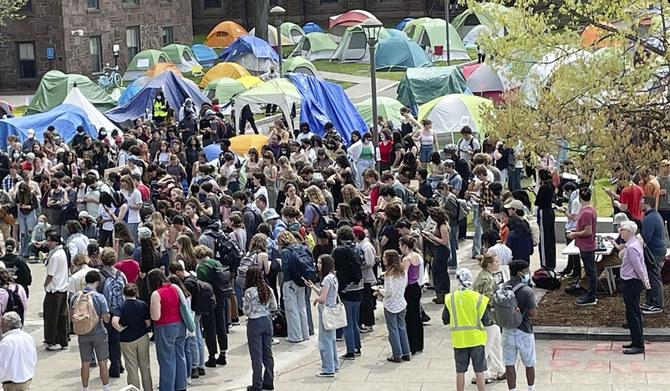
Some colleges that had been permissive of pro-Palestinian protests begin taking a tougher stance
- Tensions have continued to ratchet up in standoffs with protesters on campuses across the US — and increasingly, in Europe — nearly three weeks into a movement launched by a protest at Columbia University
- Israel has killed more than 34,700 Palestinians in Gaza, mostly women and children, according to the health ministry in the Hamas-run territory
CHICAGO: Police cleared a pro-Palestinian tent encampment at the University of Chicago on Tuesday after administrators who had initially adopted a permissive approach said the protest had crossed a line and caused growing concerns about safety.
University President Paul Alivizatos acknowledged the school’s role as a protector of freedom of speech after officers in riot gear blocked access to the school’s Quad but also took an enough-is-enough stance.
“The university remains a place where dissenting voices have many avenues to express themselves, but we cannot enable an environment where the expression of some dominates and disrupts the healthy functioning of the community for the rest,” Alivizatos wrote in a message to the university community.
Tensions have continued to ratchet up in standoffs with protesters on campuses across the US — and increasingly, in Europe — nearly three weeks into a movement launched by a protest at Columbia University. Some colleges cracked down immediately on protests against the Israel-Hamas war. Among those that have tolerated the tent encampments, some have begun to lose patience and call in police over concerns about disruptions to campus life, safety and the involvement of nonstudents.
Since April 18, just over 2,600 people have been arrested on 50 campuses, figures based on AP reporting and statements from universities and law enforcement agencies.
But not all schools are taking that approach, with some letting protesters hold rallies and organize their encampments as they see fit.
The president of Wesleyan University, a liberal arts school in Connecticut, has commended the on-campus demonstration — which includes a pro-Palestinian tent encampment — as an act of political expression. The camp there has grown from about 20 tents a week ago to more than 100.
“The protesters’ cause is important — bringing attention to the killing of innocent people,” university President Michael Roth wrote to the campus community Thursday. “And we continue to make space for them to do so, as long as that space is not disruptive to campus operations.”
The Rhode Island School of Design, where students started occupying a building Monday, affirms students’ rights to freedom of speech and peaceful assembly and supports all members of the community, a spokesperson said. The school said President Crystal Williams spent more than five hours with the protesters that evening discussing their demands.
On Tuesday the school announced it was relocating classes that were scheduled to take place in the building. It was covered with posters reading “Free Palestine” and “Let Gaza Live,” and dove was drawn in colored chalk on the sidewalk.
Campuses have tried tactics from appeasement to threats of disciplinary action to resolve the protests and clear the way for commencements.
At the University of Chicago, hundreds of protesters gathered for at least eight days until administrators warned them Friday to leave or face removal. On Tuesday, law enforcement dismantled the encampment.
Officers later picked up a barricade erected to keep protesters out of the Quad and moved it toward the demonstrators, some of whom chanted, “Up, up with liberation. Down, down with occupation!” Police and protesters pushed back and forth along the barricade as the officers moved to reestablish control.
Officials at the University of North Carolina, Chapel Hill, told deans and department chairs Monday that some students have been informed by instructors opposing the suspension of student protesters that they will withhold grades.
The school provost’s office said it will support “sanctions for any instructor who is found to have improperly withheld grades.”
At the Massachusetts Institute of Technology, protesters were given a deadline to voluntarily leave or face suspension. Many left, according to an MIT spokesperson, who said protesters breached fencing after the arrival of demonstrators from outside the university. On Monday night, dozens remained at the encampment in a calmer atmosphere.
MIT officials said the following day that dozens of interim suspensions and discipline committee referrals were in process, actions taken to ensure the “safety of our community.”
Sam Ihns, a graduate student studying mechanical engineering and a member of MIT Jews for a Ceasefire, said the group has been there for two weeks and is calling for an end to the killing in Gaza.
“Specifically, our encampment is protesting MIT’s direct research ties to the Israeli Ministry of Defense,” he said.
Many protesters want schools to divest from companies that do business with Israel or otherwise contribute to the war effort. Others simply want to call attention to the deaths in Gaza and for the war to end.
Wesleyan senior Uday Narayanan said students there are prepared to protest through the summer if that’s what it takes for their demands to be met.
“Our tuition dollars are still going toward the brutalization of Palestinians,” the 21-year-old physics major said. “So, ultimately, even though our president has said, ‘Oh, I’m not going to call the cops. Oh, I’m not going to beat up students,’ that’s still not enough, and that’s not the bare minimum for us.”
And as Wesleyan’s May 26 commencement approaches, some protesters fear they will be forcibly removed from the center of campus, adjacent to the field where the ceremony is to take place.
“The longer we are here, the more that their facade of laid back, hands off is falling away,” said Batya Kline, a 22-year-old graduate student. “We know that the university does not want us here, and we know that they can change their pace at the drop of a hat without letting us know.”
Frank Straub, senior director of violence prevention at nonprofit advocacy organization Safe and Sound Schools, said these and past protests have shown the need for early dialogue among the university, police and protesters to establish ground rules.
Straub said Wesleyan, for example, needs to have conversations about commencement and where protesters can be, and should make sure a plan is in place to respond, should protesters want to get arrested, so that can be done without violence.
“By their nature, protests are adversarial, but I think we can have controlled adversity,” he added. “And I think the more campus officials are engaged with the protesters and the more police are included in those conversations, that’s critically important.”
The protests stem from the conflict that started Oct. 7 when Hamas militants attacked southern Israel, killing about 1,200 people, mostly civilians, and taking roughly 250 hostages.
Vowing to destroy Hamas, Israel launched an offensive in Gaza that has killed more than 34,500 Palestinians, about two-thirds of them women and children, according to the Health Ministry in the Hamas-ruled territory. Israeli strikes have devastated the enclave and displaced most of its inhabitants.
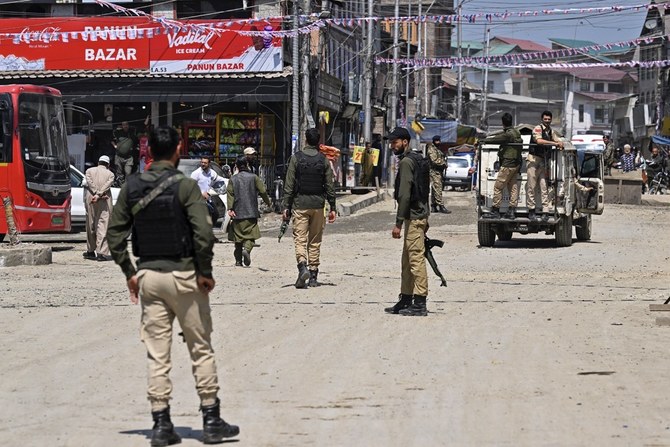
Two suspected Kashmir rebels killed in clash with Indian forces
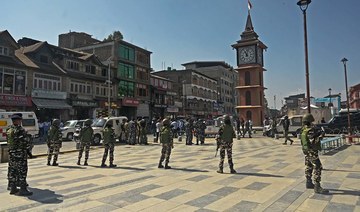
SRINAGAR, India: Two suspected rebels were killed in Indian-administered Kashmir during a firefight with soldiers, police said Tuesday, at a time when campaigning for national elections is underway in the disputed territory.
Scores of soldiers besieged a residential area in southern Kulgam district, some 70 kilometers (43 miles) from Kashmir’s biggest city Srinagar, on Monday after armed militants were suspected to be present inside a house.
Two bodies of the suspected rebels “were recovered so far” from the site, police said in a statement posted Tuesday on social media platform X.
Images from the area showed smoke billowing from a house after it caught fire during the skirmish.
Kashmir has been divided between India and Pakistan since their independence in 1947, with both claiming the Himalayan territory in full.
Rebel groups opposed to Indian rule have for decades waged an insurgency in Indian-controlled Kashmir, demanding either independence or a merger with Pakistan.
The conflict has left tens of thousands of civilians, soldiers and militants dead.
Violence and anti-India protests have drastically reduced since 2019, when Prime Minister Narendra Modi’s government canceled the Muslim majority region’s limited autonomy.
But clashes between security forces and rebel groups have increased since voting began last month in India’s six-week election.
Three suspected rebels were killed and a police officer and three soldiers wounded in three separate clashes across the territory in April.
Militants ambushed a military convoy in Kashmir’s south on Sunday, killing one Indian air force corporal and wounding four other troops.

Israeli Rafah offensive would break international law, says UK deputy foreign minister
- Andrew Mitchell warns a ground invasion could strengthen Hamas, in comments viewed as attempt to get Israel to sign up for peace deal accepted by Hamas on Monday
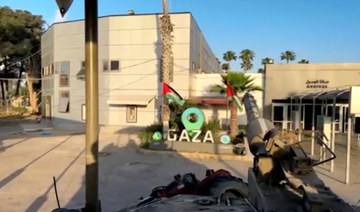
- UN chief Antonio Guterres urges Israel to ‘stop any escalation’ after tanks enter Rafah and army takes control of crossing on the border with Egypt
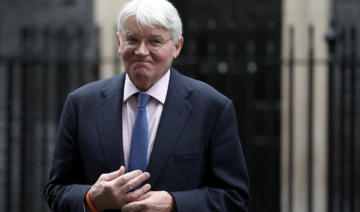
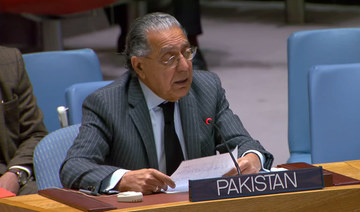
LONDON: An Israeli ground offensive in Rafah would contravene international humanitarian law and would not succeed in removing Hamas from power in Gaza or eradicating the organization, Britain’s deputy foreign minister warned on Tuesday.
Andrew Mitchell said Israeli authorities had failed to present a military plan that complies with international law, and that entering Rafah, which has become the final refuge for more than a million people displaced by fighting in other parts of Gaza, could strengthen, not weaken, Hamas.
However, he stopped short of saying what international consequences, if any, Israel might face if it proceeds.
Mitchell reiterated the UK government’s desire for a permanent, sustained ceasefire in Gaza. His comments, which followed a similar statement by authorities in France on Monday, were seen as an attempt to put pressure on Israel to sign up for a provisional, three-stage peace deal that was accepted by Hamas on Monday, The Guardian newspaper reported on Tuesday.
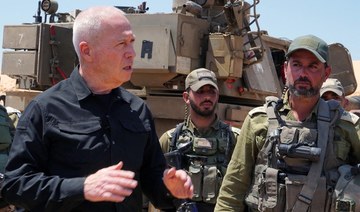
Israeli minister Benny Gantz has said the peace proposal did not “correspond to the dialogue that has taken place so far with the mediators and has significant gaps.”
Mitchell also echoed calls from the UN for Israel to end a renewed block on humanitarian aid entering Gaza. Also on Tuesday, UN Secretary-General Antonio Guterres called for border crossings to be reopened “immediately” so that essential aid can be delivered to Gaza. He urged Israeli authorities to “stop any escalation” after they sent tanks into Rafah early on Tuesday and the army took control of the nearby crossing on the border with Egypt.
“Things are moving in the wrong direction. I am disturbed and distressed by the renewed military activity in Rafah by the Israel Defense Forces,” Guterres said.
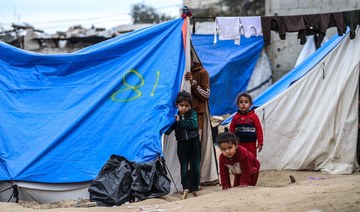
International pressure has been building on Israel over the potentially devastating consequences of a threatened ground invasion of Rafah, where the UN estimates about 1.4 million Palestinians are sheltering.
EU foreign policy chief Josep Borrell said such action could cause many “civilian casualties.” White House spokesperson John Kirby said that Israel told Washington its operation in Rafah “was limited and designed to cut off Hamas’s ability to smuggle weapons” into Gaza.
Egypt has urged Israeli authorities to “exercise the utmost restraint.” The Organization for Islamic Cooperation condemned Israel’s “criminal aggression.”
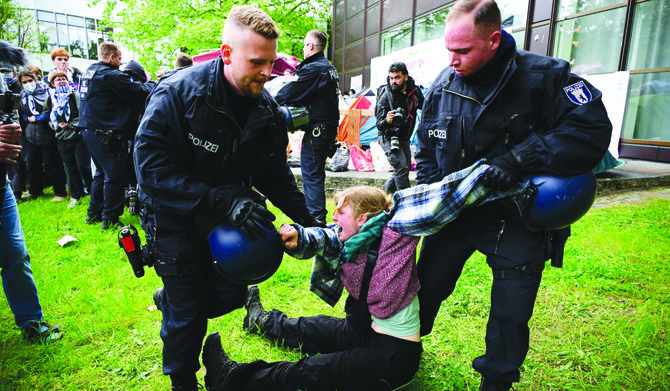
Berlin students protest for Gaza as demos spread across Europe
- Scuffles erupt between officers, protesters
- Crackdown on University of Amsterdam protest
- Israel has killed more than 34,700 Palestinians, most of them women and children, according to the Hamas government's Ministry of Health
AMSTERDAM: German police on Tuesday broke up a protest by several hundred pro-Palestinian activists who had occupied a courtyard at Berlin’s Free University earlier in the day, the latest such action by authorities as protests that have roiled campuses in the US spread across Europe.
Some demonstrators have even called for a break in academic ties with Israel over the war in Gaza.
In Berlin, the protesters had put up about 20 tents and formed a human chain around them. Most had covered their faces with medical masks and draped keffiyeh scarves around their heads, shouting slogans such as “Viva, viva Palestina.”
Berlin police called on the students via loudspeakers to leave the campus. Police were seen carrying some students away as scuffles erupted between officers and protesters. Police also used pepper spray against some of the protesters.
In the eastern German city of Leipzig, about 50 pro-Palestinian protesters set up tents on campus of Leipzig University and occupied a lecture hall on Tuesday afternoon.
Earlier on Tuesday, Dutch police broke up a similar pro-Palestinian demonstration camp at the University of Amsterdam. Police spokeswoman Sara Tillart said about 140 protesters were arrested, two of whom remain in custody on suspicion of committing public violence.
Amsterdam police said on the social media platform X that their action was “necessary to restore order” after protests turned violent. There were no immediate reports of injuries.
Video aired by national broadcaster NOS shows police using a mechanical digger to push down barricades and officers with batons and shields moving in, beating some of the protesters and pulling down tents. Protesters had formed barricades from wooden pallets and bicycles, NOS reported.
In Austria, protesters camped out in about 20 tents set up in the main courtyard of the University of Vienna for a second day Tuesday. With police monitoring, protesters cordoned off the encampment, which is near a memorial for Austrian Jews who perished in the Holocaust.
The University of Vienna and the main Austrian Union of Students distanced themselves from the protest. The union said “antisemitic groups were among the protest’s organizers,” which the protesters denied. Pro-Palestine protest camps have sprung up at about a dozen universities in Britain, including at Oxford and Cambridge, urging the institutions to fully disclose investments, cut academic ties with Israel and divest from businesses linked to the country.
Dozens of students have pitched up Gaza solidarity encampments on lawns outside King’s College at Cambridge University and the Pitt Rivers Museum in Oxford.
“Oxbridge’s profits cannot continue to climb at the expense of Palestinian lives, and their reputations must no longer be built on the whitewashing of Israeli crimes,” said a joint statement from protesters at the two universities.
Over 200 Oxford academics have signed an open letter supporting the protests.
In Finland, dozens of protesters from the Students for Palestine solidarity group set up an encampment outside the main building at the University of Helsinki, saying they would stay there until the university, which is Finland’s largest academic institution, cuts academic ties with Israeli universities.
In Denmark, students set up a pro-Palestinian encampment at the University of Copenhagen, erecting about 45 tents outside the campus of the Faculty of Social Sciences. The university said students can protest but called on them to respect the rules on campus grounds.
In Italy, students at the University of Bologna, one of the world’s oldest universities, set up a tent encampment over the weekend to demand an end to the war in Gaza as Israel prepared an offensive in Rafah, despite pleas from its Western allies against it. Groups of students organized similar protests in Rome and Naples, which were largely peaceful.
In Spain, dozens of students have spent over a week at a pro-Palestinian encampment on the University of Valencia campus. Similar camps were set up Monday at the University of Barcelona and at the University of the Basque Country. A group representing students at Madrid’s public universities announced it would step up protests against the war in the coming days.
In Paris, student groups called for gatherings in solidarity with Palestinians later Tuesday.
On Friday, French police peacefully removed dozens of students from a building at the Paris Institute of Political Studies, known as Sciences Po, after they had gathered in support of Palestinians.
On Tuesday, students at the prestigious institution, which counts French Premier Gabriel Attal and President Emmanuel Macron among its alumni, were seen entering the campus unobstructed to take exams as police stood.