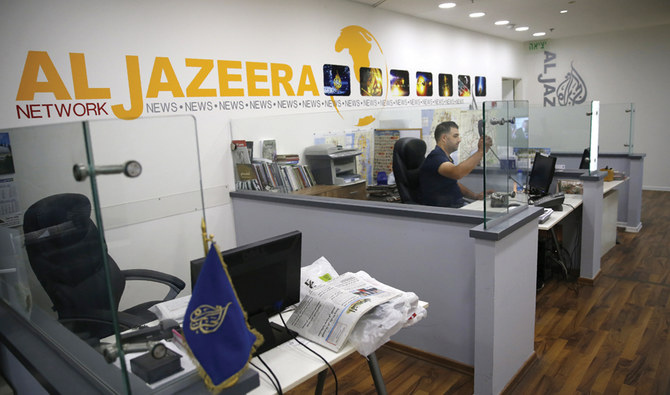

CHICAGO: Six Republican leaders of the House and Senate called for the expulsion of the Qatari-owned satellite television news network Al Jazeera accusing it of violating the Foreign Agents Registration Act (FARA).
Six GOP US senators including Charles Grassley of Iowa, Ted Cruz of Texas and Marco Rubio of Florida are demanding an investigation into why Al Jazeera is permitted to operate on American territory while two major Chinese government-controlled news agencies, Xinhua News Agency and China Global Television Network, are required to register under FARA.
The senators and representatives are calling for the Department of Justice to open hearings into Al Jazeera’s work in the US, accusing the government-owned Arabic and English-language news outlet of being an “agent” of the government of Qatar, which has been criticized as a safe haven and sponsor of the Muslim Brotherhood and other religious extremist groups. Qatar is also accused of being an ally of Iran.
“News articles have reported activities in which Al Jazeera Media Network (Al Jazeera) is engaged that raise legitimate questions about whether it should register as a foreign agent,” the letter addressed to US Attorney General William Barr argues.
“Al Jazeera is a global organization spanning dozens of countries, including the United States, and reaches hundreds of millions of people worldwide. In 2016, its offshoot, Al Jazeera America, closed. However, Al Jazeera expanded its digital presence via Al Jazeera Plus (AJ+), its online news channel which is headquartered in the United States.”
HIGHLIGHT
The senators and representatives are calling for the Department of Justice to open hearings into Al Jazeera’s work in the US, accusing it of being an ‘agent’ of the government of Qatar.
The letter, dated June 18, 2019, argues that Al Jazeera, founded in 1996, is owned and operated by members of the Qatari royal family.
“Al Jazeera’s videos on YouTube are stamped with the disclaimer, ‘Al Jazeera is funded in whole or in part by the Qatari government.’ Thus, Al Jazeera is not only a foreign principal, but it is also owned by a foreign principal – the government of Qatar,” the Congressional and Senate leaders claim.
“Several members of the ruling family of Qatar have held senior positions at Al Jazeera: Sheikh Hamad bin Thamer Al-Thani, a member of the ruling family of Qatar, is the chairman of Al Jazeera; Sheikh Abdulrahman bin Hamad bin Jassim bin Hamad Al-Thani is the CEO of Qatar Media Corporation and a board member of Al Jazeera; Sheikh Ahmed bin Jassim Al-Thani served as the director general of Al Jazeera from 2011 until June 2013.
“Given that members of the ruling family are in charge of managing the media network, it is more likely than not that the government can and will assert editorial control over media content.”
All of the signatories of the letter are outspoken critics of the Palestinian cause, and champions of Israel, and are among the largest recipients of campaign contributions from Israel’s American-based lobbying umbrella network, AIPAC (American Israel Public Affairs Committee). AIPAC, whose network donates hundreds of millions to the election campaigns of thousands of elected officials from senators all the way down to local legislators, is also not registered under FARA.
The letter comes as Qatari officials are launching a “charm offensive” to woo the administration of President Donald Trump. Trump is expected to meet in July with Qatari Emir Sheikh Tamim bin Hamad Al-Thani at the White House.
Critics, predominantly pro-Israel, have argued that Al Jazeera exploits its Arabic and English-language dual roles, embracing extremist and often anti-Semitic rhetoric in its Arabic broadcasts while softening language in its English online platforms.
In response to the criticism, Al Jazeera announced it was suspending two of its reporters for accusing Israel of being “the biggest winner from the Holocaust.”
Since its foundation, Al Jazeera has drifted further and further to the extreme. After its launch, it was banned from being broadcast or carried by many American-based cable TV systems that routinely carry news broadcasts from most other foreign countries including Israel. That changed after September 11, 2001, and Al Jazeera began to spend millions on opening offices in 12 American cities including in New York City in 2013.
Al Jazeera responded in a statement released to several US news outlets that it “is not owned by Qatar” and that “its reporting is not directed or controlled by the Qatari government nor does it reflect any government viewpoint.”