

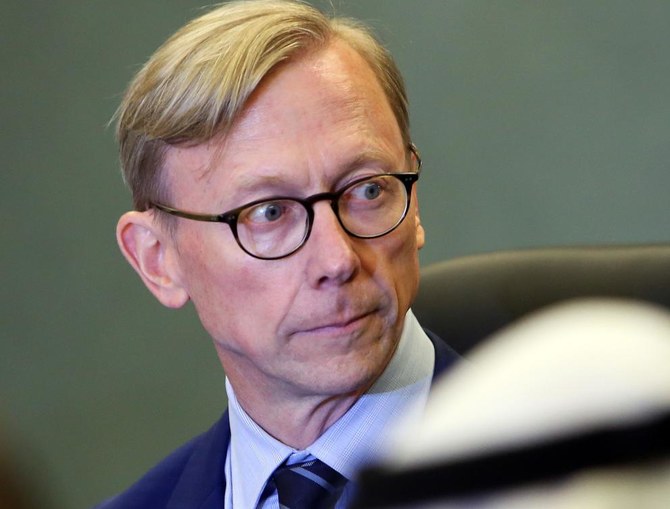

LONDON: US President Donald Trump is ready to talk to Iran about a deal that would lift American sanctions but Tehran would need to curtain its nuclear and missile program, as well as its support for proxies, US Special Representative on Iran Brian Hook said on Monday.
Hook told reporters that Iran could “come to the table or watch its economy crumble,” but declined to give more details about fresh US sanctions expected later on Monday.
Hook was speaking to media by telephone from Oman, where he is touring Gulf countries — including Saudi Arabia, the UAE and Kuwait — before heading to Paris for talks with his E3 counterparts.
#LIVE: US envoy on #Iran Brian Hook - 60% of oil shipped through #StraitofHormuz is for Asian markets. Iran's threats to maritime security make this is a "global issue that requires a global response" pic.twitter.com/Fna8DoMRBt
— Arab News (@arabnews) June 24, 2019
Hook told reporters that the US was looking to agree a treaty that would be ratified by the US Congress, saying the 2015 nuclear accord between Iran and world powers was flawed because it had no legal basis.
"This is a president who is very willing to sit down with the regime," Hook said, speaking by telephone from Oman, where he is touring Gulf countries before heading to Paris to explain U.S. policy to European powers. "I think the question people should be asking is ... why Iran continues to reject diplomacy."
The US withdrew last year from the 2015 accord under which Iran accepted curbs to its nuclear programme in return for the lifting of sanctions.
Last week the two countries came the closest in years to direct military confrontation after Iran shot down a US drone. Trump called off a retaliatory air strike minutes before impact.
#LIVE: US #Iran envoy Brian Hook: Sanctions have "weakened" Iran's ability to support its regional proxies, they must come to the negotiating table or "watch their economy continue to crumble" #IranSanctions pic.twitter.com/ZkG2IEYQKp
— Arab News (@arabnews) June 24, 2019
Hook, who accused Tehran of "violent responses to diplomatic pressure," said Iran could come to the negotiating table or watch its economy "continue to crumble."
"They are in a recession now, it is going to get significantly worse," he said ahead of an expected announcement later on Monday on further US sanctions.
He said there was no diplomatic contact, or back channel, between Washington and Tehran at present. Hook said elements of a deal with Tehran would need to involve an end to the arrest of dual nationals in Iran and an end to support for what he said were Iranian proxies in the Middle East who committed clandestine attacks on Iran's behalf.
#LIVE: US envoy Hook - Fresh US sanctions on #Iran to be announced later today, says “more may be coming” depending on nuclear moves, citing Iranian “blackmail” against remaining parties to JCPOA nuclear deal pic.twitter.com/sISjnpfAIM
— Arab News (@arabnews) June 24, 2019


