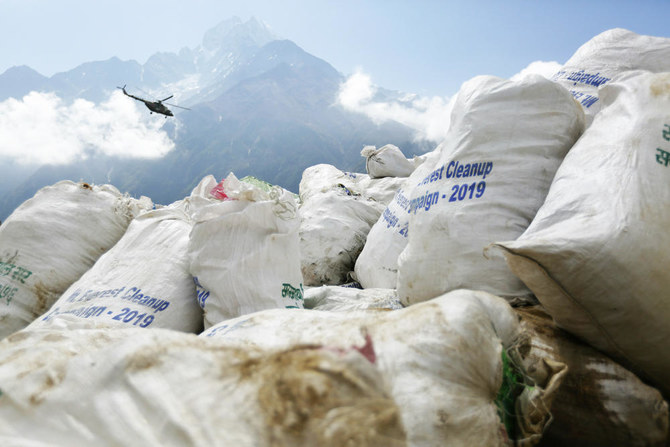
KATMANDU, Nepal: After every party it’s time to clean up and Mount Everest is no different. The record number of climbers crowding the world’s highest mountain this season has left a government cleanup crew grappling with how to clear away everything from abandoned tents to human waste that threatens drinking water.
Budget expedition companies charge as little as $30,000 per climber, cutting costs including waste removal. Everest has so much garbage — depleted oxygen cylinders, food packaging, rope — that climbers use the trash as a kind of signpost. But this year’s haul from an estimated 700 climbers, guides and porters on the mountain has been a shock to the ethnic Sherpas who worked on the government’s cleanup drive this spring.
Moreover, the tents are littering South Col, or Camp 4, which, at 8,000 meters (26,240 feet) is the highest campsite on Everest, just below the summit. The high winds at that elevation have scattered the tents and trash everywhere.
“The altitude, oxygen levels, dangerously icy and slippery slopes, and bad weather of South Col make it very difficult to bring such big things as tents down,” said Dawa Steven Sherpa, who led an independent cleanup last month and has been a leading figure in the campaign to clean Mount Everest for the past 12 years.
Exhausted climbers struggling to breathe and battling nausea leave heavy tents behind rather than attempt to carry them down. Sherpa said the logos on the ice-embedded tents that identify the expedition companies were deliberately ripped out so the culprits could evade detection.
“It took us an hour to dig out just one tent out of the frozen ice and bring it down,” said Sherpa. His expeditions have alone brought down some 20,000 kilograms (44,000 pounds) of garbage since 2008.
Sherpa estimated 30 tents had been left on South Col, and as much as 5,000 kilograms (11,000 pounds) of trash. Bringing it down is a herculean task when any misstep at such altitudes could be fatal.
It is impossible to know exactly how much litter is spread across Everest because it only becomes visible when the snow melts. At Camp 2, two levels higher than Base Camp, the campaigners believe that around 8,000 kilograms (17,637 pounds) of human excrement were left during this year’s climbing season alone.
Some climbers do not use makeshift toilets, instead digging a hole in the snow, letting the waste fall into small crevasses. However, rising temperatures have thinned the glacier, leaving fewer and smaller crevasses. The overflowing waste then spills downhill toward Base Camp and even communities below the mountain.
People living at the Base Camp use melted snow for drinking water that climbers’ toilets threaten to contaminate.
“During our expedition to Camp 2, eight of our 10 Sherpas got stomach illness from bad water at Camp 2,” said John All, a professor of environmental science at Western Washington University who visited Everest on a research expedition.
For the Nepalese who regard the mountain as “Sagarmatha,” or Mother of the World, littering amounts to desecration. Climber Nima Doma, who returned recently from a successful ascent, gets angry thinking that the sacred mountain is being turned into a garbage dump.
“Everest is our god and it was very sad to see our god so dirty. How can people just toss their trash on such a sacred place?” she said.
The trash is creating danger for future climbers and spurring calls for action now.
“When the snow melts the garbage surfaces. And when there is high wind, tents are blown and torn and the contents are scattered all over the mountain, which makes it even more dangerous for climbers already navigating a slippery, steep slope in snow and high winds,” said Ang Tshering, former president of Nepal Mountaineering Association.
Ang Dorjee, who heads the independent Everest Pollution Control Committee, has demanded that the Nepal government — whose general oversight of Everest has come under scrutiny this year as climbers died waiting in line to ascend — institute some rules.
“The problem is there are no regulations on how to dispose of the human waste. Some climbers use biodegradable bags that have enzymes which decompose human waste but most of them don’t,” he said.
The bags are expensive and have to be imported from the United States.
“The biggest problem and concern now on Everest is human waste. Hundreds of people are there for weeks who go to open toilets,” Tshering said. Melting conditions at Camp 2 create a odor that is sickening to climbers, and the waste will eventually contaminate water sources below and become a health hazard, he said.
Tshering and other mountaineers say the government should mandate the use of biodegradable bags. It would spare Dorjee and his team the unpleasant task of collecting the waste and carrying it down the dangerous slopes.
The government is working on a plan to scan and tag climbers’ equipment and gear. All climbers would have to deposit $4,000 before their ascent and might not get the money back if they return without their items.


![]()
![]()
![]()

Abandoned tents, human waste piling up on Mount Everest

Abandoned tents, human waste piling up on Mount Everest
- Sherpa estimated 30 tents had been left on South Col, and as much as 5,000 kilograms (11,000 pounds) of trash
- Budget expedition companies charge as little as $30,000 per climber, cutting costs including waste removal


Latest updates


Recommended


© 2026 SAUDI RESEARCH & PUBLISHING COMPANY, All Rights Reserved And subject to Terms of Use Agreement.