Internet blackout imposed on Myanmar's restive Rakhine state

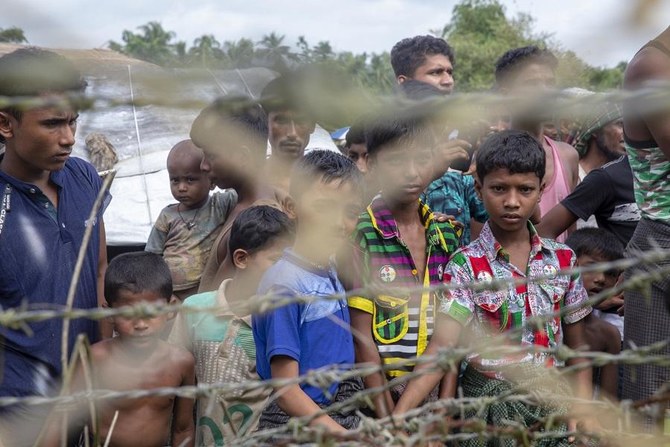
Rohingya refugees gather near the fence in the "no man's land" zone between Myanmar and Bangladesh border as seen from Maungdaw, Rakhine state during a government-organized visit for journalists on August 24, 2018. (AFP)
Updated 23 June 2019
Follow

Internet blackout imposed on Myanmar's restive Rakhine state

  • "As a basis for its request, the MoTC has referenced disturbances of the peace and internet services to coordinate illegal activities," Telenor Myanmar said
  • Myanmar's army is fighting ethnic Rakhine rebels who want greater autonomy from the central state

YANGON: An unprecedented shutdown of mobile data across swathes of Myanmar's restive Rakhine state entered a third day Sunday, blocking villagers from the internet in areas where the army is accused of abuses in its battle with ethnic rebels.
Myanmar's Ministry of Transport and Communications (MoTC) ordered all mobile phone operators on Friday to suspend internet data in nine townships across Rakhine and neighbouring Chin State.
"As a basis for its request, the MoTC has referenced disturbances of the peace and internet services to coordinate illegal activities," Telenor Myanmar said in a statement.
The decree was made under the Telecommunications Law, hitting all mobile operators for an unspecified period.
Myanmar's army is fighting ethnic Rakhine rebels who want greater autonomy from the central state. The Rakhine are Buddhists and are also fighting in northern Chin state which borders their homeland.
The Rakhine accuse the army of committing abuses -- including arbitrary arrests -- against them, while the military confirmed it shot dead six Rakhine detainees in late April.
Civilians have been killed in crossfires and shellings, even while taking refuge in monasteries.
Villagers in Rakhine said the mobile data ban had cut them off from the outside world, where few have personal computers and most people share information on the violence through social media.
"We have no internet at all. We use the internet to share information through (messaging app) Viber," Kyaw Soe Moe, head of Inn Din village in Rathedaung told AFP.
Local authorities have also been hit by the blanket shutdown.
A police officer in Mrauk U town, home to Rakhine temples but also the seat of ferocious fighting in recent months, said that communication was being hampered.
"We have to use the phone, SMS and fax to report back to our headquarters. Fighting is still on going here every day," the officer who did not want to be named told AFP.
Rakhine is also home to the remaining Rohingya Muslim population, many confined to squalid camps.
Around 740,000 of the stateless group were driven into Bangladesh in a 2017 army crackdown.


Philippines signs free trade pact with UAE

Updated 4 sec ago
Follow

Philippines signs free trade pact with UAE

  • UAE deal is Philippines’ fourth free trade pact, after South Korea, Japan, and EFTA
  • Business body warns of uneven gains if domestic safeguard mechanisms insufficient

MANILLA: The Philippines signed on Tuesday a comprehensive economic partnership agreement with the UAE, its first such deal with a Middle Eastern nation.

The Philippines and the UAE first agreed to explore a free trade pact in February 2022 and formalized the process with terms of reference in late 2023. Negotiations started in May 2024 and were finalized in 2025.

The CEPA signing was witnessed by President Ferdinand R. Marcos Jr. who led the Philippine delegation to Abu Dhabi.

“The CEPA is the Philippines’ first free trade pact with a Middle Eastern country, marking a milestone in expanding the nation’s global trade footprint,” Marcos’s office said.

“The agreement aims to reduce tariffs, enhance market access for goods and services, increase investment flows, and create new opportunities for Filipino professionals and service providers in the UAE.”

The UAE is home to some 700,000 Filipinos, the second-largest Filipino diaspora after Saudi Arabia.

With bilateral trade worth about $1.8 billion, it is also a key trading partner of the Philippines in the Middle East, and accounted for almost 39 percent of Philippine exports to the region in 2024.

The Philippine Department of Trade and Industry earlier estimated it would lead to at least 90 percent liberalization in tariffs and give the Philippines wider access to the GCC region.

“Preliminary studies indicate the CEPA could boost Philippine exports to the UAE by 9.13 percent, generate consumer savings, and strengthen overall trade linkages with the Gulf region,” Marcos’s office said.

The Philippine Chamber of Commerce and Industry-Makati expects the pact to bring stronger trade flows, capital and technology for renewable energy, infrastructure, food, and water security projects as long as domestic policy supports it.

“CEPA can serve as a trade accelerator and investment catalyst for the Philippines,” Nunnatus Cortez, the chamber’s chairman, told Arab News.

The pact could result in “expanding exports, attracting capital, diversifying economic partners, upgrading industries, and supporting long-term growth — provided the country actively supports exporters and converts provisions into concrete commercial outcomes,” said Cortez.

“The main downside risk of CEPA lies in domestic readiness. Without strong industrial policy, MSME (Micro, Small and Medium Enterprises) support, safeguard mechanisms, and export development, CEPA could lead to import dominance, uneven gains, fiscal pressure, and limited structural transformation.”

The deal with the UAE is the Philippines’ fourth bilateral free trade pact, following agreements with South Korea, Japan, and the European Free Trade Association, which comprises Iceland, Liechtenstein, Norway, and Switzerland.