

Workers sent home as India’s IT capital runs out of water

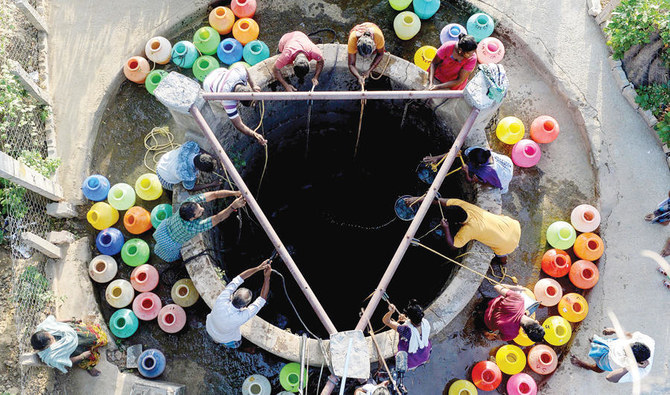
People get water from a community well in Chennai, southern India. (AFP)
Updated 22 June 2019
Follow

Workers sent home as India’s IT capital runs out of water

  • ‘Man-made drought’ leaves 5 million people in Chennai facing severe restrictions
  • ‘Man-made drought’ leaves 5 million people in Chennai facing severe restrictions

NEW DELHI: Workers in the southern Indian city of Chennai are being told to work from home to save water as the country’s sixth-biggest city grapples with its worst-ever water crisis.
The city’s five major reservoirs are now all but empty following two failed monsoons, leaving more than 5 million people facing severe water restrictions.
Growing unrest over increasingly tight restrictions has led to protests and up to 500 arrests.
Chennai, known as the “Detroit of India,” is home to one-third of the country’s automobile industry, and is also an IT hub with more than 500 national and multinational firms.
The drought has forced leading multinational companies to issue open instructions to employees to cut back on water use. Some IT companies have also asked about a fifth of their employees to work from home in order to save water.
Italian auto giant Fiat Chrysler and multinational IT firms such as Tata Consultancy Services, Wipro and Cognizant have told employees to reduce water usage in canteens and restrooms.
The US-listed Cognizant Technology Solutions has instructed thousands of employees to reduce water use in its canteen and gym.
“We have also switched to biodegradable plates in our cafeterias, closed shower facilities in our gyms, and minimized washing of utensils by cafeteria vendors,” the firm said.
Vinod A, general secretary of the Forum for IT Employees, told Arab News that “some major IT companies have suggested employees work from home till the water crisis is solved.”
The Madras high court on Wednesday attacked the Tamil Nadu government for failing to take adequate measure to address Chennai’s water crisis.
In lower-middle-class areas of the city, the municipality is supplying water only twice a week.

BACKGROUND

The drought has forced leading multinational companies to issue open instructions to employees to cut back on water use.

Sunitha, a homemaker from Chitlapakam, said that “piped water now comes only twice a week and we cannot survive with that.”
The city requires 800 million liters of water every day, but Chennai Municipal Corporation is supplying less than 500 million liters.
The deficit is filled by private tankers, which charge more than 5,000 rupees ($71) for each supply — almost 10 times higher than recent prices.
Around 100 hostels housing young professionals and students from different parts of India have been forced to close in the past month.
Chennai is dependent on five lakes for its water supply, but all have gone dry as a result of two failed monsoons in the past two years.
Tamil Nadu Chief Minister Edappadi Palaniswami blamed the media for “blowing the situation out of proportion.”
“By October, when the rain starts, the problem will be over,” he said.
Professor S. Janakarajan, of the Madras Institute of Development Studies, said: “This is a man-made drought. The crisis is due to the lack of application of mind and negligence on the part of the government.
“Despite the failure of two consecutive monsoons, the government failed to devise a plan to find another source of water for this expanding city.
“The only immediate option for the government is to get ground water from wherever it is available,” he added.


India accelerates free trade agreements against backdrop of US tariffs

Updated 21 December 2025
Follow

India accelerates free trade agreements against backdrop of US tariffs

  • India signed a CEPA with Oman on Thursday and a CETA with the UK in July 
  • Delhi is also in advanced talks for trade pacts with the EU, New Zealand, Chile 

NEW DELHI: India has accelerated discussions to finalize free trade agreements with several nations, as New Delhi seeks to offset the impact of steep US import tariffs and widen export destinations amid uncertainties in global trade. 

India signed a Comprehensive Economic Partnership Agreement with Oman on Thursday, which allows India to export most of its goods without paying tariffs, covering 98 percent of the total value of India’s exports to the Gulf nation. 

The deal comes less than five months after a multibillion-dollar trade agreement with the UK, which cut tariffs on goods from cars to alcohol, and as Indian trade negotiators are in advanced talks with New Zealand, the EU and Chile for similar partnerships. 

They are part of India’s “ongoing efforts to expand its trade network and liberalize its trade,” said Anupam Manur, professor of economics at the Takshashila Institution. 

“The renewed efforts to sign bilateral FTAs are partly an after-effect of New Delhi realizing the importance of diversifying trade partners, especially after India’s biggest export market, the US, levied tariff rates of up to 50 percent on India.” 

Indian exporters have been hit hard by the hefty tariffs that went into effect in August. 

Months of negotiations with Washington have not clarified when a trade deal to bring down the tariffs would be signed, while the levies have weighed on sectors such as textiles, auto components, metals and labor-intensive manufacturing. 

The FTAs with other nations will “help partially in mitigating the effects of US tariffs,” Manur said. 

In particular, Oman can “act as a gateway to other Gulf countries and even parts of Eastern Europe, Central Asia, and Africa,” and the free trade deal will most likely benefit “labor-intensive sectors in India,” he added. 

The chances of concluding a deal with Washington “will prove to be difficult,” said Arun Kumar, a retired economics professor at the Jawaharlal Nehru University.

“With the US, the chances of coming to (an agreement) are a bit difficult, because they want to get our agriculture market open, which we cannot do. They want us to reduce trade with Russia. That’s also difficult for India to do,” he told Arab News.  

US President Donald Trump has threatened sanctions over India’s historic ties with Moscow and its imports of Russian oil, which Washington says help fund Moscow’s ongoing war with Ukraine.

“President Trump is constantly creating new problems, like with H-1B visa and so on now. So some difficulty or the other is expected. That’s why India is trying to build relationships with other nations,” Kumar said, referring to increased vetting and delays under the Trump administration for foreign workers, who include a large number of Indian nationals. 

“Substituting for the US market is going to be tough. So certainly, I think India should do what it can do in terms of promoting trade with other countries.” 

India has free trade agreements with more than 10 countries, including comprehensive economic partnership agreements with South Korea, Japan, and the UAE.

It is in talks with the EU to conclude an FTA, amid new negotiations launched this year for trade agreements, including with New Zealand and Chile.  

India’s approach to trade partnerships has been “totally transformed,” Commerce and Industry Minister Piyush Goyal said in a press briefing following the signing of the CEPA with Oman, which Indian officials aim to enter into force in three months. 

“Now we don’t do FTAs with other developing nations; our focus is on the developed world, with whom we don’t compete,” he said. “We complement and therefore open up huge opportunities for our industry, for our manufactured goods, for our services.”