ISLAMABAD: Pakistan’s former president Asif Ali Zardari on Thursday said he was ready to extend a helping hand to the government to fix the country’s crumbling economy while demanding an end to the victimization of his opposition Pakistan Peoples Party party through what he said was selective and politically motivated accountability.
Zardari, the widower of the assassinated former prime minister Benazir Bhutto, addressed the National Assembly for the first time after his arrest on money laundering charges by an anti-corruption watchdog on June 10.
“Let us sit together to talk about an economic policy,” the former president said on the floor of the house while the budget for fiscal year to June 2020 was being debated, adding that governments “keep changing, but let us make an economic policy that withstands all these changes.”
Participating in the budget debate, Zardari advised the government to “stop accountability” and move forward.
“My arrest doesn’t make any difference [to my party], but the average Pakistani is scared that if Mr. Zardari can be arrested, what will happen to him,” he said.
Reacting to Zardari’s statement, former finance minister of the ruling Pakistan Tehreek-e-Insaf party Asad Umar said accountability for political reasons was “neither good for the country nor for the person doing it.”
However, he added that it was the constitutional responsibility of parliament to hold criminals and corrupt elements accountable.
“If someone has stolen the country’s money, then there must be a system of reward and punishment for it. There is no politics in it,” Umar said.
Following a week of ruckus in the National Assembly, opposition parties and the government agreed on Wednesday not to disrupt the debate on the proposed federal budget presented by the PTI government on June 11.
“We completely reject this budget [which is like] a sword slitting the common man’s throat,” Shehbaz Sharif, leader of opposition in the National Assembly, said on Wednesday in a three-hour-long speech.
The federal budget is expected to be approved by the National Assembly next week.

Ex-president Zardari says willing to help government fix ailing economy
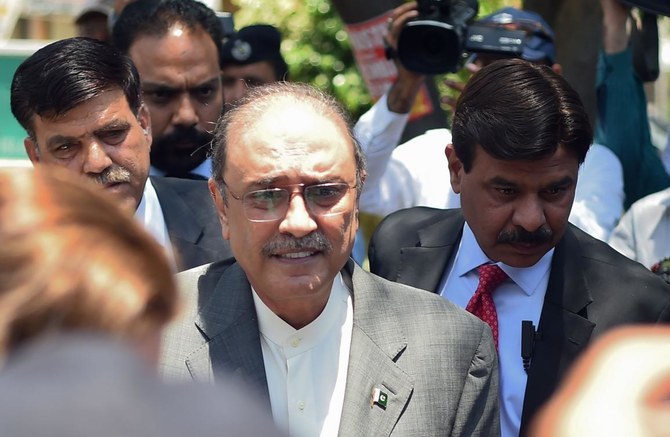
- Addresses Pakistan’s National Assembly for first time since his arrest on money laundering charges on June 10
- The federal budget is expected to be approved by parliament next week
Pakistan passes Virtual Assets Act 2026, empowers regulator to combat money laundering
- Legislation introduces licensing for virtual asset service providers, market surveillance mechanisms
- Pakistan is one of the world’s top cryptocurrency markets, with millions actively using virtual assets
KARACHI: Pakistan’s parliament on Friday passed the Virtual Assets Act 2026, granting the Pakistan Virtual Assets Regulatory Authority (PVARA) powers to combat money laundering, militant financing and other illicit activities, the regulator said.
The legislation introduces regulatory provisions including mandatory licensing for virtual asset service providers, market surveillance mechanisms, anti-money laundering and counter-terrorism financing compliance, and coordination with Pakistani financial regulators including the State Bank of Pakistan and the Securities and Exchange Commission of Pakistan.
Pakistan has in recent months stepped up efforts to draft rules for regulating the fast-expanding market for digital coins and tokens, requiring virtual asset service providers to secure government approval. Islamabad’s move to embrace digital currency marks a significant policy shift as it had banned cryptocurrency in 2018, citing financial risks.
“A year ago, Pakistan’s digital asset landscape was defined by uncertainty and grey areas. Today, we have the country’s first Act of Parliament establishing a regulatory body for virtual assets, building on the Presidential Ordinance introduced in 2025,” PVARA Chairman Bilal bin Saqib said in a post on X.
“With NOCs [no objection certificates] already issued and banking rails being developed in coordination with the State Bank of Pakistan, we are now moving toward a comprehensive licensing framework aligned with global AML [anti-money laundering] and financial integrity standards.”
Meanwhile, PVARA said the framework aims to boost transparency, protect investors, and ensure a stable, trustworthy virtual asset market while supporting responsible fintech innovation.
“The legislation also equips the Authority with powers to address money laundering, terrorist financing, and other illicit activities associated with virtual assets, bringing Pakistan’s regulatory approach in line with international standards,” it added.
Pakistan ranks among the world’s largest cryptocurrency markets by adoption, with millions of citizens actively engaged in virtual assets.
In February, Dr. Afnanullah Khan, a Pakistani senator from the ruling party, had said major crypto coins such as Bitcoin, Ethereum and XRP will soon be traded in Pakistan through crypto exchanges.
Pakistan earlier launched a “regulatory sandbox” for firms to trial crypto services under PVARA’s supervision before full approval.
In January, Pakistan signed a memorandum of understanding with a World Liberty Financial-linked firm, tied to US President Donald Trump’s family, to explore a dollar-backed stablecoin for cross-border payments.


