

Turkey sentences 24 to life in ‘coup ringleaders’ trial

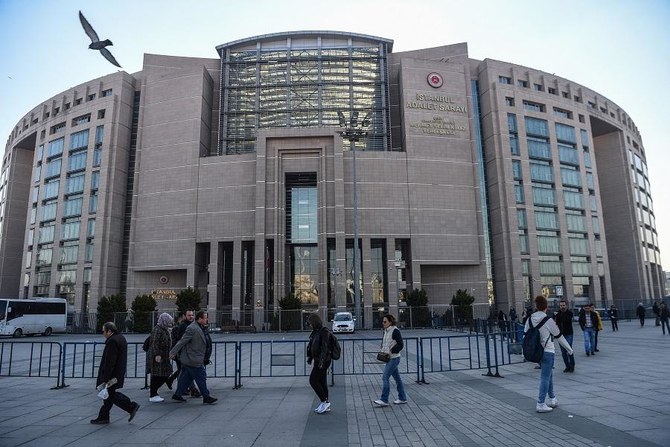
People walk by Istanbul's courthouse on March 26, 2019, during the trial of a US consulate staffer accused of spying and attempting to overthrow the government. (AFP)
Updated 20 June 2019
Follow

Turkey sentences 24 to life in ‘coup ringleaders’ trial

  • Of the 24 on trial, 17 received 141 aggravated life terms
  • The trial began in May 2017

SINCAN, Turkey: A Turkish court on Thursday gave life sentences to 24 people in one of the biggest trials over the 2016 failed bid to overthrow President Recep Tayyip Erdogan, state media reported.

Of the 24, the judge gave 17 accused 141 aggravated life terms each over the deaths of 139 people, for “violating the constitution” and “attempting to assassinate the president,” state news agency Anadolu reported.

Such sentences carry harsher prison conditions.

Former air force chief Akin Ozturk and Mehmet Disli, the brother of former ruling party lawmaker Saban Disli, who since September has served as Turkey’s ambassador to the Netherlands, were among the 17.

There was a tense atmosphere minutes before the judge issued his verdicts with dozens of people including relatives of those killed during the coup bid in July 2016, lambasting the court for not allowing them to enter.

Saliha Arigan, whose son was killed on the night of the failed overthrow, pressed herself against the gates, crying and shouting to be allowed inside.

“The state should be ashamed,” she said. Even as the verdicts were handed down, the strained mood continued with further attempts by individuals to enter the courtroom complex by force.

An AFP correspondent was not allowed to enter the courtroom by police.

The trial began in May 2017 in the country’s largest courtroom inside a prison complex in Sincan, outside the capital Ankara.

The court also handed down an aggravated life sentence for “violating the constitution” to Col. Ali Yazici, Erdogan’s former military aide, Anadolu reported.

Yazici was sentenced before to 18 years in jail in 2017 after a trial of dozens who plotted to assassinate Erdogan at a luxury Aegean hotel during the coup attempt.

More verdicts are expected from the trial.

Among the total 224 suspects on trial in Sincan over the coup bid was US-based Muslim preacher Fethullah Gulen, who Turkey accuses of ordering the attempted putsch.

Gulen, who strongly denies the claims, is being tried in absentia as Turkey has failed to secure his extradition.

The judge ordered the case of 13 fugitives including Gulen to be separated from the main coup ringleaders’ trial.

The failed overthrow left 248 people dead, according to the Turkish presidency, not including 24 coup-plotters killed on the night.

Nearly 290 coup-linked court cases have been launched, 261 of which ended with 3,239 defendants convicted, according to justice ministry figures given to AFP before the verdicts.


Israel bars some aid workers from Gaza as groups face suspension

Updated 4 sec ago
Follow

Israel bars some aid workers from Gaza as groups face suspension

  • NGOs ordered to cease operations unless they give employee details to Israel
  • MSF and others denied entry, impacting key medical services in Gaza
GENEVA/CAIRO/JERUSALEM: Israel said on Thursday it had barred entry to Gaza of foreign medical and humanitarian staff whose organizations ​were ordered to cease operations unless they register employee details with Israeli authorities and meet other new rules.
Fearing a renewed humanitarian crisis if medical and aid services can suddenly no longer access war-shattered Gaza, some of the 37 international nongovernmental organizations that were ordered to halt work are weighing whether to submit staff names to Israeli authorities, two aid sources told Reuters.
Three of the aid groups said their foreign staff were told by Israeli authorities this week they could not enter Gaza.
Israel’s diaspora ministry, which manages the registration process, says the measures are meant to prevent diversions of aid by Palestinian armed groups. NGOs say sharing staff details poses too much of a risk, pointing to the hundreds of aid workers who were killed or injured ‌during the two-year ‌Gaza war.
Israel has shared little evidence of aid being diverted in the Palestinian enclave, ‌an ⁠allegation ​that was ‌disputed in a US government analysis.
The diaspora ministry said that while the NGOs had been granted 60 days to conclude operations, “the entry of foreign personnel into Gaza is not approved.” It said international staff with “approved organizations” including the United Nations could continue work as usual.
Three prominent global NGOs — Medecins Sans Frontieres (MSF), Medecins du Monde Suisse and the Danish Refugee Council — said their international staff were refused entry to Gaza this week. Foreign aid staff had generally been permitted to rotate in and out of Gaza since the start of the war.
“If we don’t have somebody in a key position, such as the emergency coordinator in charge of operations, then we either have to ⁠compensate, or we have a gap” in aid service, said Anna Halford, Gaza emergency coordinator at MSF.

'System breaks down'

Israel’s government said some 23 aid groups ‌had agreed to the new registration rules, meaning humanitarian goods will continue to get ‍into Gaza.
But a UN-led coordination body has said the ‍international groups that have registered could meet only a fraction of the required humanitarian response in the devastated Gaza Strip, where ‍homelessness and hunger remain rife.
Some of the 37 banned groups operate specialized services like field hospitals, aid officials say. MSF bolsters six Gaza health ministry hospitals and runs two field hospitals. The Medicos del Mundo NGO screens Gaza residents for malnutrition and provides mental health services.
“Without nutritional staff doing the screening and primary health care centers doing the therapeutic feeding and referral of patients with severe malnutrition to in-patient care — the whole system ​breaks down,” an aid source told Reuters.
Fearing the loss of those essential services for Gaza’s two million residents, some aid groups are considering reversing course and agreeing to the new registration rules.
“The essence of ⁠the debate (for aid groups) is how to safeguard their principles, humanitarian standards, and the safety of the local staff while being able to continue the services,” a senior aid source said.
COGAT, the Israeli defense ministry unit that controls access to Gaza, said the NGOs’ conduct “raises suspicion regarding the parties with whom they operate” in Gaza, but they remained free to register with the diaspora ministry.

'Everything is missing'

Samira Al-Ashqar, 40, who fled her Beit Lahia home to Al-Ansar camp in north Gaza with her disabled husband and nine others during the war, depends on Oxfam — one of the aid groups facing an Israeli ban — for food and financial support.
“Now, after the war, everything is missing, and things have become dire ... If these institutions were to stop, the people of Gaza would face complete devastation,” Al-Ashqar said.
Mohamed Abu Selmia, head of Gaza’s Al Shifa Hospital, told Reuters the banning of groups like MSF could affect hundreds of thousands of people.
“The Israeli occupation’s decision comes at a time of unprecedented deterioration in health conditions. We suffer acute shortages of medication that ‌reach 100 percent in some areas, and 55 percent overall,” he said.
MSF said an Israeli ban could also mean that foreign aid groups would no longer be able to pay local staff in Gaza because Israel could block bank transfers.