CAIRO: The Arab Parliament announced on Wednesday that it has designated the Iranian-backed Houthi militia as a terrorist group for its role in deliberately targeting civilians and civilian installations, calling on the League of Arab States and the UN to take similar action.
The resolution was issued during an Arab Parliament meeting in Cairo in the wake of the “terrorist attack on civilian installations in Saudi Arabia and commercial vessels in the territorial waters of the United Arab Emirates and the Sea of Oman,” reported the Saudi Press Agency (SPA).
The Arab Parliament called on the UN and the Security Council to adopt a firm and immediate position to classify the Houthi militia as a terrorist organization; for its flagrant violation of international law and its deliberate targeting of civilian and vital installations in Saudi Arabia with ballistic missiles and aircraft.
It also called on the world body to also pursue its leaders, financiers and supporters, whether they are states or groups.
Meshaal bin Fahm Al-Sulami, spokesperson of the Arab Parliament, said the Parliament will not condone any group targeting civilian areas, such as the Houthi attacks on neighboring countries like Saudi Arabia.
“These attacks are a war crime,” he said.
He also mentioned that the Houthis are threatening Yemeni MPs for attending parliament sessions. The parliament condemned in the strongest terms the Houthi attack targeting two oil pumping stations in Saudi Arabia and the Kingdom’s Abha International Airport in the southwest.
It also condemned the sabotage of four commercial vessels of a number of countries near the UAE’s territorial waters and two vessels for transporting oil in the Sea of Oman, affirming its full solidarity with Saudi Arabia and the UAE in maintaining their security and stability and the measures they take to protect their security and the safety of their citizens.
The Arab Parliament denounced Iran’s negative interference in the internal affairs of Arab countries, directly or indirectly, as well as threatening to close the Strait of Hormuz, which is an international strait for international navigation and can not be attacked or harmed, or to mobilize its terrorist organizations within Arab countries to destabilize security and stability.
The parliament also denounced the continued launching of Iranian-made ballistic missiles by the Houthi militia on Saudi Arabia, which has seen more than 225 rockets launched toward the Kingfom and have even targeted toward the holy city of Makkah.
The Arab Parliament gave its full support for the resolutions issued by the Arab emergency summit held in Makkah in May, calling on the Arab League to raise the issue of Iranian threats and its interference in the internal affairs of Arab countries to the UN Security Council to halt these interventions.
The Parliament called on the UN Security Council, the UN General Assembly and the Inter-Parliamentary Union to shoulder their responsibilities toward Iran’s violation of Yemen’s sovereign rights and the smuggling of weapons and ballistic missiles to the Houthi militia with the aim of destabilizing the region and maintaining chaos. It also urged the UN to compel Iran to comply with Security Council Resolution 2216, which prohibits the supply of arms to the Houthis.
The Arab Parliament also condemned the continuing Iranian interference in Bahrain’s internal affairs, including the formation and support of militias, supporting extremist groups and terrorist organizations, training terrorists, supplying weapons and fueling sectarianism to destabilize security and stability in the kingdom.
It also condemned Iran’s continued occupation of three occupied islands of the United Arab Emirates: Greater Tunb, Lesser Tunb and Abu Musa, and stressed its full support for the UAE in all its actions to restore its three islands.
The Arab Parliament appreciated the leading and pivotal role played by Saudi Arabia and the great efforts of King Salman to host the two Arab and Gulf emergency summits in Makkah on May 29.


![]()

Arab Parliament classifies Houthis as a terrorist group, calls on UN and Arab League to do the same
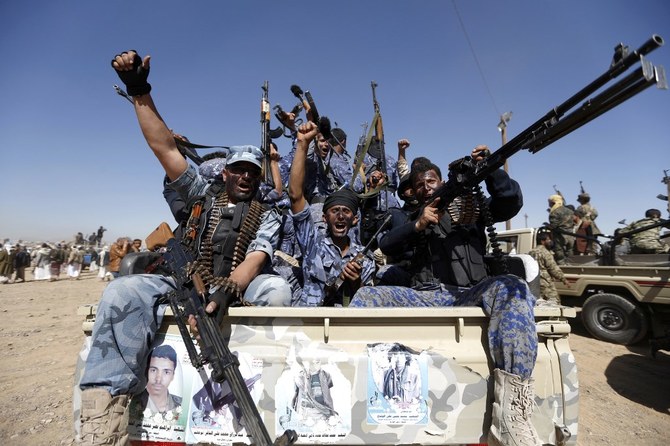
Arab Parliament classifies Houthis as a terrorist group, calls on UN and Arab League to do the same
- The Parliament voted on the draft resolution before submitting it to the UN and Arab League
- The spokesperson called the Houthi attacks a war crime


Latest updates


© 2026 SAUDI RESEARCH & PUBLISHING COMPANY, All Rights Reserved And subject to Terms of Use Agreement.