China completes outer dome on overseas Hualong One reactor in Pakistan

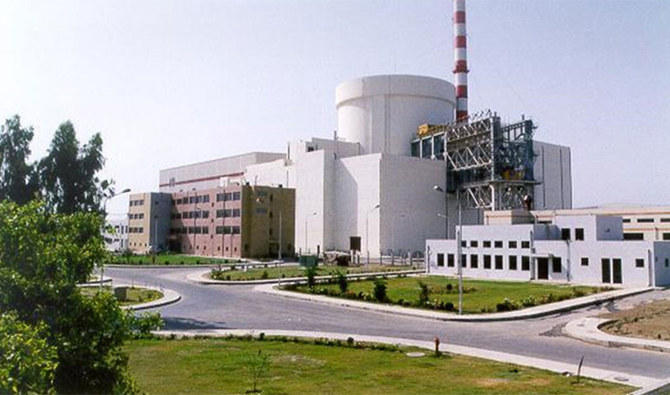
The completion of the double-layered steel dome on the containment building of the Karachi 2 nuclear power plant in Pakistan as a milestone that would help demonstrate China’s Hualong One technology worldwide.. Photo Courtesy: Social Media
Updated 20 June 2019
Follow

China completes outer dome on overseas Hualong One reactor in Pakistan

  • World's first Hualong One reactor is set to go into operation ahead of schedule
  • China is hoping to use its third-generation Hualong One design to boost its presence overseas

SHANGHAI: China has finished building the outer safety dome at its first overseas “Hualong One” nuclear reactor in Pakistan, with the project scheduled to be finished by the end of 2020, the China National Nuclear Corp. (CNNC) said late Tuesday.
China is hoping to use its third-generation Hualong One design to boost its presence in the overseas nuclear power sector and it is already making plans to build projects in Argentina and Britain.
CNNC described the completion of the double-layered steel dome on the containment building of the Karachi 2 nuclear power plant in Pakistan as a milestone that would help demonstrate China’s Hualong One technology worldwide. The firm is building two Hualong One units at the site.
China developed the Hualong One reactor as a rival to the Westinghouse-developed AP1000 and Europe’s “Evolutionary Pressurised Reactor,” with both models beset by cost overruns and construction delays.
The world’s first Hualong One reactor is set to go into operation ahead of schedule in the southeast Chinese province of Fujian late next year.
CNNC said its four demonstration projects in China and Pakistan are progressing in an orderly manner, noting that they “are the only third-generation pressurised water reactor projects in the world that are being constructed on schedule.” 


Pakistan reports current account surplus in Jan. owing to improved trade, remittances

Updated 4 sec ago
Follow

Pakistan reports current account surplus in Jan. owing to improved trade, remittances

  • Pakistan’s exports crossed the $3 billion mark in Jan. as the country received $3.5 billion in remittances
  • Last month, IMF urged Pakistan to accelerate pace of structural reforms to strengthen economic growth

ISLAMABAD: Pakistan recorded a current account surplus of more than $120 million in January, the country’s finance adviser said on Tuesday, attributing it to improved trade balance and remittance inflows.

Pakistan’s exports rebounded in January 2026 after five months of weak performance, rising 3.73 percent year on year and surging 34.96 percent month on month, according to data released by the country’s statistics bureau.

Exports crossed the $3 billion mark for the first time in January to reach $3.061 billion, compared to $2.27 billion in Dec. 2025. The country received $3.5 billion in foreign remittances in Jan. 2026.

Khurram Schehzad, an adviser to the finance minister, said Pakistan reported a current account surplus of $121 million in Jan., compared to a current account deficit of $393 million in the same month last year.

“Improved trade balance in January 2026, strong remittance inflows, and sustained momentum in services exports (IT/Tech) continue to reinforce the country’s external account position,” he said on X.

Pakistan has undergone a difficult period of stabilization, marked by inflation, currency depreciation and financing gaps, and international rating agencies have acknowledged improvements after Islamabad began implementing reforms such as privatizing loss-making, state-owned enterprises (SOEs) and ending subsidies as part of a $7 billion International Monetary Fund (IMF) loan program.

Late last month, the IMF urged Pakistan to accelerate the pace of these structural reforms to strengthen economic growth.

Responding to questions from Arab News at a virtual media roundtable on emerging markets’ resilience, IMF’s director of the Middle East and Central Asia Jihad Azour said Islamabad’s implementation of the IMF requirements had been “strong” despite devastating floods that killed more than 1,000 people and devastated farmland, forcing the government to revise its 4.2 percent growth target to 3.9 percent.

“What is important going forward in order to strengthen growth and to maintain the level of macroeconomic stability is to accelerate the structural reforms,” he said at the meeting.

Azour underlined Pakistan’s plans to privatize some of the SOEs and improve financial management of important public entities, particularly power companies, as an important way for the country to boost its capacity to cater to the economy for additional exports.

“This comes in addition to the effort that the authorities have made in order to reform their tariffs, which will allow the private sector of Pakistan to become more competitive,” the IMF official said.