SACRAMENTO, California: Gov. Gavin Newsom formally apologized Tuesday and pushed the state to reckon with California’s dark history of violence, mistreatment and neglect of Native Americans, saying it amounted to genocide.
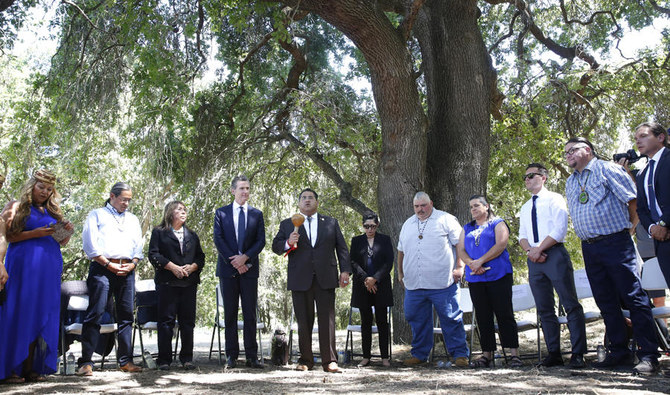
The Democratic governor met with tribal leaders at the future site of the California Indian Heritage Center, where he also announced the creation of a council to examine the state’s role in campaigns of extermination and exploitation.
Throughout history, the California government was key to efforts to remove and kill Native Americans who lived on land that would become part of what is now the world’s fifth-largest economy.
“Genocide. No other way to describe it, and that’s the way it needs to be described in the history books,” Newsom said.
Mark Macarro, tribal chairman of the Pechanga Band of Luiseño Indians, said the apology is significant.
“To hear an apology like that today from the head of this state sets a new tone. It does for me, on a personal level,” said Macarro.
Newsom did not propose any specific changes in policy toward Native American communities, though tribal leaders raised concerns about issues such as managing natural resources, preventing wildfires and addressing the historical trauma of the government’s campaigns to wipe out indigenous California residents as well as their culture.
“It was a step into healing,” said Joseph L. James, chairman of the Yurok Tribe, which has territory near the Northern California coast.
James said that he hopes the governor maintains a close relationship with tribes, adding: “Actions speak louder than words.”
Newsom is not the first to apologize for the treatment of Native Americans.
Congress tucked an apology into a 2009 military spending bill, acknowledging “years of official depredations, ill-conceived policies, and the breaking of covenants by the federal government regarding Indian tribes.”
Last year, then-Alaska Gov. Bill Walker issued an apology to the state’s indigenous people, listing a series of wrongs.
Other governors have apologized for specific episodes in history, from the killing of Arapaho and Cheyenne people in the Sand Creek Massacre of 1864 to the forced move of Potawatomi people from Indiana to Kansas in 1838 on what has become known as a “Potawatomi Trail of Death.”
Newsom pointed to California’s efforts to remove American Indians as people flooded the state searching for gold in the mid-19th century.
California’s first governor, Peter Burnett, declared to legislators in 1851 “that a war of extermination will continue to be waged between the two races until the Indian race becomes extinct must be expected.”
The Legislature subsequently approved $1.29 million to subsidize militia campaigns against American Indians, Newsom’s office said.
The state’s objections to several federal treaties with tribes left most American Indians in California landless, said Albert Hurtado, professor emeritus at the University of Oklahoma.
“The actions of the state 150 years ago have ongoing ramifications even today,” he said.
In using the word genocide to describe California’s treatment of Native Americans, Newsom threw the weight of the state government behind a term that is heavy with emotion and still stirs debate, from California to Canada.
“I think it’s really important to name it and if you don’t, you don’t do justice to what actually occurred,” Newsom said. “This was not just traditional pioneering spirit and we came into some conflict, as someone suggested. This was something completely organized and systemic.”
The governor’s office said the new Truth and Healing Council will more closely explore the historical relationship between the state of California and California Native Americans.
Newsom did not directly call for any changes to the state’s history curriculum or commemorations of colonialists and pioneers who have counties, schools and streets named for them across California. But the governor endorsed renaming Columbus Day as Indigenous Peoples Day, as a few states have in recent years.
Like other states in the US West, California has seen renewed debate about its treatment of indigenous people.
Stanford University announced last year it would remove the name of Spanish missionary and Catholic saint Junipero Serra from some parts of campus following criticism over his treatment of Native Americans.
And in recent years, some schools have abandoned what was once a common project in elementary classrooms around California: building models of Spanish missions, which were constructed in real life with the forced labor of Native Americans.
California has the largest proportion of American Indians in the United States. About 723,000 residents identified as American Indian during the 2010 census.