Boris Johnson builds lead in race to be UK prime minister

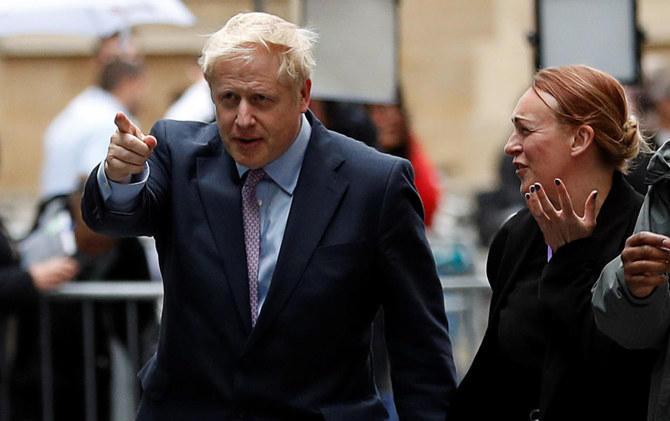
Boris Johnson arrives at BBC studios to take part in a TV debate with candidates campaigning to replace British Prime Minister Theresa May, in London. (Reuters)
Updated 18 June 2019
Follow

Boris Johnson builds lead in race to be UK prime minister

  • Johnson won 126 of the 313 votes cast Tuesday in a second-round ballot of Conservative Party lawmakers
  • Johnson added a dozen votes to his tally from last week, securing more votes than the combined total for the next three challengers: Hunt with 46 votes, Gove with 41 and Stewart with 37

LONDON: Boris Johnson increased his lead Tuesday in the race to become Britain’s next prime minister as one of his rivals was eliminated in a party vote, leaving a five-strong field.
Johnson won 126 of the 313 votes cast Tuesday in a second-round ballot of Conservative Party lawmakers, all but guaranteeing he will be one of the final two candidates in a runoff that will be decided by party members.
Dominic Raab, who tried to vie with Johnson for the votes of committed Brexit supporters, got 30 votes, three short of the threshold needed to go through to the next round.
Foreign Secretary Jeremy Hunt, Environment Secretary Michael Gove, International Development Secretary Rory Stewart and Home Secretary Sajid Javid all remain contenders in what is now effectively a race for second place.
All five candidates were taking part in a live television debate on Tuesday evening, two days after Johnson skipped another televised debate despite being the front-runner for the post.
Tory lawmakers will vote again Wednesday and, if needed, Thursday. The final two contenders will go to a postal ballot of all 160,000 Conservative Party members nationwide.
The winner, due to be announced in late July, will replace Theresa May as both party leader and British prime minister. May stepped down as party leader earlier this month after failing to secure Parliament’s approval for her Brexit deal.
Johnson, a flamboyant former foreign secretary, was already the front-runner after last week’s first round of voting in a race that started out with 10 competitors. He has since been backed by several lawmakers who have dropped out, including hard-line Brexit supporters Esther McVey and Andrea Leadsom and moderate Matt Hancock.
Johnson added a dozen votes to his tally from last week, securing more votes than the combined total for the next three challengers: Hunt with 46 votes, Gove with 41 and Stewart with 37.
All the contenders vow they will succeed where May failed and lead Britain out of the European Union, though they differ about how they plan to break the country’s Brexit deadlock.
Johnson — a leading figure in the 2016 campaign to leave the EU — says the UK must leave the bloc on the scheduled date of Oct. 31, with or without a divorce deal to smooth the way.
The EU says it won’t reopen the Brexit agreement it struck with May’s government, which has been rejected three times by Britain’s Parliament. Many economists and businesses say a no-deal exit would cause economic turmoil by ripping up the rules that govern trade between Britain and the EU.
Johnson’s rivals are divided over how willing they are to contemplate a no-deal Brexit. Javid says no-deal would be preferable to further delay, while Hunt warns it would cause “potentially severe economic disruption” and Gove says he would be willing to postpone Brexit further in order to secure a deal.
Johnson’s team is keeping him on a tight leash, wary of gaffes that could derail his campaign. Johnson is admired by many Conservatives for his ability to energize voters, but others mistrust him for his long record of misleading and false statements, verbal blunders and erratic performance in high office.
Stewart, who started the campaign as a rank outsider but has electrified the race, accused Johnson of selling “fairy tales” about how he would solve the Brexit puzzle.
Stewart’s energetic campaign and call for compromise has won praise from many outside the Conservative Party. He urged Tory lawmakers to put him into the final two and give the party a distinct alternative to Johnson.
“I would love to go against him in the final two in order to give members the chance to choose whether they want Boris’s Brexit or mine,” Stewart said.


Trump says US could run Venezuela and its oil for years

Updated 2 sec ago
Follow

Trump says US could run Venezuela and its oil for years

  • US president made the comments less than a week after Washington seized Maduro in a raid on Caracus
  • Oil has emerged as the key to US control over Venezuela, which has the world’s largest proven reserves
WASHINGTON: The United States could run Venezuela and tap into its oil reserves for years, President Donald Trump said in an interview published Thursday, less than a week after toppling its leader Nicolas Maduro.
“Only time will tell” how long Washington would demand direct oversight of the South American country, Trump told The New York Times.
But when asked whether that meant three months, six months or a year, he replied: “I would say much longer.”
The 79-year-old US leader also said he wanted to travel to Venezuela eventually. “I think at some point it’ll be safe,” he said.
US special forces snatched president Maduro and his wife in a lightning raid on Saturday and whisked them to New York to face trial on drug and weapons charges, underscoring what Trump has called the “Donroe Doctrine” of US hegemony over its backyard.
Since then Trump has repeatedly asserted that the United States will “run” Venezuela, despite the fact that it has no boots on the ground.
Venezuela’s interim leader Delcy Rodriguez insisted that no foreign power was governing her country. “There is a stain on our relations such as had never occurred in our history,” Rodriguez said of the US attack.
But she added it was “not unusual or irregular” to trade with the United States now, following an announcement by state oil firm PDVSA that it was in negotiations to sell crude to the United States.

‘Tangled mess’

Oil has in fact emerged as the key to US control over Venezuela, which has the world’s largest proven reserves.
Trump announced a plan earlier this week for the United States to sell between 30 million and 50 million barrels of Venezuelan crude, with Caracas then using the money to buy US-made products.
On the streets of Caracas, opinions remain mixed about the oil plan.
“I feel we’ll have more opportunities if the oil is in the hands of the United States than in the hands of the government,” said Jose Antonio Blanco, 26. “The decisions they’ll make are better.”
Teresa Gonzalez, 52, said she didn’t know if the oil sales plan was good or bad.
“It’s a tangled mess. What we do is try to survive, if we don’t work, we don’t eat,” she added.
Trump, who will meet oil executives on Friday, is also considering a plan for the US to exert some control over Venezuela’s PDVSA, the Wall Street Journal reported.
The US would then have a hand in controlling most of the oil reserves in the Western Hemisphere, as Trump aims to drive oil prices down to $50 a barrel, the paper reported.
Vice President JD Vance underscored that “the way that we control Venezuela is we control the purse strings.”
“We tell the regime, ‘you’re allowed to sell the oil so long as you serve America’s national interest,’” he told Fox News host Jesse Watters in an interview broadcast late Wednesday.

‘Go like Maduro’

Vance, an Iraq veteran who is himself a skeptic of US military adventures, also addressed concerns from Trump’s “Make America Great Again,” saying the plan would exert pressure “without wasting a single American life.”
The US Senate is voting Thursday on a “war powers” resolution to require congressional authorization for military force against Venezuela, a test of Republican support for Trump’s actions.
Caracas announced on Wednesday that at least 100 people had been killed in the US attack and a similar number wounded. Havana says 32 Cuban soldiers were among them.
Trump’s administration has so far indicated it intends to stick with Rodriguez and sideline opposition figures, including Nobel Peace Prize winner Maria Corina Machado.
But Rodriguez’s leadership faces internal pressures, analysts have told AFP, notably from her powerful Interior Minister Diosdado Cabello and Defense Minister Vladimir Padrino Lopez.
“Her power comes from Washington, not from the internal structure. If Trump decides she’s no longer useful, she’ll go like Maduro,” Venezuela’s former information minister Andres Izarra told AFP in an email.
The US operation in Venezuela — and Trump’s hints that other countries could be next — spread shockwaves through the Americas, but but he has since dialed down tensions with Colombia.
A day after Colombia’s leftist President Gustavo Petro spoke with Trump on Wednedsday, Bogota said Thursday it had agreed to take “joint action” against cocaine-smuggling guerrillas on the border with Venezuela.