LAHORE: Leaders of Pakistan’s two largest opposition parties held a meeting here on Sunday to devise a joint strategy against the Pakistan Tehreek-e-Insaf government and run a coordinated campaign against its “anti-people policies.”
The gathering was organized by Pakistan Muslim League-Nawaz (PML-N) Vice President Maryam Sharif who invited Pakistan Peoples Party (PPP) Chairman Bilawal Bhutto Zardari to jointly review the country’s prevailing political situation.
Together the two young politicians agreed to revive the May 2006 Charter of Democracy, signed by their parents in London, to strengthen parliamentary democracy in Pakistan and challenge the incumbent administration.
“The two parties discussed the current situation of the country and decided to work together to get rid of the anti-people policies [of the PTI government]. In the first phase, a joint strategy will be evolved which will help the two factions work together in parliament. The leaders of the parties will also meet to formulate a strategy to work outside the parliament,” PPP Punjab Secretary General Chaudhry Manzoor Ahmed, who was present at the meeting, told Arab News.
A senior PML-N politician thought the meeting would prove beneficial for Pakistan’s future politics since the two parties were operating under a young leadership.
“The two young leaders have become successful in convincing their parties regarding their approach and style of politics. Their parents may have a history of friendship and enmity, but these two have no bad blood between them. They share the same woes and want to work together to take the country forward,” Senator Pervaiz Rasheed, another participant of the meeting, said.
Maryam Sharif and Bilawal Bhutto also discussed the fresh wave of the arrests of opposition leaders and thought it was to terrify the opponents of the government.
The PPP chairman said in a media talk after the meeting that the opposition would not be deterred by such political pressure. He also pointed out that no single party could take the country out of the present political and economic situation, adding it would require a collaborative effort.
The two leaders decided they would not let the PTI government pass the national budget, saying it was making life difficult for the people of Pakistan. They also agreed to involve other parliamentary forces to achieve that objective.
The PPP chairman and PML-N vice president demanded the administration to withdraw corruption references filed against their family members and insisted the National Assembly speaker issue production orders of all jailed members of parliament.
While some of the government ministers ridiculed the meeting, independent analysts thought it could create problems for the PTI administration.
“The PTI has pushed the main leaders of the PPP and PML-N against the wall. The proposed joint movement of these opposition faction can put the ruling party in hot water,” Arif Nizami, a senior analyst, told Arab News.


![]()

PPP, PML-N to challenge ‘anti-people policies’ of government
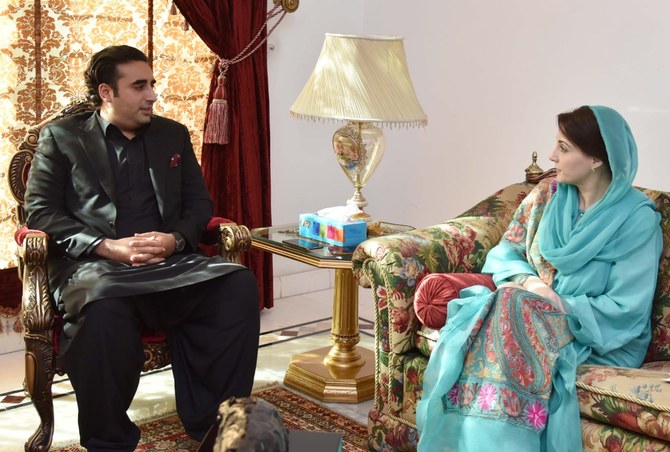
PPP, PML-N to challenge ‘anti-people policies’ of government
- Maryam Nawaz and Bilawal Bhutto hold an important political meeting in Lahore
- Analysts say their proposed campaign against government can put PTI in difficult situation
Latest updates


© 2026 SAUDI RESEARCH & PUBLISHING COMPANY, All Rights Reserved And subject to Terms of Use Agreement.