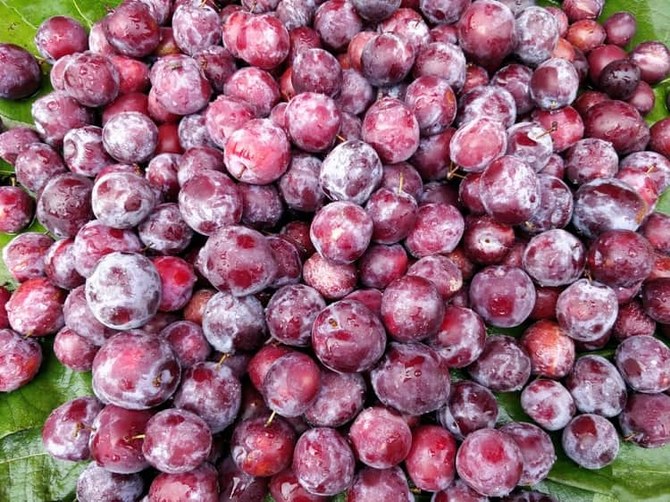
Berry versatile: Falsa rules the roost as Pakistan’s most favored summer fruit

With its botanical name as Grewia Asiatica, falsa or phalsa traces its roots to South Asia and is very similar to the blueberry. Photo (Social Media)
Updated 17 June 2019
Follow

Berry versatile: Falsa rules the roost as Pakistan’s most favored summer fruit

  • From kulfis and juices to pickles, the tangy-sweet fruit is on most checklists
  • Restaurants put on their thinking caps by adding it to traditional dishes and drinks

ISLAMABAD: When it comes to berries, falsa remains the top pick for Pakistanis in this scorching heat, with several food and beverage outlets reaching out for the versatile fruit to pack a punch in their choice of menus.
With its botanical name as Grewia Asiatica, falsa or phalsa traces its roots to South Asia and is very similar to the blueberry.
Demand for the tangy-sweet fruit reaches a fever pitch in summer when restaurants and bakeries dole out falsa-based desserts, juices and smoothies.
One such food outlet is Funky Pop, an ice-cream retailer which is popular for its fresh fruit popsicles that are devoid of artificial flavours or added sugar. Watch out for their falsa popsicles available at their outlet in F10 Markaz, or if creamy Italian ice cream is more up your alley, right around the corner at Manolo Gelato in F11 markaz they are serving up falsa hype with a special availability of falsa gelato.
Close on the heels of Funky Pop is Sooper Scooperz in Islamabad’s Jinnah Market, whose rich and seasonal juices are a favorite among locals and visitors alike. New on their menu is the falsa juice which can be devoured on its own or blended with a combination of other fruits.
Not one to be limited to juices and popsicles, the fruit – with the help of Karachi-based Tempting Bites by Zee – is pushing the envelope by adding a little bit of glamor to the humble kulfi as well.
The retailer which delivers the delight at home too, has been churning out cups of the icecream for years now and is very popular among residents in the metro.
Shehreen Farhan who runs a bakery in Bara Kahu, Islamabad says the fruit has been an industry favorite, mostly for its versatility, as it can jazz up any classic desserts.
“Cobblers (that are traditionally made with apples and peaches), pies and fruit tarts are so easy to modify by using falsa in place of berries and other fruits,” she said, adding that “fruit tarts are our best falsa seller.”
A more desi spin to the fruit is by using it in fruit chaats and salads, as well as boiling it down to jams and syrups or as a tangy replacement for regular chutneys and achaars (pickles).


Islamabad offers skilled manpower to help Iraq in reconstruction, development efforts

Updated 10 sec ago
Follow

Islamabad offers skilled manpower to help Iraq in reconstruction, development efforts

  • The development comes during Pakistan President Asif Ali Zardari’s four-day visit to Iraq to strengthen bilateral cooperation
  • Zardari says current levels of bilateral trade do not reflect true potential of Pakistan-Iraq ties, highlights opportunities

ISLAMABAD: Pakistan has offered to provide skilled manpower to support Iraq’s reconstruction and development efforts, the Pakistani government said on Sunday, signaling Islamabad’s willingness to deepen cooperation with Baghdad in sectors including infrastructure, technical services and human resource development.

The development comes during Pakistan President Asif Ali Zardari’s four-day visit to Iraq to strengthen cooperation in trade, investment, religious tourism, energy and other sectors.

Zardari held a one-on-one meeting with his Iraqi counterpart, Dr. Abdul Latif Jamal Rashid, at Baghdad Palace, which was followed by delegation-level talks to review the state of bilateral relations.

“President Zardari reiterated Pakistan’s willingness to support Iraq’s reconstruction and development efforts through the provision of skilled and semi-skilled manpower under the existing Memorandum of Understanding on manpower transmission,” Pakistan’s Press Information Department (PID) said in a statement.

“He also highlighted Pakistan’s capacity in medical services, financial expertise and digital governance, and expressed readiness to share technical experience, including in secure data management, to support institutional capacity-building in Iraq.”

Iraq has been working to rebuild its economy and infrastructure after decades of conflict, including the 2003 US-led invasion and years of instability caused by sectarian violence and the fight against Daesh group. Although security conditions have improved in recent years, large parts of the country still face damaged roads, power plants, hospitals and housing, requiring large-scale reconstruction and public service delivery.

During Sunday’s meeting, Zardari noted that the current levels of bilateral trade do not reflect the true potential of Pakistan-Iraq economic, cultural and security relations, highlighting opportunities in agriculture, defense production, information technology, construction, pharmaceuticals and other sectors. He underscored the importance of business-to-business engagement and the establishment of direct banking channels to facilitate trade and commercial activity, according to the PID.

Zardari also requested improved facilitation for Pakistani pilgrims visiting Iraq and expressed hope for early finalization and implementation of a proposed Memorandum of Understanding on Zaireen (pilgrims) Management, aimed at ensuring orderly travel. He expressed his firm resolve to work with the Iraqi government to stop illegal entry and overstay of those Pakistanis who violate Iraqi law.

“Both Presidents expressed their resolve to fight extremism, terrorism and narco trade and enhance bilateral cooperation,” the PID said. “The two leaders reaffirmed their commitment to further deepening bilateral cooperation across political, economic and social domains.”

Pakistan and Iraq established diplomatic relations in 1947 and have traditionally maintained cordial ties, though commercial links remain modest. The volume of trade between both countries stood at $268 million in 2023.

Pakistan’s major exports to Iraq include machinery and mechanical appliances, pharmaceutical products, fish, cereals, essential oils and resinoids. Islamabad’s imports from Iraq include mineral fuels, mineral, organic chemicals, edible fruit and nuts.