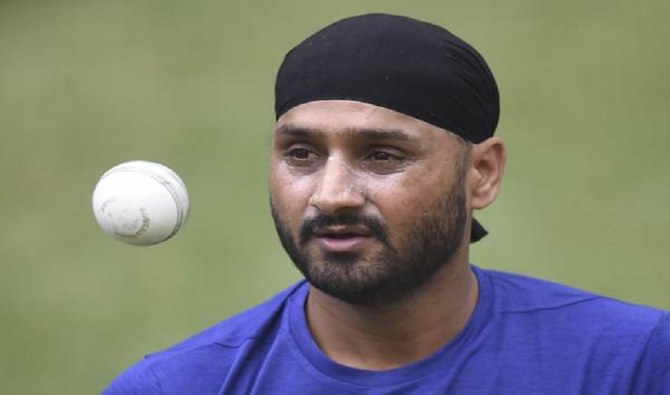
Harbhajjan warns India stars to expect sleepless night as Pakistan loom

Arch rivals India and Pakistan to clash on Sunday June 16, 2019 - AFP
Updated 15 June 2019
Follow

Harbhajjan warns India stars to expect sleepless night as Pakistan loom

  • Perennial political rivals India and Pakistan will face off in Manchester on Sunday
  • Match will be one of World Cup’s most hotly-anticipated and massively-watched games

LONDON: Harbhajjan Singh has warned India’s stars to expect a sleepless night ahead of their World Cup showdown with arch rivals Pakistan on Sunday.
India legend Harbhajjan knows from bitter experience just how stressful it is to take part in one of the most fierce rivalries in world sport.
The tense political situation between India and Pakistan lends an extra level of animosity whenever the feuding neighbors clash on the cricket pitch.
Their latest meeting comes with the stakes even higher than usual in the World Cup at Old Trafford this weekend and Harbhajjan is well aware just how high emotions will be running on the pitch and in the stands.
The 38-year-old spinner played 17 times against Pakistan in a 236-match ODI career for India, including arguably their biggest ever match in the 2011 World Cup semifinals on home soil in Chandigarh.
It was such a critical fixture that Harbhajjan lay awake for hours tossing and turning in bed the night before the game as he visualized the furious response from the Indian public if they lost.
“The memories of that game was I couldn’t sleep the night before, even though I tried my best,” Harbhajjan said.
“I was just worried about what would happen if we lost the game. There were a lot of thoughts coming into my mind.
“People get angry and they can do anything. In the 2003 World Cup we didn’t play one game as well as we should have against Australia and people got really angry.
“They were just burning our stuff and throwing stones at our homes. They get a bit emotional.”
Despite his sleep-deprived preparation, Harbhajjan took two wickets as India beat Pakistan by 29 runs, with his side going on to win the World Cup for the second time.
Even with a disastrous defeat averted, the adrenaline of victory kept Harbhajjan from sleeping the night after the match as well.
“When we won the game I couldn’t sleep the next day either because I was too excited and too happy. That’s what the Pakistan game does to you,” he said.
“Obviously it’s one of those games when the pressure is a little more than when you play against England or New Zealand.
“People in both countries want their respective teams to win and if you end up losing the game the people really get up upset and they go on to lose their minds, which is obviously quite bad.”
Although they were crushed by Pakistan in the 2017 Champions Trophy final, India have never lost to them at a World Cup, winning at the last two tournaments, and are favorites to extend that run when the rivalry resumes in Manchester.
However, Harbhajjan acknowledges India’s status brings its own burdens, raising expectations among their passionate fanbase of another win over the old enemy.
“As a player you always want to play well against Pakistan, so there is more pressure. It’s not just for Indian players but for Pakistani players as well,” he said.
“But there is more pressure on the Indian players because we have a very good record in these games and we don’t want to change that.”


Pakistan approves upgrades to national ID cards in push to strengthen digital ecosystem

Updated 24 February 2026
Follow

Pakistan approves upgrades to national ID cards in push to strengthen digital ecosystem

  • The amendments allow for QR-based verification, authentication controls, biometric expansion, and card format updates
  • The measures advance integrated digital governance through National Data Exchange Layer and broader digital ID ecosystem

ISLAMABAD: Pakistan has notified amendments to the National Identity Card and Pakistan Origin Card rules and introduced QR-based verification and stronger fraud controls, the National Database and Regulatory Authority (NADRA) said on Tuesday, amid efforts to strengthen the country’s digital ecosystem.

The amendments modernize Pakistan’s identity document framework by legally embedding QR-based verification, strengthening authentication controls across digital services, expanding biometric recognition and updating card formats for key citizen categories.

A core reform is the statutory introduction of the Quick Response (QR) code as a defined security and verification feature, authorizing the use of “QR code or any other technological feature” in lieu of current microchip enabling NADRA to adopt evolving verification technologies without repeated rule amendments.

This QR-enabled capability directly strengthens Pakistan’s Digital ID ecosystem and supports interoperability through the National Data Exchange Layer, according to the national database regulator.

“This establishes a robust legal basis for quick and secure verification of identity credentials in both offline and online environments,” NADRA said.

“This will also enable all citizens to carry similar card instead of currently prevalent two types of national identity cards one of which is with microchip and the other without.”

Pakistani state media reported in August that the country was developing digital identities of all its citizens to enable secure and efficient payments. The measures came as part of a broader effort to digitize the economy for greater transparency.

QR-based credentials allow rapid front-end validation of identity attributes in service delivery settings, while also enabling back-end systems to confirm authenticity and status through trusted exchanges. This is expected to improve speed, transparency and consistency of identity verification across government entities and regulated sectors, reduce manual handling, and lower the risk of fraud and impersonation, according to NADRA.

The amendments also strengthen the enforcement effect of card suspension. The Rules now clarify that where a card is suspended, all verification, authentication and related services linked to that card shall stand suspended forthwith. This closes a key risk area by ensuring that once a card is suspended, it cannot continue to be used through digital verification channels or institutional authentication processes.

“The amendments also introduce standardized identification for residents of Azad Jammu and Kashmir by requiring an inscription indicating ‘Resident of Azad Jammu and Kashmir’ in the manner specified by the Authority, thereby ensuring uniform geographic identification on the document,” NADRA said.

“Overall, these amendments strengthen the legal and technological foundations of Pakistan’s identity system by enabling secure QR-based verification, reinforcing the integrity of digital authentication services, improving biometric assurance,” it said. “They also advance readiness for integrated digital governance by supporting structured interoperability through the National Data Exchange Layer and a broader Digital ID ecosystem.”