


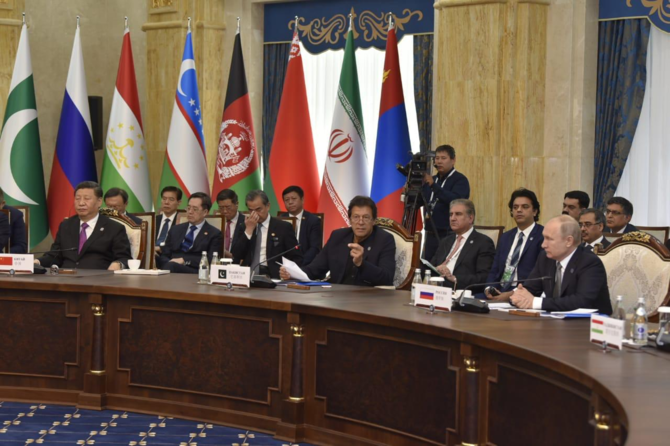

ISLAMABAD: Pakistani Prime Minister Imran Khan on Friday called on heads of state of the Shanghai Cooperation Organization (SCO) to finalize arrangements for trade in local currencies and set up an SCO development bank to expedite interregional development.
Khan arrived in Bishkek on Thursday for the SCO’s 19th Council of the Heads of State (CHS), which sets the strategy, prospects and priorities of the body.
Addressing the Council, Khan urged member states to “finalize arrangements for trade in local currencies, and set up SCO Fund and SCO Development Bank to catalyze the trans-regional development agenda.”
The prime minister also spoke about increasing regional connectivity through culture and tourism corridors and setting up a comprehensive framework for combating corruption and white-collar crime.
Talking about investment opportunities in Pakistan, he said the country was blessed with a vast pool of skilled human resource, a large agrarian base, tremendous tourism potential, diverse mineral wealth, and a developed IT infrastructure.
“Our predominantly young population is imbued with immense energy and creativity,” he said, adding that Pakistan’s foreign policy outlook was anchored on the inextricable link between peace and development. “We build partnerships based on mutual respect, sovereign equality and equal benefit.”
Khan lauded Chinese infrastructure development in Pakistan under the $62 billion China-Pakistan Economic Corridor (CPEC) and said “in time, CPEC is destined to catalyze the creation of an integrated pan-Asian sphere of shared prosperity.”
Khan said “a multipolar global order” was emerging for the first time as epicenters of economic power and growth momentum shifted eastwards, regional integration sped up, and disruptive technologies matured.
However, he said threats from terrorism, climate change, narcotics and bacterial resistance continued to loom large.
The premier said growing intolerance and Islamophobia were threatening to accentuate religious fault-lines. “We are among the few countries to have successfully turned the tide against terrorism,” he said. “We will also remain actively engaged in SCO’s counter-terrorism initiatives.”
Talking about the ongoing peace process in Afghanistan, Khan said there was finally a realization among world powers that the conflict in Afghanistan did not have a military solution.
“Pakistan is fully supporting efforts for peace and reconciliation, through an Afghan-led and Afghan-owned process,” he said.”We deem this to be part of a shared responsibility and, therefore, appreciate the positive contributions being made by China, Russia and Afghanistan’s immediate neighbors,” he said, adding: “SCO’s support for post-conflict Afghanistan will remain crucial.”
Expressing concern over the evolving situation in the Gulf and the Middle East given recent attacks on Saudi Arabian oil interests and a civilian airport, the PM said: “We join the SCO members in urging the parties to exercise restraint, take steps to de-escalate the situation, and find solutions through diplomatic means.”
“We believe implementation of the Joint Comprehensive Plan of Action [commonly known as Iran nuclear deal signed in July 2015] by all parties is essential for international and regional stability,” Khan added.
Khan also met with Indian prime minister Narendra Modi during the day and had a brief conversation.
“No structured meeting was planned [between the two leaders],” said Pakistan’s foreign minister Shah Mahmood Qureshi in an interview with Independent Urdu. “Yet they met each other, shook hands and exchanged pleasantries.”
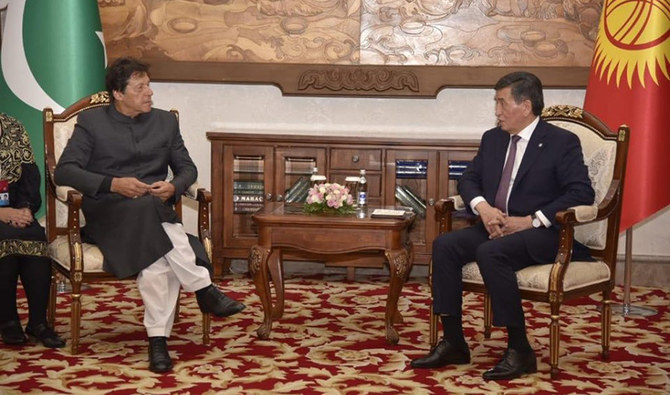
The prime minister also interacted with Kyrgyzstan President Sooronbay Jeenbekov, Russian President Vladimir Putin and Chinese President Xi Jinping on the sidelines of the summit. He left for Islamabad on Friday late afternoon.
The SCO was founded in Shanghai in 2001 by the leaders of Kazakhstan, Kyrgyzstan, Tajikistan, Uzbekistan, Russia and China. It evolved from an earlier regional security grouping formed in 1996 after the collapse of the Soviet Union, when the Central Asian states gained independence.
India and Pakistan, originally observers, became full members in 2017 at a summit in Astana, Kazakhstan. Iran, Afghanistan, Mongolia and Belarus have observer status.


