



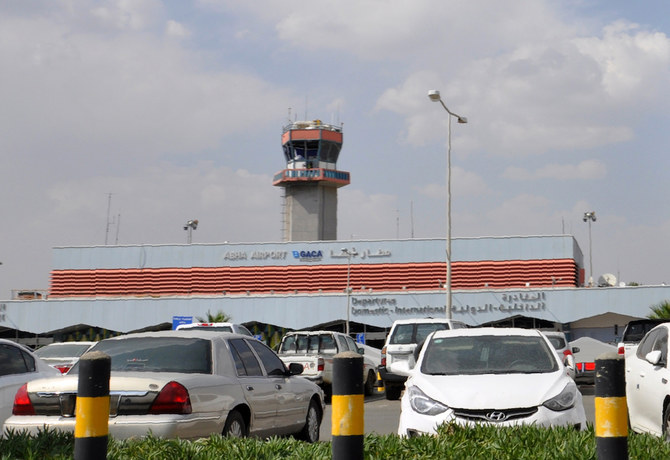
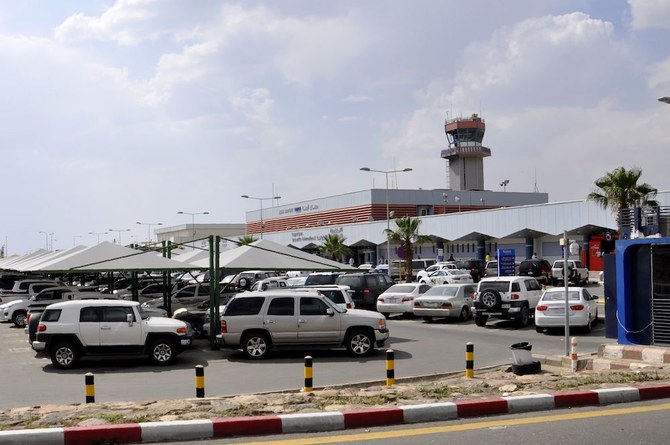


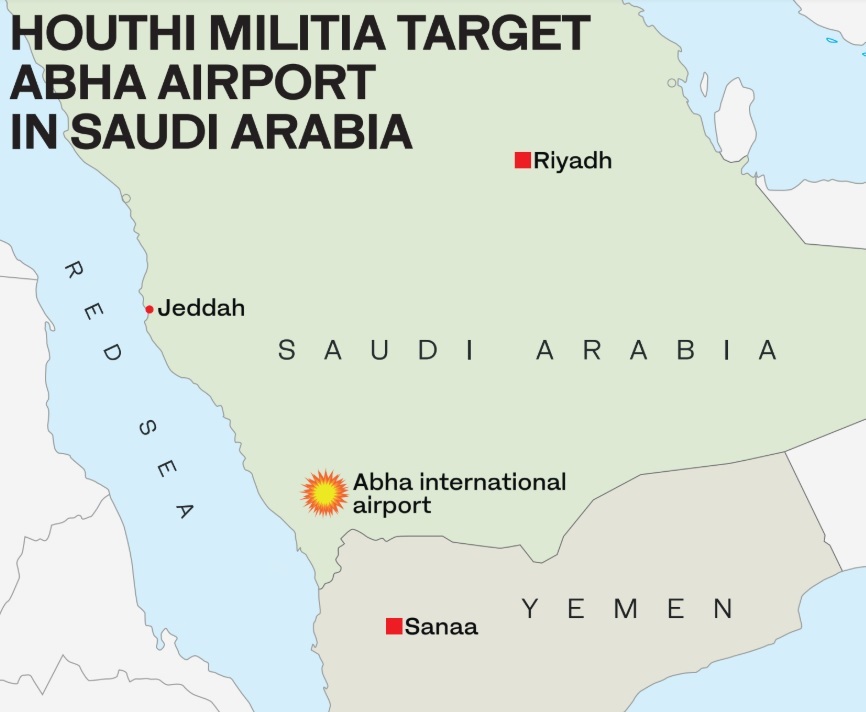
JEDDAH: At least 26 people were injured Wednesday when a Houthi missile fired from Yemen hit Abha International Airport in Saudi Arabia.
The Arab Coalition fighting to support Yemen’s government vowed a firm response and said the attack proved Tehran’s support for cross-border terrorism.
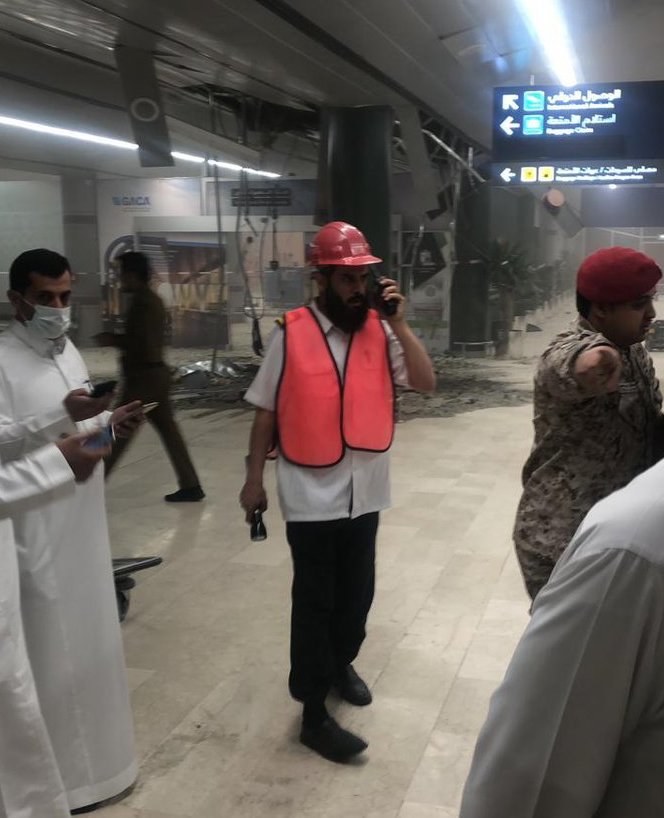
The attack took place in the early hours when the missile hit the arrival lounge of the airport in Asir Province at 2:21 a.m.
The coalition said the injured were all civilians of different nationalities and included two Saudi children and three women - a Saudi, a Yemeni and an Indian.
Eight people were transferred to hospital for treatment for moderate injuries, while 18 were treated at the site for minor injuries.
The general supervisor of Asir Central Hospital told Al Ekhbariya that all the patients had been discharged by 10 a.m.
Part of the airport lounge was damaged, but television pictures later showed passengers queueing inside the airport as normal services resumed.
The Iran-backed Houthi militia, has fired dozens of missiles into Saudi Arabia from Yemen, either short range missiles across the border or longer-range ballistic missiles targeting the Kingdom’s main cities.
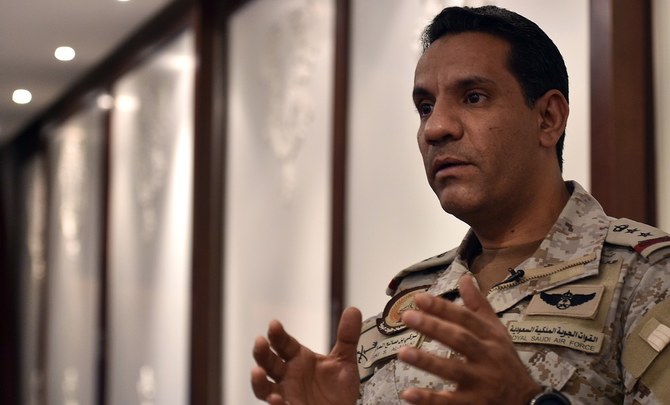
Coalition spokesman Col. Turki Al-Maliki said the military and security forces were working to determine the type of “hostile projectile” used in the attack.
A Houthi boast that it struck the airport with a sophisticated cruise missile was “misinformation spread by Houthi media and Iranian social media,” security analyst Dr. Theodore Karasik told Arab News.
“The interception rate by Saudi PAC-3 air defense is extremely high,” said Karasik, senior adviser at Gulf State Analytics in Washington, DC.
“But Iranian supplied and supported Houthi drones are another matter. They deliver an explosive charge either on the target or above, raining down debris.
“The Houthis conducted such an attack on a Yemeni military parade in Aden in January, killing senior Yemeni leaders in a lucky strike. The Abha attack appears to be the same in terms of the spread of injuries caused by falling debris.”
*********
READ MORE:
International condemnation of Houthi attack on Saudi Arabia’s Abha airport
TIMELINE: Houthi attacks on Saudi Arabia
*********
Saudi Arabia and its allies have blamed Iran for supplying ballistic missiles and drones to the Houthis. If a cruise missile, which flies at lower altitudes than ballistic missiles, has been used in the attack, it would raise further concerns that Iran is supplying increasingly sophisticated weaponry to the militants.
The attack “proves this terrorist militia's acquisition of new special weapons; the continuation of the Iranian regime’s support and practice of cross-border terrorism,” Al-Maliki said.
He said the attack could amount to a war crime and that the coalition would take “urgent and timely” measures in response.
He later told Al Arabiya that the evidence so far suggests that Iran's Islamic Revolutionary Guard Corps provided the weapons that targeted the airport.
Prince Turki bin Talal bin Abdul Aziz, the governor of the Asir region, said that attacks by the Iranian-backed Houthis would not affect the security and stability of Saudi Arabia and that plots to destabilize the Kingdom would not succeed.
Command of the Joint Forces of the Coalition to Restore Legitimacy in #Yemen: A Terrorist Act Targets #SaudiArabia’s Abha International Airport pic.twitter.com/JPdKZbqRFI
— Foreign Ministry (@KSAmofaEN) June 12, 2019
A Houthi military spokesman Tuesday threatened that the group would target every airport in Saudi Arabia and that the coming days would reveal "big surprises".
Saudi Arabia’s civil aviation authorities said that airport operations and air traffic had returned to normal.
Thousands of passengers pass through Abha airport every day.
The Yemeni government, which the Houthis drove from Sanaa in 2014 to spark the war, said that only military action will end the militia’s “terrorism,” Al Arabiya reported.
Other countries rushed to condemn the attack.
Th US Embassy in Saudi Arabia condemned "in the strongest terms" the attack, while the Pentagon said it showed new evidence of Iran's malicious role in the region.
On behalf of Ambassador #Abizaid and the entire U.S Mission in Saudi Arabia, we condemn in the strongest possible terms the Houthi attack on innocent civilians at #AbhaAirport. We wish those injured a speedy recovery. pic.twitter.com/SO2JheS9Ia
— U.S. Mission to KSA (@USAinKSA) June 12, 2019
The UAE, a coalition member, said the attack is proof of the Houthi’s aggression and its determination to undermine regional security.
Bahrain’s Foreign Minister Khalid bin Ahmed Al-Khalifa, said the “Houthi attack on Abha airport is an act of terrorism and a serious escalation on the use of Iranian weapons.”
Palestine, Jordan, Kuwait, Egypt and Djibouti all condemned the missile strike.
The attack follows an armed drone strike last month on two oil-pumping stations in the Kingdom that were claimed by the Houthis. Saudi Arabia accused Iran of ordering the attack.
The Houthi group last month stepped up its attacks following a lull last year ahead of UN-led peace efforts. The coalition has responded by carrying out air strikes on Houthi-held Sanaa.
There have been 226 ballistic missiles launched by the Houthi militias toward Saudi Arabia between March 26, 2015 and June 10, 2019.


