Pakistan to present austerity-centered budget today following IMF deal

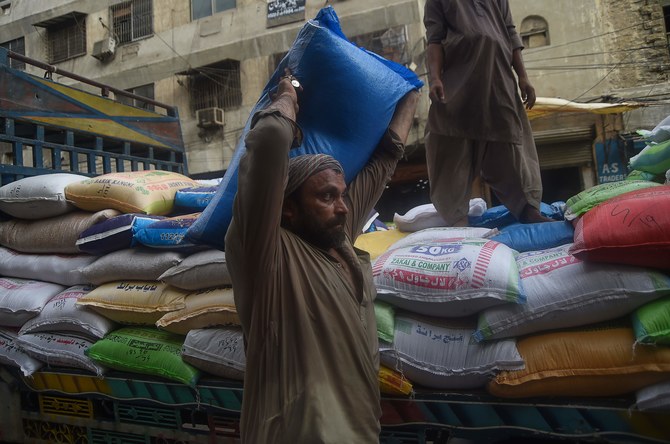
A Pakistani labourer shifts rice bags at a market in Karachi on June 10, 2019, ahead of the country state budget. (AFP)
Updated 11 June 2019
Follow

Pakistan to present austerity-centered budget today following IMF deal

  • The PKR 6.8 trillion budget is likely to be impacted by IMF conditionalities
  • Pakistan has struggled for decades to expand its tax base and revenue collection

ISLAMABAD: Pakistan Prime Minister Imran Khan’s government is set to present an austerity-focused budget Tuesday, weeks after the country reached an agreement with the International Monetary Fund for a $6 billion bailout.
The presentation of Khan’s first budget comes just a day after the government released the latest round of bleak economic figures for the cash-strapped country, showing growth for the current fiscal year falling to 3.3 percent — well below the 6.2 percent target.
The release of the figures comes as discontent simmers in Pakistan following repeated devaluations of the rupee, soaring inflation, and increasing utility costs.
The economic pain follows months of failed efforts by Khan’s administration to stave off ballooning fiscal and balance of payments deficits, along with low tax yields and mounting debt.
“Prime Minister Imran Khan has committed to... trying to correct things permanently even if we go through hard times for six months or one year or one and a half years,” said the country’s finance adviser, Abdul Hafeez Sheikh, late Monday.
Earlier Monday, Khan took to the country’s airways for the second time in recent weeks to plead with Pakistanis to declare their assets in the latest scheme aimed at increasing tax revenues.
Pakistan has struggled for decades to collect taxes with estimates suggesting that only around one percent of the 200-million strong population filed a return in 2018.
The agreement eked out with the IMF still needs final approval by the fund’s board, and it is widely believed the body is waiting for the presentation of the budget before giving the final sign-off.
Analysts have warned the IMF deal would likely come with myriad restrictions that could bridle Khan’s grand promises to build an Islamic welfare state, as the country is forced to tighten its purse strings.
Pakistan’s increasing economic woes also come as the country is facing possible sanctions from the Financial Action Task Force — a money-laundering monitor based in Paris — for failing to rein-in terror financing.
The organization will decide soon whether to add Pakistan to a blacklist that would trigger automatic sanctions, further weakening an already-faltering economy.
To add to its troubles, the United States has also warned it will be watching closely to ensure Pakistan does not use IMF money to repay debts to China, which has poured billions into the country for infrastructure projects under its Belt and Road Initiative.


China’s mediation eases fighting between Pakistan, Afghanistan — sources

Updated 4 sec ago
Follow

China’s mediation eases fighting between Pakistan, Afghanistan — sources

  • China’s envoy shuttles between Pakistan and Afghanistan to mediate in conflict
  • Gulf countries that mediated in the past embroiled in Middle East conflict

ISLAMABAD/BEIJING: Chinese mediation efforts, including a message from ​President Xi Jinping, have helped ease the worst fighting between Pakistan and Afghanistan since the Taliban returned to power in 2021, three Pakistani government officials said.

The officials said a meeting between the Chinese ambassador to Pakistan, Jiang Zaidong, and Prime Minister Shehbaz Sharif late last month included a message from Xi to cease hostilities.

Neither side has reported any Pakistani air strikes on Afghanistan in recent days and ground fighting along the 2,600-km (1,600-mile) border has tapered off, although daily clashes continue to be reported.

China has said it is ‌in contact ‌with both countries about ending hostilities but Mosharraf Zaidi, a ​spokesman ‌for ⁠Sharif who ​has previously ⁠said there would not be any talks with the Taliban, did not respond to questions about Beijing’s efforts.

Pakistani security officials have said the military campaign will continue until desired goals were achieved, which was to prevent militant attacks in Pakistan launched from Afghan soil.

Pakistan’s foreign ministry and military did not respond to Reuters requests for comment.

Islamabad launched air strikes on Afghanistan on February 26, saying the Taliban were providing a safe haven to ⁠militants carrying out attacks in Pakistan. Kabul denies the charge ‌and says militancy in Pakistan is an internal problem.

The ‌Chinese efforts came as Qatar, Saudi Arabia and ​Turkiye, who hosted talks between Pakistan and ‌Afghanistan during previous clashes in October, have been embroiled in the war in the Middle ‌East following the US and Israeli strikes on Iran.

“China’s Special Envoy for Afghanistan Affairs is currently shuttling between the two countries to mediate, while Chinese embassies in both nations maintain close communication with the respective parties,” the Chinese foreign ministry told Reuters in an email.

“The most urgent task ‌is to prevent the fighting from expanding and for the two countries to return to the negotiating table as soon as possible.”

The ⁠foreign ministry added ⁠that Foreign Minister Wang Yi held telephone talks with Pakistan’s Deputy Prime Minister and Foreign Minister Ishaq Dar on Tuesday to discuss the conflict.

China’s ambassador to Kabul, Zhao Xing, and the special envoy Yue Xiaoyong met Afghanistan’s acting Foreign Minister Amir Khan Muttaqi this week, the Afghan foreign ministry said in a statement.

Afghanistan and Pakistan have said they inflicted heavy damage on the other in the conflict and killed hundreds of opposition troops, without providing evidence. Reuters has not been able to verify the reports.

Beijing, a longtime Pakistani ally, has invested heavily in mines and minerals in both nations.

The investments include over $65 billion in road, rail and other development projects in Pakistan, part ​of Beijing’s Belt and Road Initiative to ​expand land and sea trade routes to Europe and Africa.