Saudi private sector growth rises to 17-month high

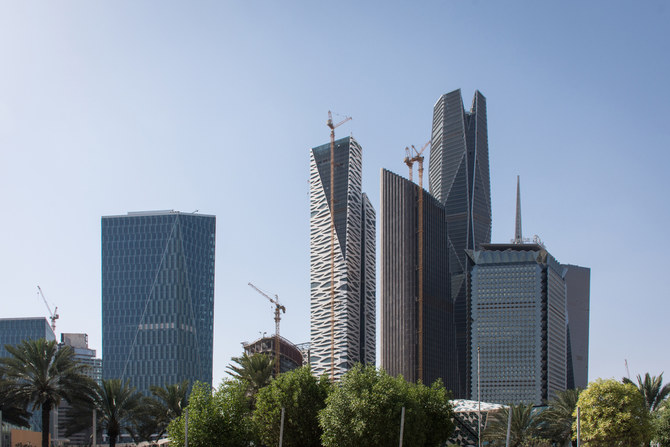
Saudi Arabia’s private sector was subdued last year as it felt the impact of fuel price hikes. (Shutterstock)
Updated 11 June 2019
Follow

Saudi private sector growth rises to 17-month high

  • Business bounces back after ‘relatively soft’ 2018
  • Purchasing Managers’ Index well above the 50 mark indicating expansion

DUBAI: Saudi Arabia’s non-oil private sector growth rose to a 17-month high in May as credit conditions improved, output expanded and output prices increased, a monthly survey of companies showed on Monday.

The seasonally adjusted Emirates NBD Saudi Arabia Purchasing Managers’ Index rose to 57.3 in May from 56.8 in April, well above the 50 mark indicating expansion.

Saudi Arabia’s private sector was subdued last year as it felt the impact of fuel price hikes, the introduction of a 5 percent value-added tax and the higher cost of hiring foreign workers.

But it has rebounded this year, with the index for purchasing managers averaging 56.8 points so far against last year’s average of 53.8.

“The gradual rise in the headline PMI this year suggests that growth in the Kingdom’s non-oil private sector is recovering after a relatively soft 2018,” said Khatija Haque, head of MENA research at Emirates NBD.

Job creation accelerated slightly to 50.5 in May from 50.1 a month earlier. Though still weak, May’s rise in employment was the biggest jump since January.

Output prices for goods and services rose for the first time in seven months after a significant drop in April.

Output rose in May for the fifth month in a row, with the subindex climbing to 61.4 from 61.2 in April. This largely reflected improved demand conditions, according to the survey’s authors.

Meanwhile, growth in the UAE’s non-oil private sector rose in May at its fastest pace since October 2014, although job creation was largely stagnant, the PMI survey showed.

The index for the UAE rose to 59.4 in May from 57.6 a month earlier.

Stronger demand, marketing activity and the start of new projects all reportedly contributed to the increases, with companies largely expecting growth to continue over the coming year, the survey’s authors said.

External demand rose at the fastest pace in the index’s nearly 10-year history as new work from Saudi Arabia and Oman in particular pushed the rate of growth in new export orders, according to survey respondents.

“While the rise in the headline PMI indicates faster GDP growth in the UAE’s non-oil private sector, the environment remains a challenging one for businesses,” said Haque.

Output and new order growth has come on the back of price discounting and new export orders, with job creation and wages remaining stagnant, Haque said.

“When the headline PMI was last at a similar level (in October 2014 and January 2015) the survey showed solid growth in private sector jobs, which is not the case this time.”

The employment sub-index nudged down to 50.1, however, with non-oil companies still showing reluctance to hire additional staff.

The UAE economy grew about 1.7 percent in 2018, slower than projected despite a boost from higher oil prices, preliminary data showed in March. The economy is projected to grow 3.5 percent in 2019, helped by strong non-oil activity, the central bank said in a quarterly report.


PIF’s Humain invests $3bn in Elon Musk’s xAI prior to SpaceX acquisition

Updated 18 February 2026
Follow

PIF’s Humain invests $3bn in Elon Musk’s xAI prior to SpaceX acquisition

JEDDAH: Humain, an artificial intelligence company owned by Saudi Arabia’s Public Investment Fund, invested $3 billion in Elon Musk’s xAI shortly before the startup was acquired by SpaceX.

As part of xAI’s Series E round, Humain acquired a significant minority stake in the company, which was subsequently converted into shares of SpaceX, according to a press release.

The transaction reflects PIF’s broader push to position Saudi Arabia as a central hub in the global AI ecosystem, as part of its Vision 2030 diversification strategy.

Through Humain, the fund is seeking to combine capital deployment with infrastructure buildout, partnerships with leading technology firms, and domestic capacity development to reduce reliance on oil revenues and expand into advanced industries.

The $3 billion commitment offers potential for long-term capital gains while reinforcing the company’s role as a strategic, scaled investor in transformative technologies.

CEO Tareq Amin said: “This investment reflects Humain’s conviction in transformational AI and our ability to deploy meaningful capital behind exceptional opportunities where long-term vision, technical excellence, and execution converge, xAI’s trajectory, further strengthened by its acquisition by SpaceX, one of the largest technology mergers on record, represents the kind of high-impact platform we seek to support with significant capital.” 

The deal builds on a large-scale collaboration announced in November at the US-Saudi Investment Forum, where Humain and xAI committed to developing over 500 megawatts of next-generation AI data center and computing infrastructure, alongside deploying xAI’s “Grok” models in the Kingdom.

In a post on his X handle, Amin said: “I’m proud to share that Humain has invested $3 billion into xAI’s Series E round, just prior to its historic acquisition by SpaceX. Through this transaction, Humain became a significant minority shareholder in xAI.”

He added: “The investment builds on our previously announced 500MW AI infrastructure partnership with xAI in Saudi Arabia, reinforcing Humain’s role as both a strategic development partner and a scaled global investor in frontier AI.”

He noted that xAI’s trajectory, further strengthened by SpaceX’s acquisition, exemplifies the high-impact platforms Humain aims to support through strategic investments.

Earlier in February, SpaceX completed the acquisition of xAI, reflecting Elon Musk’s strategy to integrate AI with space exploration.

The combined entity, valued at $1.25 trillion, aims to build a vertically integrated innovation ecosystem spanning AI, space launch technology, and satellite internet, as well as direct-to-device communications and real-time information platforms, according to Bloomberg.

Humain, founded in August, consolidates Saudi Arabia’s AI initiatives under a single entity. From the outset, its vision has extended beyond domestic markets, participating across the global AI value chain from infrastructure to applications.

The company represents a strategic initiative by PIF to diversify the Kingdom’s economy and reduce oil dependence by investing in knowledge-based and advanced technologies.