

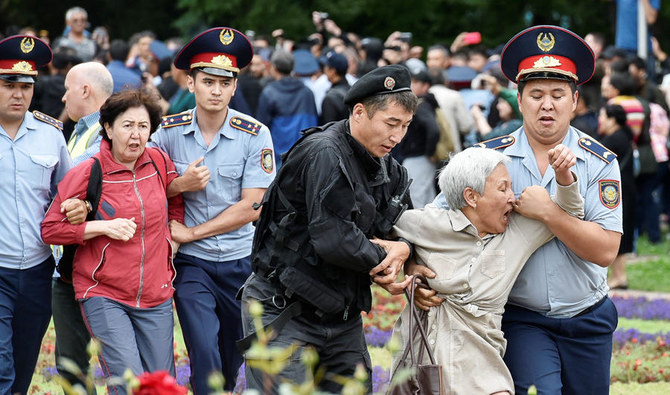
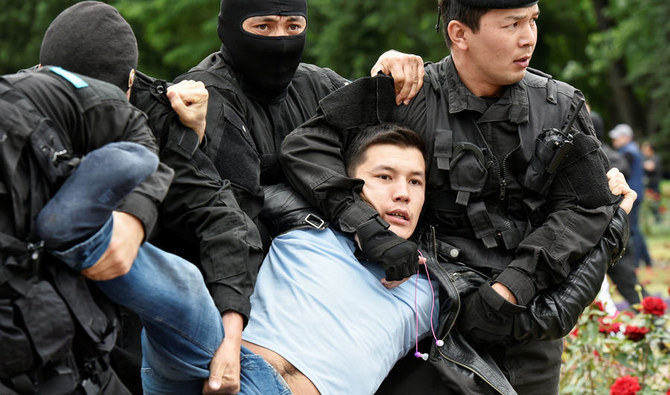
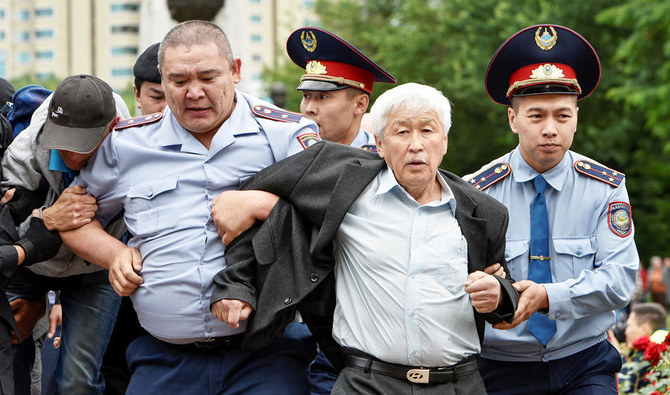

ALMATY, KAZAKHSTAN: Kazakhstan on Sunday elected the hand-picked successor of former president Nursultan Nazarbayev with 70 percent of the vote, exit polls showed, as police arrested hundreds of opposition protesters.
The victory of career diplomat Kassym Jomart-Tokayev was never in doubt after he received the blessing of powerful Nazarbayev, who had led the Central Asian nation for the last three decades.
Tokayev, 66, took just over 70 percent of the vote, according to the government-approved “Public Opinion” pollster. His nearest opposition rival Amirzhan Kosanov had around 15 percent.
But the day was marked by the biggest protests the Muslim-majority country has seen in three years, as demonstrators urged a “boycott” of what they said was a fixed election.
The build-up to the vote saw an intensifying crackdown on the opposition with courts sentencing protesters to short stays in jail and police raiding activists’ homes.
The interior ministry said around 500 people were arrested on Sunday, with deputy minister Marat Kozhayev blaming “radical elements” for holding “unsanctioned” rallies.
Two AFP journalists were among those detained in largest city Almaty, where police broke up a protest involving several hundred people.
Protesters shouted “shame, shame, shame!” and said “police come to the side of the people” as officers moved in on the crowd.
One AFP correspondent was taken to a police station before being released while another had video equipment confiscated.
Journalists for Radio Free Europe/Radio Liberty and an independent local news site were also arrested, as was a representative of the Norwegian Helsinki Committee rights NGO. They were all later released.
Dimash Alzhanov, a noted civic activist and political analyst, was arrested and was still being held on Sunday evening.
Turnout in the election was around 77 percent, the Central Election Commission said earlier in the day.
Nazarbayev’s announcement in March that he was stepping down from the presidency and naming Toyakev interim leader shocked Kazakhs who had lived under his rule since Soviet times.
But the 78-year-old, who turned the country of 18 million people into an energy powerhouse while governing with little tolerance for opposition, is still expected to call the shots from behind the scenes.
As he voted, Tokayev told reporters in the capital Nur-Sultan that Nazarbayev was “still in power in the capacity of chairman of the security council... and other capacities.”
Marat Sagyndykov, a 65-year-old retired civil servant told AFP he had voted for Tokayev “in order to continue the course of the Leader of the Nation,” referring to Nazarbayev’s constitutionally designated status.
“I think in 30 years we have had some successes. There have been negatives, too, but they exist in all countries,” he said.
Aslan Sagutdinov, a video blogger who was detained last month for holding up a blank placard at a protest, told AFP in an email he was not taking part in the election.
“If you vote in unfair elections you are allowing them to say they are fair,” said Sagutdinov, who lives in the northwestern town of Uralsk.
Four years ago Nazarbayev scored nearly 98 percent of a virtually uncontested vote where the official turnout was 95 percent.
No Kazakh vote has ever been recognized as fully democratic by the Organization for Security and Cooperation in Europe (OSCE), which sent more than 300 observers to monitor this election.
One of Tokayev’s first acts as interim president was to propose that the capital Astana — which Nazarbayev transformed from a steppe town into a million-strong city — be renamed “Nur-Sultan” in honor of his mentor.
The change went ahead without public consultation.
There was only one candidate who was openly in opposition in the race, journalist Amirzhan Kosanov, who has criticized the government.
However, even his criticism was vague, rather than directly attacking either Tokayev or Nazarbayev.
Human Rights Watch called the prospect of a genuine political transition “an illusion” and noted the persistence of rights abuses under Tokayev’s interim presidency.
“Kazakh authorities routinely break up peaceful protests, forcibly round up participants... and sanction them with warnings, fines, and short-term imprisonment,” the watchdog said.


