

Qatar admits having different ‘assessment’ to US on Iran threat

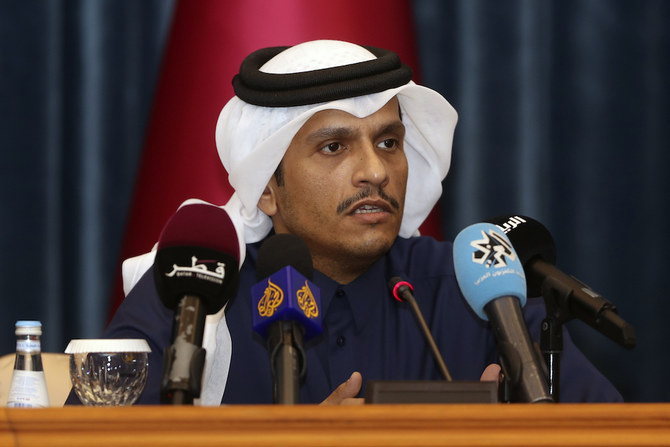
Qatari Foreign Minister Sheikh Mohammed bin Abdulrahman Al-Thani said Qatar respected US policy on Iran, but added: “We have our own assessment.” (AFP/File photo)
Updated 10 June 2019
Follow

Qatar admits having different ‘assessment’ to US on Iran threat

  • Comments expected to alarm members of the Trump administration, which has beefed up America’s military presence against Tehran
  • Qatari Foreign Minister Sheikh Mohammed bin Abdulrahman Al-Thani

LONDON: Qatar has its "own assessment” different to the US on policy towards Iran, the country’s foreign minister said Sunday.

The comments are expected to alarm members of the Trump administration, which has beefed up America’s military presence in the region after an increased Iranian threat. 

Qatar hosts the biggest US military base in the Middle East but has become increasingly close to Iran despite Washington viewing Tehran as the world’s largest state sponsor of terror.

Since withdrawing from the 2015 agreement to curb Iran’s nuclear program, President Donald Trump has ramped up sanctions and vowed to curb Tehran’s destabilizing activities in the region.

Speaking in London, Qatari Foreign Minister Sheikh Mohammed bin Abdulrahman Al-Thani said Qatar respected US policy on Iran, but added: “We have our own assessment.”

“There is a big pressure on Iran’s economy, but Iran lived under sanctions for 40 years. It’s never been like this but they survived. We don’t see the repetition of the same way will create a different result,” he said. “They don’t want to have a continuation of the sanctions at the same level and enter negotiations. They believe there was an agreement and US was part of the agreement.” 

Sheikh Mohammed said Qatar and other countries have been talking to both Iran and the United States about de-escalation, urging both sides to meet and find a compromise.

“We believe that at one point there should an engagement – it cannot last forever like this,” he said. “Since they are not willing to engage in further escalation, they should come up with ideas that open the doors.”

Qatar’s close ties with Iran, along with its support of extremist groups, was one of the reasons Saudi Arabia, the UAE and other Gulf and Arab countries cut ties with Doha two years ago.

The comments from Qatar on a differing approach to Iran come after the US last month deployed an aircraft carrier strike group and B-52 long-range bombers to the region to tackle escalatory action by Iran.

The US has also said Iran was almost certainly behind an attack on four oil tankers, including two Saudi ships, off the coast of the UAE. 

Sheikh Mohammed also spoke about the Trump administration's impending Middle East peace deal, saying there was a disconnect between the Palestinians and the US over the blueprint.

"It cannot be a solution like, sort of, imposed on the Palestinians – no country in the Arab world can accept that," Sheikh Mohammed said, of the deal to end decades of confict with Israel.

*With Reuters


Hundreds mourn in Syria’s Homs after deadly mosque bombing

Updated 27 December 2025
Follow

Hundreds mourn in Syria’s Homs after deadly mosque bombing

  • Officials have said the preliminary investigations indicate explosive devices were planted inside the mosque but have not yet publicly identified a suspect

HOMS: Hundreds of mourners gathered Saturday despite rain and cold outside of a mosque in the Syrian city of Homs where a bombing the day before killed eight people and wounded 18.
The crowd gathered next to the Imam Ali ibn Abi Talib Mosque in the Wadi Al-Dhahab neighborhood, where the population is predominantly from the Alawite minority, before driving in convoys to bury the victims.
Officials have said the preliminary investigations indicate explosive devices were planted inside the mosque but have not yet publicly identified a suspect.
A little-known group calling itself Saraya Ansar Al-Sunna claimed responsibility for the attack in a statement posted on its Telegram channel, in which it indicated that the attack intended to target members of the Alawite sect, an offshoot of Shia Islam whom hard-line Islamists consider to be apostates.
The same group had previously claimed a suicide attack in June in which a gunman opened fire and then detonated an explosive vest inside a Greek Orthodox church in Dweil’a, on the outskirts of Damascus, killing 25 people as worshippers prayed on a Sunday.
A neighbor of the mosque, who asked to be identified only by the honorific Abu Ahmad (“father of Ahmad“) out of security concerns, said he was at home when he heard the sound of a “very very strong explosion.”
He and other neighbors went to the mosque and saw terrified people running out of it, he said. They entered and began trying to help the wounded, amid blood and scattered body parts on the floor.
While the neighborhood is primarily Alawite, he said the mosque had always been open to members of all sects to pray.
“It’s the house of God,” he said. “The mosque’s door is open to everyone. No one ever asked questions. Whoever wants to enter can enter.”
Mourners were unable to enter the mosque to pray Saturday because the crime scene remained cordoned off, so they prayed outside.
Some then marched through the streets chanting “Ya Ali,” in reference to the Prophet Muhammad’s cousin and son-in-law whom Shiite Muslims consider to be his rightful successor.